
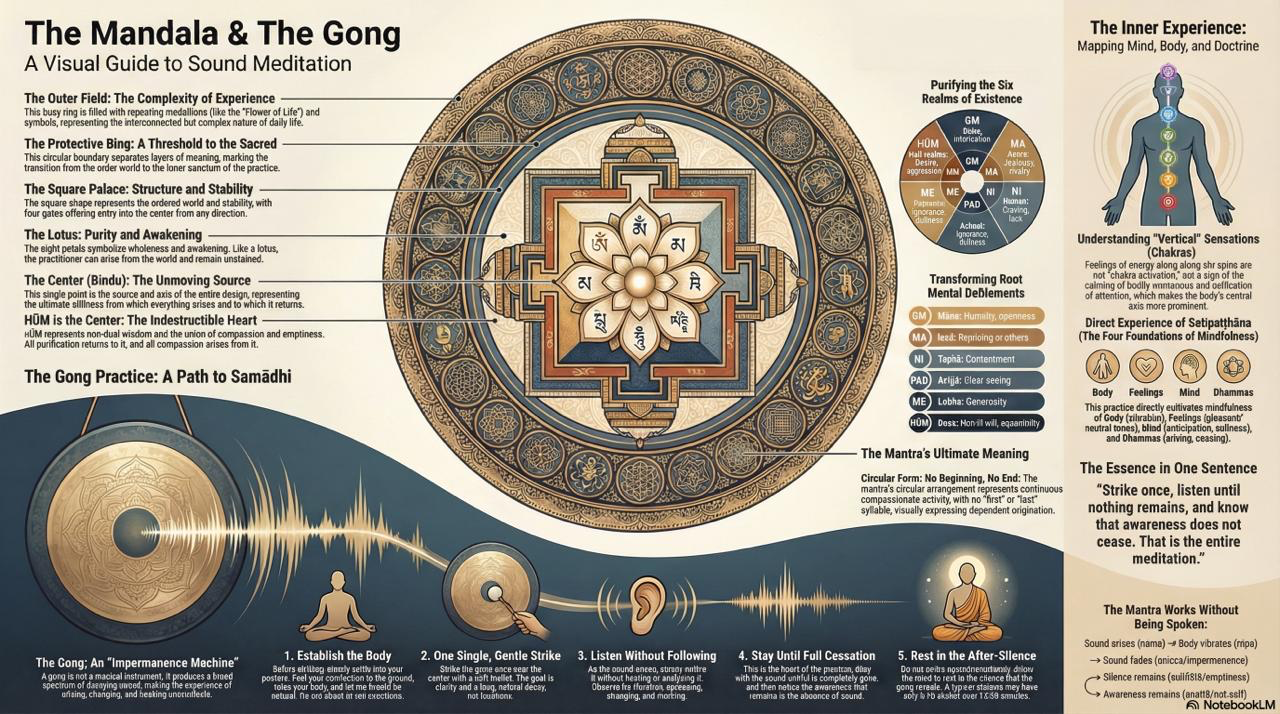
I was introduced to this fascinating gong at my dhamma friend home at Brisbane and we started using it for practice of stillness meditation – from sound to silence. Here is a short essay on how to use this wonderful Tibetan tool. The enclosed video provides you with instructions and so also the pdf file.
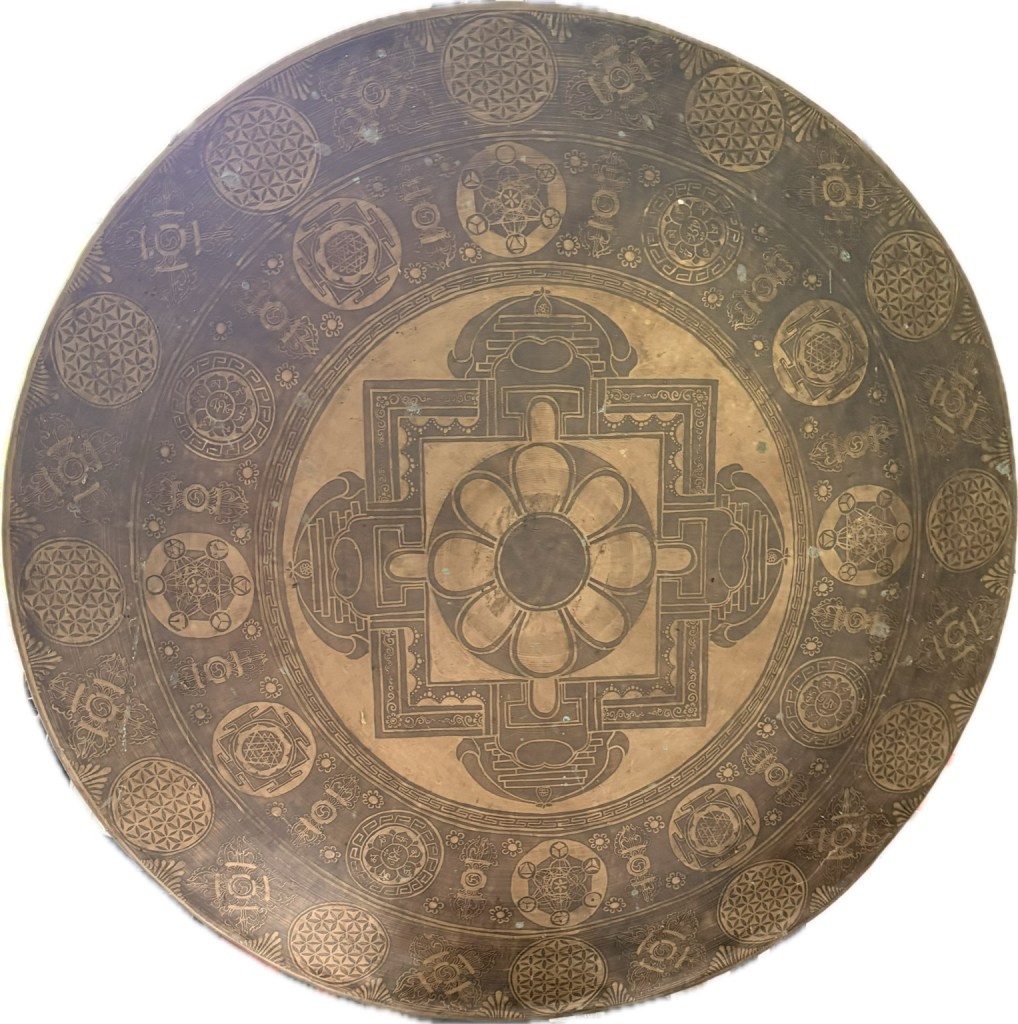
Center (bindu): the unmoving point; source; the “axis” of the whole design.
Lotus: purity and awakening—everything that arises from the world is seen and yet remains unstained.
Eight petals often evoke completeness/wholeness (and can resonate with “eightfold” structures), which leads to noble eight-fold path
Let us go to the inner square mandala: “palace” structure with four directions
Around the lotus there is a square-within-a-circle form, with four strong directional extensions (up/down/left/right). This is classic mandala geometry having:
Circle → totality / the cosmos / the “field” of experience.
Square palace → structure, stability, the “ordered world” or sacred enclosure which will be explained later in tabular format
Four directional gates/arms → the four directions and the idea of entering the center from any side.
The little architectural details at the ends of the four arms resemble stylized gateways (in traditional mandalas these are “doors” or “toranas”), suggesting:
movement from outer complexity → inner order → center.
The first circular boundary: protective ring / threshold
Just outside the square mandala is a decorative circular band. In mandala logic, these rings act like thresholds:
they separate layers of meaning,
they mark a transition from “inner sanctum” to “outer world”.
Even when the motifs differ by different vajrayana traditions, the function is similar: layering and containment.
The outer field: repeating medallions + sacred-geometry symbols
The broad outer ring is filled with repeating round medallions, alternating designs, plus small filler motifs (tiny flowers, curls, and ornaments).
A) “Flower of Life” style circles
Several medallions show a dense lattice of overlapping circles—this is widely known today as the Flower of Life family (or close variants like seed/egg-of-life patterns).
Typical meaning in modern sacred-geometry usage: interconnectedness, “blueprint” / harmony of forms, repeating order in nature.
B) “Metatron’s Cube” / network geometry
A few medallions look like a central geometry with connected nodes, reminiscent of Metatron’s Cube-style depictions (a modern esoteric motif derived from circle-lattices).
Common meaning (modern): structure underlying matter, geometry as “organizing intelligence”.
C) Wheel borders
Common meaning across decorative traditions: cyclical time, continuity, “unbroken” flow.
D) Small floral rosettes and scrollwork
These are decorative but also functionally important: they fill negative space and keep the eye moving in a circular rhythm, reinforcing the mandala’s meditative quality.
Overall composition: what the design is “doing” psychologically
This plate is built to create a guided visual journey:
The outer ring is busy and varied → like the complexity of daily experience.
You move inward across boundaries → simplification and focus.
You arrive at the square palace → stability/order.
You settle in the lotus + center point → stillness.
That “outer-to-inner” pull is exactly why mandalas are used as contemplation objects in multiple cultures.
The square mandala palace
| Element | Meaning |
|---|---|
| Square | Stability, completeness |
| Four gates | Four wisdom activities |
| Gates | Entry points for realization |
| Enclosure | Containment of awakened space |
Let us now get into the next section which has tibetan syllables
Around the central HŪṂ, each lotus petal contains one syllable of the mantra.
| Sanskrit | Tibetan | Meaning |
|---|---|---|
| OM | ཨོཾ | Sacred body, speech, mind |
| MA | མ | Compassion |
| NI | ཎི | Jewel / precious intent |
| PAD | པད | Lotus (purity) |
| ME | མེ | Wisdom |
| HŪṂ | ཧཱུྂ | Indestructible awakened heart |
HŪṂ is in the center and the remaining five syllables are placed on lotus petals
Why HŪṂ is in the center?
OM purifies body – kayagatasati
MA NI PAD ME purify speech & mind
HŪṂ represents: non-dual wisdom, the union of compassion and emptiness and the heart of Avalokiteśvara
So the mandala means:
All purification returns to HŪṂ
All compassion arises from HŪṂ and that’s why:
the lotus unfolds outward
but the center remains unmoving
Why the mantra is written in a circle (not a line)
Mantras in Tibetan are not meant to be read like sentences.
A circular mantra represents no beginning, no end and no “first” or “last” syllable due to which would be a continuous compassionate activity. This expresses pratītyasamutpāda visually.
The outer ring represents protection and stabilization
Outside the lotus you can see geometric borders, mantra wheels and repetitive symmetry
This functions as a vajra boundary which helps in stabilizes attention, protecting from distraction and keeping the mind from drifting outward.
What this mandala represents in one sentence?
The entire universe of experience purified into compassion, resting in HŪṂ.
Or in Theravada compatible language: Feeling, perception, and intention arise — compassion responds — clinging ceases.
How to relate to it (without ritual or belief)
You don’t need to chant and can simply let the eyes rest on the center (HŪṂ), allowing attention to expand to the petals while everything dissolve back to the center creating inner silence and that’s samādhi supported by form to reach 4 jhānas
OM MA NI PAD ME HŪṂ ↔ Six realms
The same six ↔ six root kilesas
Final resolution ↔ anattā & suññatā
OM MA NI PAD ME HŪṂ and the six Realms – In Tibetan Buddhism, this mantra is explicitly taught as a method for purifying the six realms of existence (gati / loka).
| Syllable | Realm (Gati) | Core suffering |
|---|---|---|
| OM | Deva (gods) | Pride, intoxication |
| MA | Asura (titans) | Jealousy, rivalry |
| NI | Human | Desire, attachment |
| PAD | Animal | Ignorance, dullness |
| ME | Preta (hungry ghosts) | Craving, lack |
| HŪṂ | Hell realms | Hatred, aggression |
Let us remember what Buddha said:
“Lokaṃ ca loka-samudayaṃ ca loka-nirodhaṃ ca paññapemi.”
“I declare the world, its arising, and its cessation right here.” (SN 12.44)
The same six as six root defilements (kilesas)Now we go deeper with each realm corresponds to a dominant kilesa.. The same mantra does not suppress them — it transforms them.
| Syllable | Kilesa | Transformation |
|---|---|---|
| OM | Māna (conceit, pride) | Humility, openness |
| MA | Issā (envy) | Rejoicing in others |
| NI | Taṇhā (desire) | Contentment |
| PAD | Avijjā (ignorance) | Clear seeing |
| ME | Lobha (grasping) | Generosity |
| HŪṂ | Dosa (hatred) | Non-ill-will, equanimity |
Why HŪṂ is placed at the center in your mandala – This is doctrinally very important.
HŪṂ is central while the other syllables are petals – This means:
Hatred and aversion are the deepest root, and when they cease, all realms collapse which aligns perfectly with the Buddha’s teaching:
“Avijjāpaccayā saṅkhārā …
avijjāya tveva asesavirāganirodhā…”
(SN 12.1)
HŪṂ represents cutting of aversion leading to the end of reactive resistance with an effect of non-arising of conflict and we can see that when there is no resistance, there is no becoming.
Final conclusion:
This mandala ultimately points to:
No syllable, no realm, no self — only cessation.
“Sabbe dhammā anattā.” “All phenomena are not-self.”
The mandala uses form to exhaust form.
The mantra uses sound to exhaust sound.
Usage of this tool
Let’s First understand what a gong actually does (important)
A gong is not a bell and not a musical instrument in the usual sense. It produces a broad spectrum of frequencies without any fixed melody, long and decaying resonance wherein the sound that you cannot hold as an object and part of crucial practice
In Vajrayana terms: A gong is an anicca machine — it makes impermanence unavoidable.
You cannot grasp a gong sound – You can only experience arising → changing → ceasing.
How this specific gong is meant to work?
Your gong has: OM MA NI PAD ME HŪṂ mandala
HŪṂ at the center which means:
the visual center = the sonic center
striking near the center emphasizes HŪṂ-like grounding frequencies
the outer areas produce more overtone complexity
So where and how you strike matters.
A. Physical setup
You have already hanged the gong freely and it can vibrate easily
Ensure nothing touches the surface except the striker
B. Position of the meditator
Sit or stand few feets away
If sitting sit upright (chair or cushion) and eyes can be:
softly open (recommended)
or gently closed after some time
C. Striker: Use a soft mallet all the time
Now let us get into the core practice: Gong-based samādhi (step by step)
Step 1: Establish the body
Before striking: feel contact with the ground, relax the jaw, shoulders, belly and let the breath be natural
Do not chant.
Do not set intentions.
Just settle.
Step 2: One single strike
Strike once
Strike near the center, not the rim
Strike gently
It is about clarity and decay.
Step 3: Listen without following
As soon as the sound arises: Do not name it, do not track it, do not expect silence
Just notice: vibration, spreading, changing, thinning, disappearing and SILENCE
This is pure vedanā + saññā observation.
Step 4: Stay until the sound fully ceases
This is the heart of the practice.
Stay with: the sound and then the absence of sound
Notice: when sound is gone, awareness remains
nothing is lost and nothing is added and this is nirodha samāpatti.
Step 5: Do nothing for a few breaths
After the sound ends: do not strike again immediately
allow the mind to rest in the after-silence while this silence is not created by the gong and the gong only reveals it.
✔ Best practice: one strike and wait until all resonance is gone and wait another 10–20 seconds
strike again till you get silence
A session may have:
5–10 strikes total lasting 15–30 minutes
How the mantra works without chanting
You do not need to say OM MA NI PAD ME HŪṂ and the structure works like this:
Sound arises → this is nāma
Sound vibrates the body → this is rūpa
Sound fades → anicca
No sound remains → suññatā
Awareness remains → anattā
The mantra is encoded, not spoken.
Mapping this directly to Satipatthana
This gong meditation directly supports:
✔ Kāyānupassanā You feel vibration in: chest, skull and skin
✔ Vedanānupassanā – which will be pleasant or neutral leading to subtle discomfort — without clinging
✔ Cittānupassanā – You see: anticipation, fading interest and ultimately stillness
✔ Dhammānupassanā – You directly observe: arising, passing, cessation and letting go
This is Satipaṭṭhāna through sound.
Further more refined practice as an advanced practitioner
Once stable: Strike once and stay with sound
When sound is almost gone, ask silently: “Where did it go?”
Do not answer verbally while attention turn inward which often drops the mind into very deep stillness.
One-sentence essence – Strike once, listen until nothing remains, and know that awareness does not cease. That is the entire meditation.
What is happening in the body and seeming like chakra movement?
First, let us acknowledge the experience (without exaggeration)
We often feel activation along the spine
sensations may appear at: pelvic floor, abdomen, chest, throat and head
there can be a sense of vertical openness, sometimes extending “beyond the head”
What is happening?
The nervous system is synchronizing
A gong produces:
low frequencies → vagal / body regulation
high overtones → cortical alertness
long decay → sustained attention without effort
This combination causes: release of habitual muscular holding providing heightened interoceptive awareness and clearer vertical body mapping and so sensations line up along the midline.
The mind interprets this using the nearest available map — for many people, that map is “chakras”.
How would Buddha explain this?
In sutta way, there is no mention of chakras opening due to following reasons:
✔ kāyasaṅkhāra passaddhi – (calming of bodily formations)
✔ cittasaṅkhāra passaddhi – (calming of mental formations)
✔ ekaggatā (unification of attention)
As these deepen: perception becomes more refined, the body feels “transparent” and attention naturally aligns centrally and this is pre-jhānic territory, not energy manipulation.
Why the sensation feels “vertical” and “ascending”
Human body-awareness is organized along: front–back, left–right and up–down. When attention stabilizes: lateral distractions reduce while vertical mapping becomes dominant which creates the sense of: “rising”, “opening upwards” and “beyond the crown”. However, nothing is actually moving upward while distractions are dropping away.