
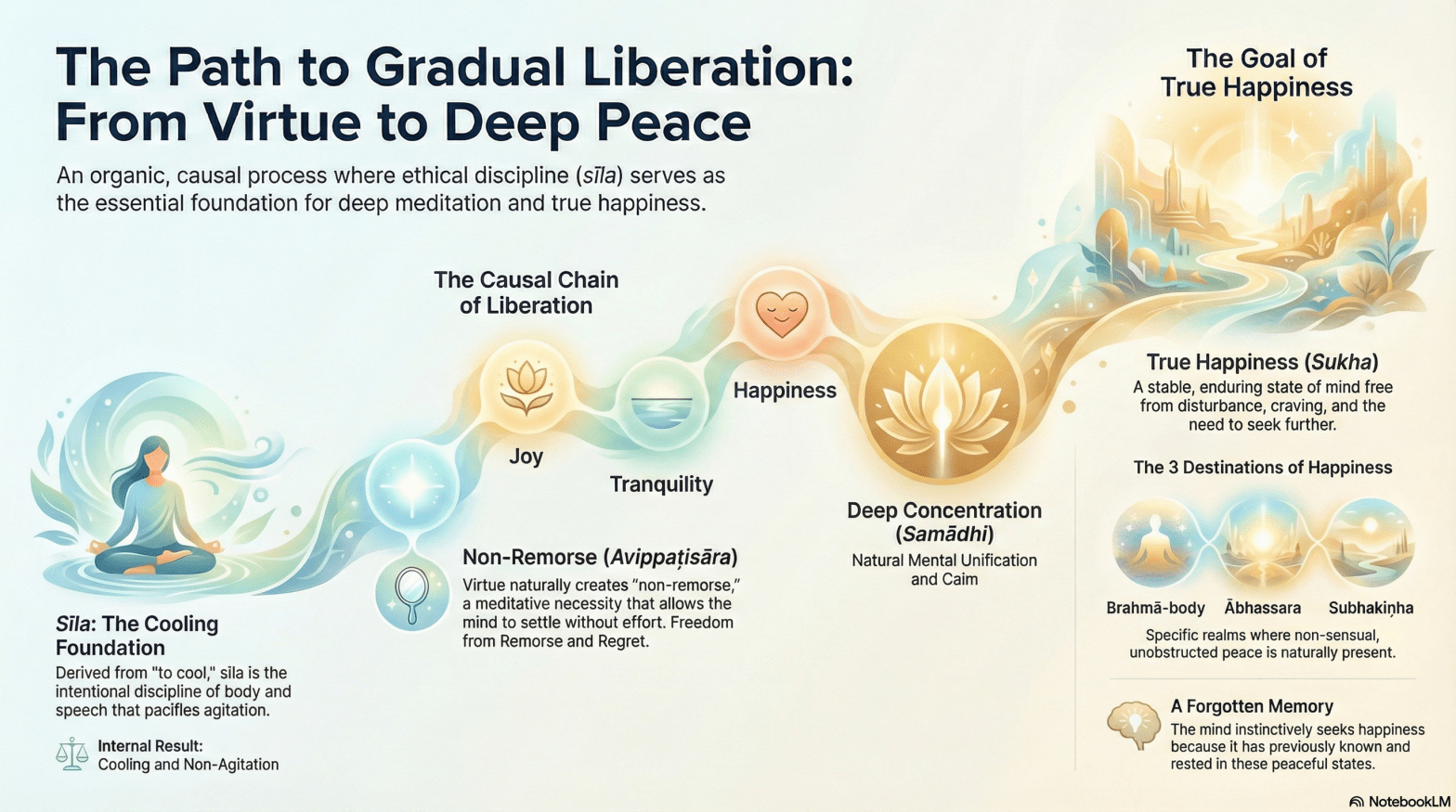
This blog is an attempt to present the Buddha’s path to liberation from saṁsāra in its complete and structured form. Beginning with the establishment of sīla, the path unfolds through the development of samādhi and culminates in paññā—the direct seeing that brings release. These are not separate practices, but interdependent trainings that mature step by step. Through this series, we will explore how liberation is approached gradually, through understanding, discipline, and direct experience. Let us undertake this journey together, with clarity, care, and fidelity to the early teachings.

Step 1 — Setting the Goal Clearly
The path must begin with clarity of purpose. If the goal itself is vague, the practice that follows will also remain uncertain. Our goal, therefore, should be nothing less than the complete ending of suffering in this very life—either through the attainment of Arahantship or, at the very least, Anāgāmī (non-returner). Only such a goal is worthy of sustained effort, discipline, and renunciation as that leads to “true happiness”
What is happiness?
Happiness is not excitement, pleasure, stimulation, or temporary relief.
True happiness is a state of mind free from disturbance, free from agitation, and free from the need to seek anything further. Most importantly, it is stable and enduring, not dependent on conditions that inevitably change.
In other words, sukha is a mind untroubled by craving, aversion, or restlessness—a mind that can remain at ease without effort.
Where Is Such Happiness Found? Buddha points to specific realms of existence where this refined happiness is naturally present. These are described as:
“Tisso sukhūpapattiyo — brahmakāyikā, ābhassarā, subhakiṇhā”
“Three destinations associated with happiness: the Brahmā-body realms, the Ābhassara realms, and the Subhakiṇha realms.”
— DN 33
These correspond to the first three jhānas and their respective planes of rebirth. In these states, happiness is pure, non-sensual, and unobstructed. There is no regret, no agitation, no coarse desire. This is why these realms are called sukhūpapatti—destinations of happiness. From beginningless time, consciousness has known these states directly. It has abided there, rested there, and tasted that peace. Yet through ignorance and distraction, it has forgotten the way back. This forgotten memory is why the mind instinctively seeks happiness—yet repeatedly searches for it in the wrong places. Ref:DN33
What Needs to Be Done? To either fully liberate the mind or secure the Anāgāmī stage, the Buddha lays out a precise and non-negotiable framework.
In the Ākaṅkheyya Sutta, the Buddha explains that five essential foundations must be fulfilled for higher attainments to become possible. These are not optional supports—they are prerequisites.
Our entire practice will therefore be anchored in this sutta, using it as both a diagnostic tool and a practical guide. The explanation and detailed application of this framework are based on MN 6 and a write up on this can be accessed here
This ensures that the path remains:
a. grounded in the suttas,
b. aligned with right view,
and c. directed toward irreversible freedom rather than temporary calm.
Setting the goal correctly is not ambition—it is honesty. Once the goal is clear, the path reveals itself step by step.
Step 2 – Removal of 10 immoral deeds through understanding of sīla
In the Buddha’s teaching, sīla is not merely moral behaviour or social ethics. It is the intentional discipline of body and speech, guided by wisdom, undertaken for the ending of suffering. Far from being a preliminary or optional practice, sīla is described again and again in the suttas as the indispensable foundation for collectedness (samādhi), wisdom (paññā), and liberation (vimutti).
What Does Sīla Mean?
The Pāli word sīla comes from the verbal root √sī (“to cool, to calm, to pacify”).
Thus, sīla literally carries the sense of cooling down, settling, and non-agitation.
In practice, sīla refers to:
a. restraint of bodily actions and verbal action
b. restraint of mental actions which is guided by proper awareness (sampajañña), moral dread and shame (hiri–ottappa)
Sīla is therefore functional that needs to be done for the whole day and forever and not ritualistic. It reduces remorse, agitation, and fear—creating the internal conditions necessary for mental unification and calmness.
Sīla as the Foundation of the Path – Buddha repeatedly presents the path as a natural progression, beginning with sīla. In the gradual training (anupubbī-kathā) found throughout the Nikāyas, sīla always comes first:
sīla → avippaṭisāra (non-remorse) → pīti → passaddhi → sukha → samādhi → yathābhūta-ñāṇadassana → nibbidā → virāga → vimutti
This causal sequence is clearly expressed in Kimatthiyasutta, where the Buddha shows that liberation does not arise from willpower alone, but from a chain of supportive conditions, beginning with ethical conduct. A complete exposition on this sutta is found here. Without sīla, this chain collapses at the very start.
Sīla and Non-Remorse (Avippaṭisāra) One of the most important psychological roles of sīla is the removal of kukkucca (remorse and regret) which has been expounded in the above sutta. However, we can take next sutta which is Cetanākaraṇīya Sutta, Buddha states clearly:
“For one who is virtuous, there is no need for an act of will:
‘May non-remorse arise.’
It is natural that non-remorse arises in one who is virtuous.”
The crucial point is that:
Sīla is not about forcing calm
Calm naturally follows from a life lived without intentional harm
A remorseful mind cannot enter stable samādhi. Thus, sīla is not moral decoration—it is meditative necessity.
From Sīla to Samādhi: Removing the Ten Immoral Deeds
Now that we have understood the importance of sīla, let us move forward toward its practical application. The next step is the deliberate removal of the ten immoral deeds (dasa akusala kammapathā), which form the essential foundation for collectedness of mind (samādhi).
The Ten Immoral Deeds and Their Removal
In our practice, we do not merely take the five precepts as a ritualistic observance. Instead, we actively undertake samādhi, with sīla functioning as its living ground. This means that restraint and purification are applied continuously—through bodily actions, speech, and thoughts—rather than being confined to a formal recitation in the morning or evening.
Samādhi is not something that arises in isolation. It grows naturally when one’s conduct is consistently aligned with restraint, clarity, and heedfulness in daily life.
Reflective Practice and Determination
For each of these ten immoral deeds, one should consciously reflect back on one’s life, even as far as childhood, and honestly observe how and where these unwholesome patterns have operated. This reflection is not meant to induce guilt or self-judgment, but to cultivate clear seeing (yoniso manasikāra).
Having clearly seen this, one should then make a firm inner determination:
“From today onwards, I shall not knowingly break any precept or engage in immoral conduct.”
This determination must not remain a mere intention. It should be verified daily through careful review of one’s actions, speech, and thoughts. Such ongoing verification strengthens integrity, builds inner confidence, and gradually establishes the unshakable basis required for deep samādhi.
When sīla is lived in this way—not as an external rule, but as a conscious training—the mind naturally becomes lighter, steadier, and ready for higher cultivation.
The sutta we are going to take up for our practice are:
AN10.176 – Cundasutta
AN8.40 – Duccaritavipākasutta
MN135 – Cūḷakammavibhaṅgasutta
MN136 – Mahākammavibhaṅgasutta
Let us now begin with AN10.176 which lays foundation for our practice of samādhi.
Buddha says that a being does immoral deeds through body, speech and mind. They are explained in detail as under
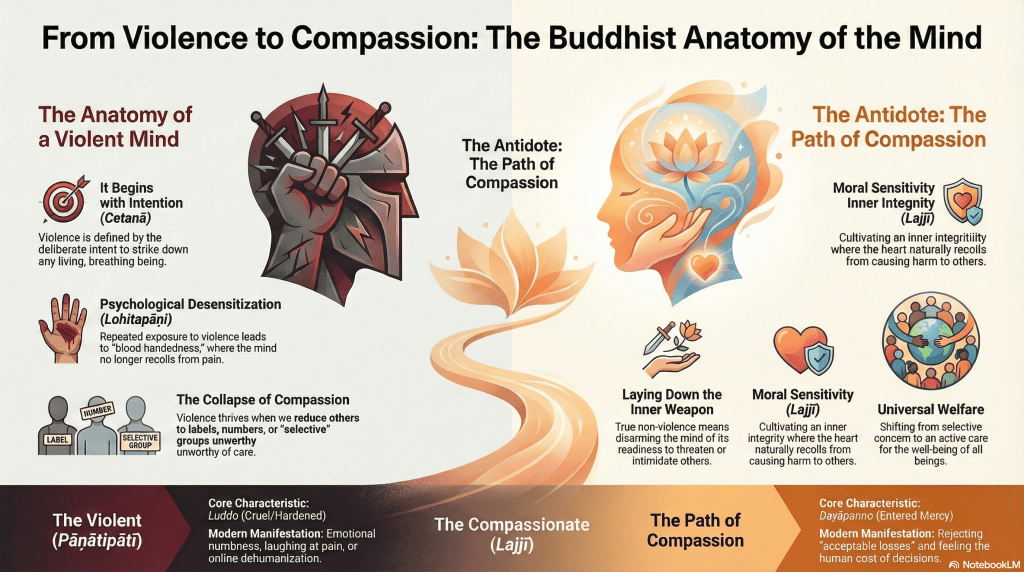
pāṇātipātī – Idha, cunda, ekacco pāṇātipātī hoti luddo lohitapāṇi hatapahate niviṭṭho adayāpanno sabbapāṇabhūtesu
ekacco pāṇātipātī hoti
“A certain person is one who takes life.”
pāṇa = a living, breathing being
atipāta = striking down, destroying
This includes intentional killing, not accidental killing.
⚠️Importantly: It is cetanā (intention) that defines pāṇātipāta.
Killing through ordering, approving, or indirect enabling also counts.
In today’s world, it would be:
Killing animals for pleasure, convenience, or habit
Ordering killing of innocent indirectly where avoidable
Enjoyment or approval of cruelty for pleasure
luddo – “Cruel, savage, hardened”
Root sense: absence of softness (mudu) – A mind that has lost tremble before suffering and not shocked by pain anymore and becomes ludda before becoming a killer.
In today’s world, it would be:
Emotional hardness – “This is how the world is”
Laughing at pain and suffering and feeling proud of it
Online aggression and dehumanisation including “digital arrest”, domestic violence, threatening etc.,
lohitapāṇi -“Blood-handed which means:
Repeated exposure to violence and normalisation of bloodshed which includes psychological desensitisation.
We can see in our modern world as:
1. Violent media addiction through social media of YouTube, News channels, Facebook, Instagram and other forms of media
2. Glorifying killing (games, movies, rhetoric)
3. Emotional numbness to suffering and feeling justified of violence and killing due to association with a particular language, customs, traditions, religious beliefs, symbolization, nationality etc.,
hatapahate niviṭṭho “Engaged in killing and beating; settled in it”
hata = “killed / slain”
pahata = “struck / beaten down”
niviṭṭho = deeply established, settled, rooted which is habitual violence, not a one-off lapse
Entrenched in (acts of) killing and beating
In today’s world, one can see it as:
1. Organized gangs – Hitmen, gang enforcers, vigilante squads, terrorist operatives, torture agents and war criminals
2. Professional roles – Running illegal slaughter operations, designing or managing torture, abuse, or coercive interrogation and operating violent repression while being emotionally numb to it
3. Proxy violence – Ordering killings and never witnessing the consequences and signing off on actions that predictably cause death and treating civilian deaths as “collateral” without inner disturbance
4. Domestic and Social violence – regular physical abuse of spouse, children, elders and violence used as “discipline” which include normalisation of fear at home
5. Psychological and emotional violence – Habitual verbal cruelty, systematic humiliation, online mobs engaging in sustained harassment and dehumanising language that strips others of dignity
6. Cultural normalization of violence – Obsessive consumption of violent content and pleasure derived from suffering scenes while applauding brutality as strength
adayāpanno = “one who has not entered into compassion/mercy” (a- negation + dayā compassion + āpanna ‘entered into, fallen into, come to’)
sabba-pāṇa-bhūtesu = “toward all living beings” (sabba all + pāṇa living/breathing + bhūta beings; locative plural “in/with regard to”)
Modern world happening and challenges
Bureaucratic indifference to suffering
1. Decisions made purely on “numbers,” “efficiency,” or “policy” and outsourcing of work for cheap labour and extraction of work
2. Human cost acknowledged intellectually but not felt
Phrases like acceptable losses, that’s outside our scope and this is unavoidable becomes the norm
Normalization of others pain into fun
Seeing images of starving, bombed, displaced people daily
Emotional response fades into scrolling, annoyance and fatigue with no inward pause, no protective impulse
Justified cruelty
This will teach them a lesson and they deserve it
They brought it upon themselves and who else to be blamed for it
Habitual harshness in daily life
Mocking pain or distress and speaking cruelly without inner discomfort while dismissing vulnerability as weakness
Modern-world violations of sabba-pāṇa-bhūtesu
A. Selective compassion which means care only for:
one’s group or one’s species as in their selective pets or one’s ideology and belief systems while being Indifferent to others’ suffering
B. Species hierarchy without reflection
Treating animals as commodities, units of production, objects without moral consideration. This can also happen with humans when used as “resources”
When one does like this it violates pāṇa
C. Dehumanisation
Reducing people to labels, stereotypes, threats and once dehumanised, harm feels permissible
This is how sabba-bhūta collapses into rubble.
adayāpanno sabbapāṇabhūtesu means a person who has not entered into compassion with regard to any living being—human or non-human, near or far, familiar or unknown.
In today’s world, this often looks like ethical numbness, moral outsourcing, emotional hardening and selective concern
Solution or antidote to killing
ekacco pāṇātipātaṁ pahāya pāṇātipātā paṭivirato hoti nihitadaṇḍo nihitasattho, lajjī dayāpanno, sabbapāṇabhūtahitānukampī viharati.
Here, a certain person, having abandoned the taking of life, abstains from taking life; having laid down the rod and laid down the weapon; being morally sensitive and entered into compassion; he dwells with concern for the welfare and well-being of all living beings
Key factors:
nihitadaṇḍo nihitasattho
“With the rod laid down, the weapon laid down”
daṇḍa = stick, punishment, coercion
sattha = weapon, instrument of harm
nihita = laid aside, put down deliberately
Not only no killing, but no readiness to threaten or intimidate
👉 Violence has been disarmed at the psychological level.
lajjī – “Morally sensitive; capable of shame”
lajjā here is moral conscience, not social embarrassment where the heart recoils from wrongdoing before action happens which means “I could not live with myself if I harmed a being.” This is inner integrity, not fear of punishment.
Which means, he would not do anything that was presented under killing and violence as this is the block to going back to the home which is jhānas.
The abandonment of killing in the Buddha’s teaching is not merely refraining from violence, but laying down the inner weapon of the mind—so that one lives with moral sensitivity, compassion, and an active concern for the welfare of all living beings.
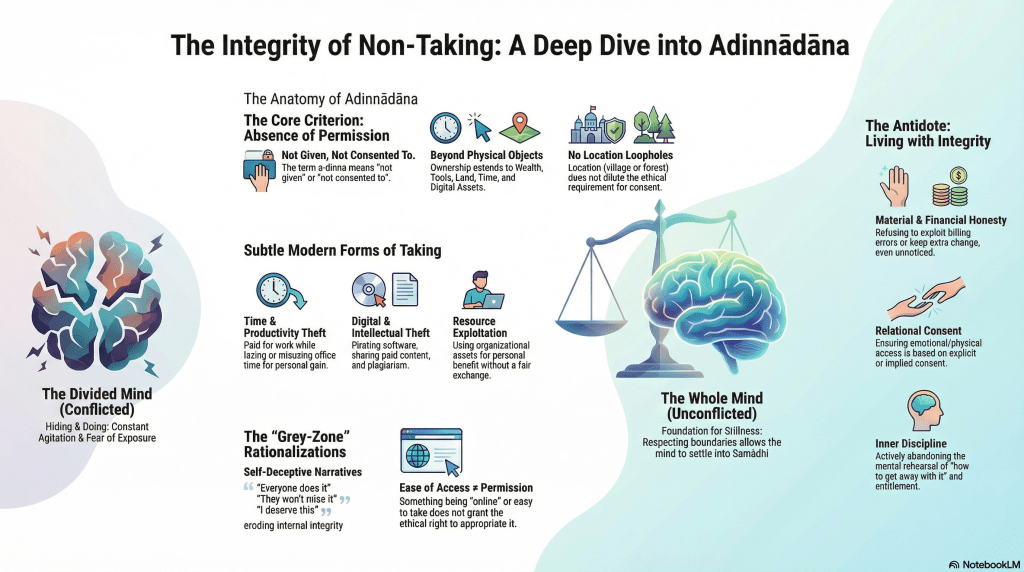
Adinnādāyī hoti. Yaṁ taṁ parassa paravittūpakaraṇaṁ gāmagataṁ vā araññagataṁ vā taṁ adinnaṁ theyyasaṅkhātaṁ ādātā hoti.
a-dinna = not given, not consented to
ādāyī = taker, appropriator
⚠️Key point: Absence of permission is the core criterion—not secrecy, not value, not visibility and hence taking what is not given.
Yaṁ taṁ parassa paravittūpakaraṇaṁ
“Whatever is another’s property or means.”
parassa = belonging to another
para-vitta-upakaraṇaṁ =
vitta → wealth, resources
upakaraṇa → means, tools, supports such as money, material objects, land, tools, time and digital assets
gāmagataṁ vā araññagataṁ vā
“Whether located in a village or in the forest.”
This phrase removes loopholes by including public or private, urban or remote, guarded or unguarded, owned or temporarily unattended
👉 Location does not dilute ownership.
taṁ adinnaṁ theyyasaṅkhātaṁ
“That which is not given, reckoned as theft.”
theyyasaṅkhātaṁ = classified as stealing
This is an ethical classification, not merely legal even if no one notices or no law is broken or no punishment follows in the lifetime, but is still theyyā in Dhamma terms.
ādātā hoti – “He takes it.”
ādātā implies deliberate appropriation which is not accidental nor mistaken but with awareness that “this is not given”
Examples for reflection
A. Obvious Forms – Taking money or goods without consent and pocketing extra change knowingly. Stealing unattended property by putting gate etc.,
B. Subtle but Widespread Forms (Very Relevant Today)
Time theft – being paid for work but deliberately not working or lazing around
Misusing office time for personal gain and pretending productivity
Digital theft – Pirating paid content knowingly and using licensed software illegally
Sharing paid material without permission
Resource misuse – Using organisational assets for personal benefit and exploiting shared resources unfairly including taking more than one’s share knowingly
Intellectual appropriation – Presenting others’ ideas as one’s own
Plagiarism
Using creative work without attribution or consent
C. Grey-Zone Rationalisations (Very Dangerous) These are especially obstructive to the path:
“Everyone does it.”
“It’s a big company.”
“They won’t miss it.”
“I deserve this.”
⚠️ These are self-deceptive narratives that erode sīla internally.
D. Systemic & Indirect Forms
Profiting knowingly from exploitative systems
Taking advantage of loopholes while knowing the harm
Extracting value without fair exchange
Adinnādāyī is not merely stealing objects, but the habitual readiness to appropriate what is not freely given—whether wealth, resources, time, or means—thereby undermining inner integrity and the foundation of samādhi.”
Solution or antidote to stealing
Adinnādānaṁ pahāya, adinnādānā paṭivirato hoti. Yaṁ taṁ parassa paravittūpakaraṇaṁ gāmagataṁ vā araññagataṁ vā, na taṁ adinnaṁ theyyasaṅkhātaṁ ādātā hoti.
Having abandoned the taking of what is not given, he abstains from taking what is not given.
Whatever belongs to another—another’s property or means—whether located in a village or in the wilderness, that which is not given and reckoned as theft, he does not take.
Solution for today’s situations:
A. Material & Financial Integrity – Such a person:
Does not take extra change knowingly
Does not exploit billing errors
Does not misuse shared or organisational resources
Even when:
“No one will notice”
“It’s a small amount”
B. Workplace & Professional Life
Does not take credit for others’ work
Does not misuse paid time
Does not exploit loopholes for personal gain
This is paravittūpakaraṇa in modern form.
C. Digital World (Extremely Relevant Today)
Does not pirate content knowingly
Does not use paid software illegally
Does not share restricted material without consent
Even when:
“Everyone does it”
“It’s already online”
👉 Ease of access ≠ permission.
D. Relationships & Social Contexts
Does not take emotional, physical, or sexual access without consent
Does not manipulate generosity
Does not exploit trust or dependency
Consent (dinna) must be explicit or clearly implied, not assumed.
E. Inner Discipline (Subtle but Crucial) Even mentally:
No rehearsing of “how to get away with it”
No justification narratives
No entitlement thinking
This is true pahāna.
Why This Is Essential for Samādhi
A mind that steals: splits into hiding and doing and runs inner arguments
fears exposure and carries subtle agitation
A mind that respects boundaries: is whole, unconflicted, unburdened and naturally settles
To abandon adinnādāna is to renounce the very notion of entitlement—so that one lives with integrity, respects others’ means of survival, and cultivates the inner unconflictedness upon which samādhi depends.

Kāmesumicchācārī hoti. Yā tā māturakkhitā piturakkhitā mātāpiturakkhitā bhāturakkhitā bhaginirakkhitā ñātirakkhitā gottarakkhitā dhammarakkhitā sasāmikā saparidaṇḍā antamaso mālāguḷaparikkhittāpi, tathārūpāsu cārittaṁ āpajjitā hoti
He is one who engages in misconduct with respect to sensual pleasures.
Those women who are protected by their mother, protected by their father, protected by both mother and father, protected by a brother, protected by a sister, protected by relatives, protected by clan, protected by Dhamma, who have a husband, who are liable to punishment— even those who are guarded by a mere garland or token— with such persons he engages in sexual conduct
Above is clear statement of what becomes adultery when one engages in and that causes following problems or issues in the mind of the person who is engaging in it.
1. secrecy and manipulation
2. fear of exposure and emotional entanglement
3. guilt and justification
A. Clear Cases Today
Adultery of all forms
Sexual relations with minors
Sexual involvement where guardianship exists
Exploiting dependents (students, patients, subordinates)
B. Power-Imbalance Relationships (Very Relevant Today)
Teacher–student sexual advances
Boss–subordinate for favour
Guru–disciple for liberation or some kind of psychic powers
Therapist–client for curing
Even if “consensual” on paper – protection exists, power asymmetry exists and vulnerability exists
👉 This falls under rakkhitā / dhammarakkhitā.
C. Digital & Modern Forms
Sexual exploitation via messaging of porn contents
Coercive sexting seeking sexual favour
Emotional manipulation leading to sexual access
Violating agreed exclusivity in relationships
Consent obtained through pressure or deception is not dinna.
Sexual misconduct produces: agitation, obsession, fear, concealment, remorse
Even if socially accepted, the mind knows.
👉 A mind entangled in sexual deception cannot become unified.
This also includes algorithm based apps like Facebook, Instagram which starts showing feeds which are sexually explicit or sensual explicit contents. Going through porn sites adds fuel to fire and distorts the mind to see girl/woman as objects and becomes an obstacle in attaining samādhi through samathā practice. Associating with friends who are always packed with verbal or bodily sexual information would cause more harm than good.
Pornography and adult entertainment may not always constitute sexual misconduct in the narrow legal sense, but they deliberately train the mind in lust, objectification, and loss of restraint—placing them firmly among the practices that obstruct sīla, samādhi, and the path to liberation.
Eventhough, societies have become liberal wherein show of skin and shapes are acceptable including live-in relationships. These harm the mind and make them more and more lustful removing the moral dread and shame which are key for getting into liberation and assists in going down rather than going up.
Solution or antidote to sexual misconduct
Kāmesumicchācāraṁ pahāya, kāmesumicchācārā paṭivirato hoti yā tā māturakkhitā piturakkhitā mātāpiturakkhitā bhāturakkhitā bhaginirakkhitā ñātirakkhitā gottarakkhitā dhammarakkhitā sasāmikā saparidaṇḍā antamaso mālāguḷaparikkhittāpi, tathārūpāsu na cārittaṁ āpajjitā hoti.
“Having abandoned sexual misconduct, he abstains from sexual misconduct.
With regard to those women who are protected by their mother, protected by their father, protected by both mother and father, protected by a brother, protected by a sister, protected by relatives, protected by clan, protected by Dhamma, who have a husband, who are liable to punishment—even those guarded by a mere garland or token—he does not engage in sexual conduct with such persons.”
Sexual restraint creates: clarity, lightness, self-respect and emotional stability. This establishes inward readiness for samathā practice. A practitioner would look at the benefit of not engaging in sexual misconduct due to getting into samādhi. This is how, he escapes the bad karma or deeds.
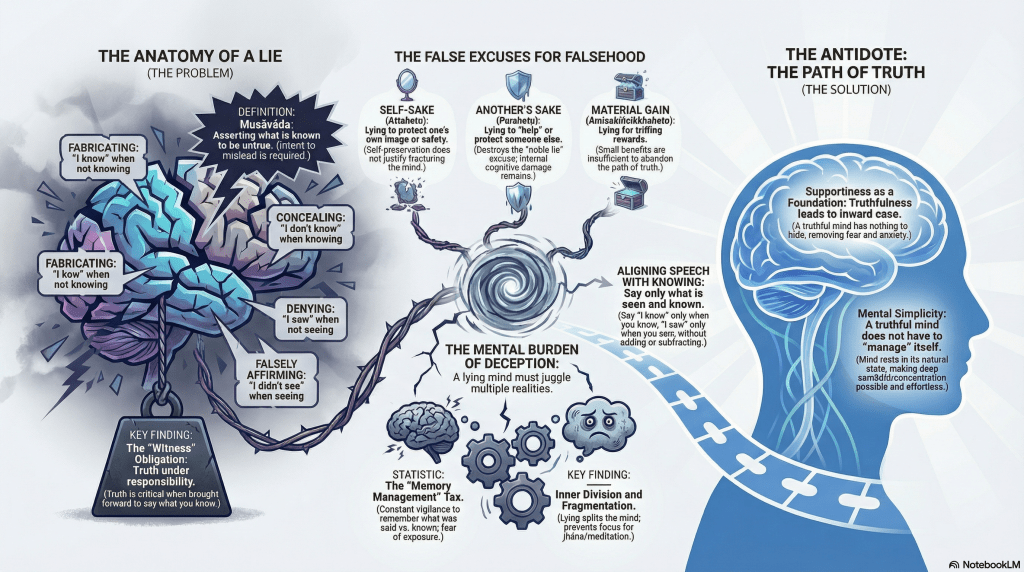
ekacco musāvādī hoti. Sabhaggato vā parisaggato vā ñātimajjhagato vā pūgamajjhagato vā rājakulamajjhagato vā abhinīto sakkhipuṭṭho: ‘ehambho purisa, yaṁ jānāsi taṁ vadehī’ti, so ajānaṁ vā āha: ‘jānāmī’ti, jānaṁ vā āha: ‘na jānāmī’ti; apassaṁ vā āha: ‘passāmī’ti, passaṁ vā āha: ‘na passāmī’ti. Iti attahetu vā parahetu vā āmisakiñcikkhahetu vā sampajānamusā bhāsitā hoti.
Here, a certain person is a speaker of falsehood.
Whether having gone into an assembly, or into a gathering, or among relatives, or among guilds, or into the royal court,
having been brought forward and questioned as a witness:
‘Come now, good man—say what you know,’
he says of what he does not know, ‘I know’;
or of what he knows, he says, ‘I do not know’;
or of what he has not seen, he says, ‘I have seen’;
or of what he has seen, he says, ‘I have not seen.’
Thus, for his own sake, or for another’s sake, or for some trifling material gain, he knowingly speaks falsehood.
(1) ekacco musāvādī hoti – “A certain person is one who speaks falsehood.”
musā = false, untrue; vādī = speaker, one who asserts
This is not accidental speech but asserting what one knows to be untrue.
(2) sabhaggato vā parisaggato vā … rājakulamajjhagato vā
“Whether in an assembly, gathering, among relatives, guilds, or in the royal court.”
This covers: legal settings, professional settings, social settings, family settings, positions of trust
👉 No context is exempt.
(3) abhinīto sakkhipuṭṭho
“Having been brought forward and questioned as a witness.”
sakkhi = witness
This implies: responsibility, expectation of truth, consequences for others
This is not idle chatter—it is truth under obligation.
(4) ‘yaṁ jānāsi taṁ vadehī’
“Say what you know.” This is crucial: One is asked only to report what one knows—not opinion, not speculation.
(5) The four precise forms of lying The Buddha lists all possible permutations:
ajānāṁ → ‘jānāmī’ – Not knowing, claiming to know
jānaṁ → ‘na jānāmī’ – Knowing, claiming not to know
apassaṁ → ‘passāmī’ – Not seeing, claiming to have seen
passaṁ → ‘na passāmī’ – Seeing, claiming not to have seen
This covers: fabrication, concealment, denial and false affirmation
👉 Both lying and withholding truth deliberately are musāvāda.
(6) attahetu vā parahetu vā āmisakiñcikkhahetu vā
“For one’s own sake, another’s sake, or for some small material gain.”
This destroys common excuses: “I lied to help someone.”
“I lied to protect myself.”
“It was only a small benefit.”
None of these justify falsehood.
(7) sampajānamusā bhāsitā hoti
“He knowingly speaks falsehood.”
sampajāna = with full awareness
Intention is fully present
👉 This completes the kamma patha.
What Exactly Constitutes Musāvāda
Musāvāda requires below conditions:
Something untrue and knowledge that it is untrue and intention is to mislead while expression is through speech (or equivalent)
A. Legal & Institutional Settings
False testimony and concealing facts in investigations
Signing false declarations and manipulating compliance reports
Direct match to sakkhipuṭṭho.
B. Workplace & Professional Life
Falsifying achievements
Denying knowledge to avoid responsibility
Claiming ignorance after approving wrongdoing
Misleading stakeholders knowingly
C. Social & Family Contexts
Lying to maintain image
Withholding truth that one is obligated to disclose
Deliberate gaslighting (“That never happened”)
Gaslighting fits passaṁ → ‘na passāmī’ exactly.
D. Digital & Online World
Spreading information known to be false
Fake reviews
Misrepresentation of identity
Manipulating narratives knowingly
Even typing counts as bhāsitā (expressed).
E. “White Lies” Under Responsibility
Lying when entrusted with truth
Misleading where others rely on one’s word
Buddha does not condemn harmless politeness—but does condemn betrayal of trust.
Musāvāda: splits the mind and requires constant memory management
creates fear of exposure and destroys inner coherence
A lying mind must: remember what it said and hide what it knows to maintain deception
👉 Such a mind cannot collect.
Musāvāda, as defined by the Buddha, is not casual inaccuracy but the deliberate distortion or concealment of truth under responsibility—an act that fractures the mind and makes genuine samādhi impossible.
Solution or antidote to lying
Considering that he needs to attain jhānas and go back to his home in either of the four jhānas, the practitioner would stop immediately telling lies and does what Buddha says below:
ekacco musāvādaṁ pahāya musāvādā paṭivirato hoti. Sabhaggato vā parisaggato vā ñātimajjhagato vā pūgamajjhagato vā rājakulamajjhagato vā abhinīto sakkhipuṭṭho: ‘ehambho purisa, yaṁ jānāsi taṁ vadehī’ti, so ajānaṁ vā āha: ‘na jānāmī’ti, jānaṁ vā āha: ‘jānāmī’ti, apassaṁ vā āha: ‘na passāmī’ti, passaṁ vā āha: ‘passāmī’ti. Iti attahetu vā parahetu vā āmisakiñcikkhahetu vā na sampajānamusā bhāsitā hoti.
Here, a certain person, having abandoned false speech, abstains from false speech.
Whether in an assembly, a gathering, among relatives, among guilds, or in the royal court,
having been brought forward and questioned as a witness:
‘Come now, good man—say what you know,’
he says of what he does not know, ‘I do not know’;
of what he knows, he says, ‘I know’;
of what he has not seen, he says, ‘I have not seen’;
of what he has seen, he says, ‘I have seen.’
Thus, for his own sake, for another’s sake, or for some small material gain,
he does not knowingly speak falsehood.
He works towards building trust as that is the foundation for “fearlessness” as fear and anxiety is a blockage to samathā practice.
Lying requires: memory juggling, fear of exposure, inner division, vigilance
Truthfulness allows: mental simplicity, lack of remorse, inward ease and effortless settling
👉 A truthful mind does not have to manage itself. It rests.
To abandon musāvāda is to align speech completely with knowing and seeing—so that even under pressure, one neither adds nor subtracts from truth—thereby freeing the mind from division and making deep samādhi possible

Pisuṇavāco hoti. Ito sutvā amutra akkhātā imesaṁ bhedāya, amutra vā sutvā imesaṁ akkhātā amūsaṁ bhedāya. Iti samaggānaṁ vā bhettā, bhinnānaṁ vā anuppadātā, vaggārāmo vaggarato vagganandī vaggakaraṇiṁ vācaṁ bhāsitā hoti
He is one who speaks divisive speech.
Having heard something here, he reports it elsewhere for the breaking of these people;
or having heard something elsewhere, he reports it here for the breaking of those people.
Thus he is a splitter of those who are united, a non-reconciler of those who are divided;
he delights in factions, rejoices in factions, takes pleasure in factions and speaks speech that creates factions.
pisuṇa = slanderous, divisive, splitting
Real-World Examples Today
A. Workplace & Institutions
Telling one colleague what another “really said” to create distrust
Selectively reporting statements to management to weaken someone
Feeding partial truths to different sides to gain advantage
This fits to sutvā amutra akkhātā exactly.
B. Family & Relationships
Repeating one person’s complaints to another without intent to heal
Stirring resentment between siblings or spouses
Acting as a “messenger” of grievance instead of a bridge
This is samaggānaṁ bhettā.
C. Religious & Spiritual Communities (Very Relevant)
Quoting teachers selectively to create camps
Whisper campaigns against practitioners – “I’m just telling you what they said”
This is textbook pisuṇavācā.
D. Social Media & Digital Spaces
Screenshot-sharing to inflame conflict
Relaying private messages publicly
Amplifying outrage between groups
Enjoying “drama” and online faction fights
This is vaggārāmo vaggarato in modern form.
E. Political & Ideological Contexts
Feeding each side what confirms hostility
Profiting emotionally or socially from polarisation
Enjoying “us vs them” narratives
This is vagganandī at scale.
vaggārāmo – vagga = group, faction, party, clique
ārāmo = delight, enjoyment, fondness (from āramaṇa, mental dwelling)
“One who delights in factions” and this refers to emotional attraction, not speech yet.
vaggarato
vagga = faction, group and rato = one who takes pleasure in, is attached to
“One who is pleased by factions.” This is active liking, stronger than ārāmo.
vagganandī
vagga = faction nandī = joy, delight, emotional satisfaction
“One who rejoices in factions.” Now the emotional climax: not just liking and not just enjoying but taking joy in division
vaggakaraṇiṁ vācaṁ
vagga = faction karaṇiṁ from karoti (to make)
karaṇīya / karaṇī → causing, producing
👉 “that which makes” vācaṁ = speech (accusative singular)
“Speech that produces factions.” Not descriptive speech — productive speech
Solution or antidote to slander
Pisuṇaṁ vācaṁ pahāya, pisuṇāya vācāya paṭivirato hoti—na ito sutvā amutra akkhātā imesaṁ bhedāya, na amutra vā sutvā imesaṁ akkhātā amūsaṁ bhedāya. Iti bhinnānaṁ vā sandhātā sahitānaṁ vā anuppadātā samaggārāmo samaggarato samagganandī samaggakaraṇiṁ vācaṁ bhāsitā hoti.
Having abandoned divisive speech, he is restrained from divisive speech:
he does not, having heard something here, tell it there for the breaking of these people;
nor, having heard something there, does he tell it here for the breaking of those people.
Thus he is a reuniter of the divided, one who does not disturb those who are united;
one who delights in harmony, takes pleasure in harmony, rejoices in harmony, and he speaks speech that produces harmony.
From bhinnānaṁ sandhātā onward, the Buddha describes:
role (reuniter) for emotional orientation (joy in unity) and speech function having harmony-producing
This is why this precept directly supports samādhi: the mind that delights in unity externally becomes capable of unity internally.
The practitioner would do as follows:
1. na ito sutvā amutra akkhātā imesaṁ bhedāya
Hearing a colleague complain about another colleague and not relaying it to create tension
A family member vents in private; you do not pass it on to inflame relationships
Seeing a WhatsApp message critical of someone and choosing not to forward it
👉 Even if the content is true, restraint is practiced because bhedāya (division) would result.
2. na amutra vā sutvā imesaṁ akkhātā amūsaṁ bhedāya
(Not bringing back information the other way to fuel conflict)
Ex: Not acting as a “messenger” between two feuding groups
Not saying: “You know what they said about you?”
Refusing to carry screenshots, voice notes, or “proof” back and forth
This is extremely relevant in: offices, families, spiritual communities and online groups
3. bhinnānaṁ vā sandhātā
(A reuniter of those who are divided)
Ex: Calmly clarifying misunderstandings between two people
Encouraging direct, respectful conversation instead of triangulation
Helping two colleagues see each other’s intentions rather than their words alone
Saying: “I think both of you are saying the same thing differently.” which is active effort, not neutrality.
4. sahitānaṁ vā anuppadātā
(One who does not disturb those who are united)
Not “testing” harmony by provocative remarks
Not injecting sarcasm, suspicion, or comparison into a peaceful group
Not saying: “But do you really trust him?” when there is no problem
This includes not stirring dormant conflict for entertainment or ego.
5. samaggārāmo
(One who delights in harmony)
Feeling genuinely happy when a group works well together and enjoying peaceful collaboration more than being “right”
Taking satisfaction in smooth relationships, not drama which is emotional preference, not just behaviour.
6. samaggarato
(One who takes pleasure in harmony)
Choosing environments that are cooperative, not combative
Avoiding social spaces that thrive on conflict and outrage
Feeling ease and relief when disputes are resolved
The mind starts to lean toward unity naturally.
7. samagganandī
(One who rejoices in harmony)
Feeling joy when: families reconcile, teams align, communities heal
Rejoicing when misunderstandings dissolve—even if you gain nothing personally
This is the opposite of enjoying “drama”.
8. samaggakaraṇiṁ vācaṁ bhāsitā hoti
(Speaking speech that produces harmony)
Speaking in ways that: include rather than exclude
clarify rather than accuse, soften rather than harden
Concrete examples:
“Let’s hear everyone fully before deciding.”
“I don’t think they meant it that way.”
“Can we talk directly instead of through messages?”
“What’s the shared concern here?”
This is constructive speech, not silence.
Digital & Social Media
Kusala practice online looks like: Not amplifying outrage posts
Not sharing partial truths that inflame camps
Not screenshotting private conversations for public judgment
Not enjoying comment-section fights
Instead focus on: De-escalating, withholding divisive content and posting clarifications rather than accusations or remaining silent when speech would divide
“Abandoning pisuṇavācā today means refusing to carry conflict between people, actively healing divisions, delighting in harmony, and speaking only in ways that protect and produce unity—offline and online.”
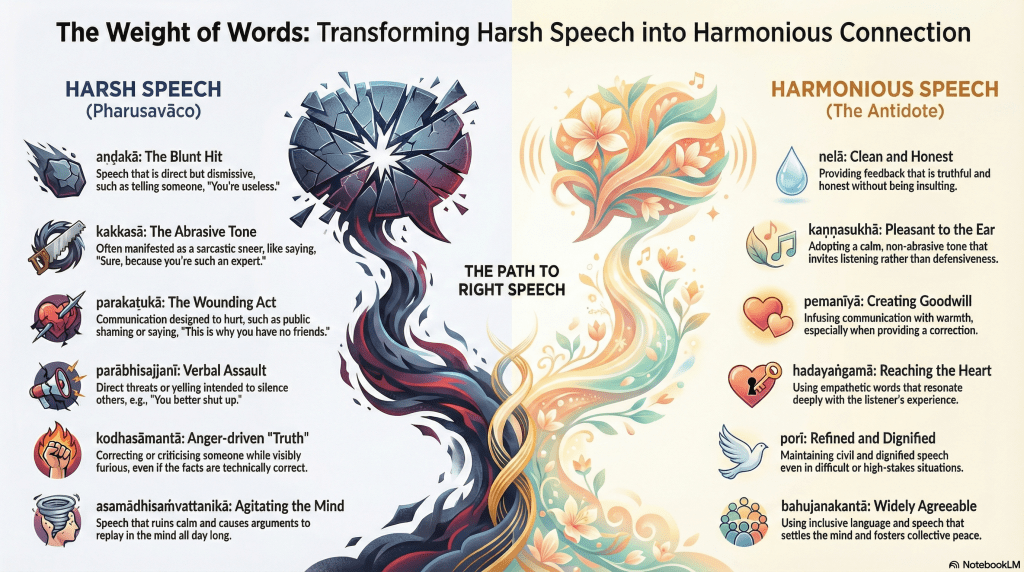
Pharusavāco hoti. Yā sā vācā aṇḍakā kakkasā parakaṭukā parābhisajjanī kodhasāmantā asamādhisaṁvattanikā, tathārūpiṁ vācaṁ bhāsitā hoti
He is one who speaks harsh speech.
That speech which is blunt, abrasive, bitter to others, verbally attacking, accompanied by anger, and leading away from concentration — such speech he speaks.
| Pāli term | Core quality | Example |
|---|---|---|
| aṇḍakā | Blunt hit | “You’re useless.” |
| kakkasā | Abrasive tone | Sarcastic sneer Sure, because you’re such an expert |
| parakaṭukā | Wounding | Public shaming This is why you have no friends |
| parābhisajjanī | Verbal assault | Threatening / yelling You better shut up |
| kodhasāmantā | Anger-driven | Furious “truth” Correcting someone while visibly furious |
| asamādhisaṁvattanikā | Agitating | Speech that ruins calm Arguments that replay in the mind all day |
Solution or antidote to harsh speech
Pharusaṁ vācaṁ pahāya, pharusāya vācāya paṭivirato hoti. Yā sā vācā nelā kaṇṇasukhā pemanīyā hadayaṅgamā porī bahujanakantā bahujanamanāpā, tathārūpiṁ vācaṁ bhāsitā hoti.
Having abandoned harsh speech, he abstains from harsh speech.
That speech which is clean, pleasant to the ear, affectionate, going to the heart, refined, dear to many people, agreeable to many people— such speech he speaks.
| Pāli term | Core quality | Modern example |
|---|---|---|
| nelā | clean | honest, non-insulting feedback |
| kaṇṇasukhā | pleasant | calm, non-abrasive tone |
| pemanīyā | goodwill-creating | warmth while correcting |
| hadayaṅgamā | heart-reaching | empathetic words |
| porī | refined | dignified, civil speech |
| bahujanakantā | widely dear | inclusive language |
| bahujanamanāpā | widely agreeable | speech that settles |
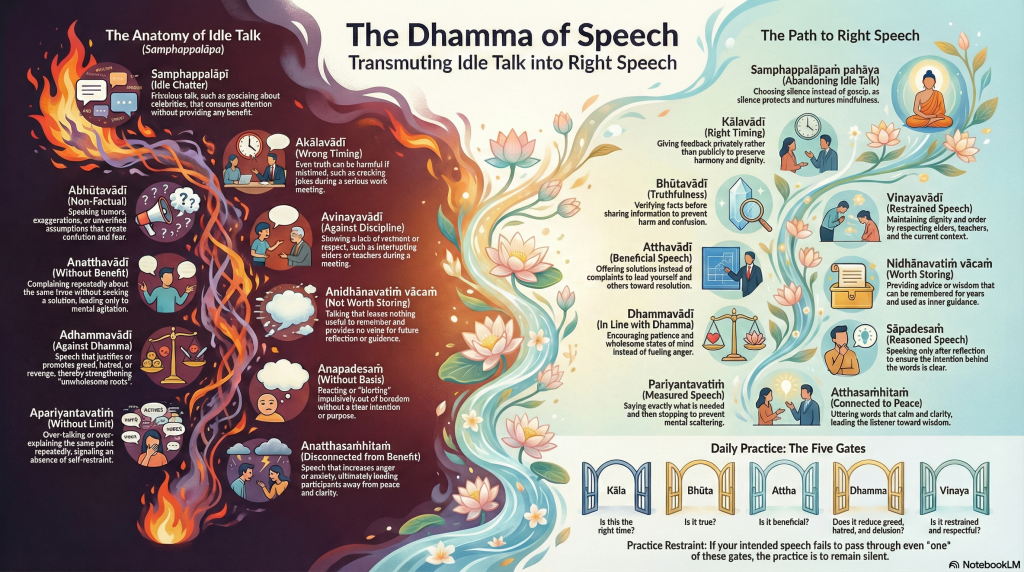
Samphappalāpī hoti akālavādī abhūtavādī anatthavādī adhammavādī avinayavādī; anidhānavatiṁ vācaṁ bhāsitā hoti akālena anapadesaṁ apariyantavatiṁ anatthasaṁhitaṁ
One engages in frivolous, idle talk, one speaks at the wrong time, speaks what is untrue,
speaks what is useless, speaks what is contrary to Dhamma, speaks what is contrary to discipline.
Such a person utters speech that is not worth storing, spoken at the wrong time, without reason,
without limit, and not connected with any benefit.”
| Pāli Term | Meaning | What the Buddha is pointing to |
|---|---|---|
| Samphappalāpī | Idle chatter, frivolous talk | Speech that burns time and attention |
| Akālavādī | Speaking at the wrong time | Even truth can be harmful if mistimed |
| Abhūtavādī | Speaking what is not factual | Rumors, exaggerations, assumptions |
| Anatthavādī | Speaking without benefit | No help, no clarity, no uplift |
| Adhammavādī | Against Dhamma | Promotes greed, hatred, delusion |
| Avinayavādī | Against restraint/discipline | Encourages carelessness, disrespect |
| Anidhānavatiṁ vācaṁ | Speech not worth treasuring | Nothing to remember or rely on |
| Anapadesaṁ | Without reason or basis | Just blurting, reacting |
| Apariyantavatiṁ | Without limit | Over-talking, no sense of enough |
| Anatthasaṁhitaṁ | Not connected to benefit | Leaves everyone worse off |
| Pāli Term | Literal Meaning | Daily-Life Example | Why This Is Samphappalāpa |
|---|---|---|---|
| Samphappalāpī | Idle, frivolous talk | Chatting for 30 minutes about celebrities or gossip | Consumes attention without benefit |
| Akālavādī | Speaking at the wrong time | Cracking jokes during a serious work meeting | Even harmless speech becomes harmful when mistimed |
| Abhūtavādī | Speaking what is not true | Forwarding unverified WhatsApp messages | Creates confusion and fear |
| Anatthavādī | Speaking without benefit | Complaining repeatedly about the same issue | No solution, only mental agitation |
| Adhammavādī | Against Dhamma | Justifying greed, anger, or revenge | Strengthens unwholesome roots |
| Avinayavādī | Against discipline | Interrupting elders, teachers, or meetings | Shows lack of restraint and respect |
| Anidhānavatiṁ vācaṁ | Not worth storing | Talking that leaves nothing useful to remember | No value for reflection or guidance |
| Anapadesaṁ | Without reason | Speaking impulsively out of boredom | No clear intention or purpose |
| Apariyantavatiṁ | Without limit | Over-explaining the same point again and again | Absence of self-restraint |
| Anatthasaṁhitaṁ | Not connected to benefit | Talking that increases anger or anxiety | Leads away from peace and clarity |
Solution or antidote to talking nonsense
Samphappalāpaṁ pahāya, samphappalāpā paṭivirato hoti kālavādī bhūtavādī atthavādī dhammavādī vinayavādī; nidhānavatiṁ vācaṁ bhāsitā hoti kālena sāpadesaṁ pariyantavatiṁ atthasaṁhitaṁ.
Abandoning idle talk, one refrains from idle talk.
One speaks at the right time, speaks what is true, speaks what is beneficial, speaks in accordance with Dhamma, speaks in accordance with discipline.
One speaks speech that is worth storing; spoken at the proper time, with a valid reason,
within proper limits, and connected with genuine benefit
| Pāli Term | Meaning | Day-to-Day Example | Why This Is Right Speech |
|---|---|---|---|
| Samphappalāpaṁ pahāya | Abandoning idle talk | Choosing silence instead of gossip | Silence protects mindfulness |
| Kālavādī | Speaking at the right time | Giving feedback privately, not publicly | Timing preserves harmony |
| Bhūtavādī | Speaking what is true | Verifying facts before sharing | Prevents confusion and harm |
| Atthavādī | Speaking what is beneficial | Offering solutions, not complaints | Leads toward resolution |
| Dhammavādī | Speaking in line with Dhamma | Encouraging patience instead of anger | Supports wholesome states |
| Vinayavādī | Speaking with restraint | Respecting elders, teachers, context | Maintains dignity and order |
| Nidhānavatiṁ vācaṁ | Speech worth storing | Advice remembered years later | Becomes inner guidance |
| Sāpadesaṁ | With reason and basis | Speaking after reflection | Intention is clear |
| Pariyantavatiṁ | Limited, measured speech | Saying what is needed, then stopping | Prevents mental scattering |
| Atthasaṁhitaṁ | Connected with benefit | Speech that calms and clarifies | Leads to peace and wisdom |
| Idle Talk | Right Speech |
|---|---|
| Fills time | Serves purpose |
| Feeds restlessness | Builds composure |
| Multiplies papanca | Supports samādhi |
| Forgotten quickly | Remembered deeply |
Daily Practice Rule (Very Practical)
Before speaking, check five gates:
Kāla – Is this the right time? Bhūta – Is it true? Attha – Is it beneficial?
Dhamma – Does it reduce greed, hatred, delusion? Vinaya – Is it restrained and respectful?
👉 If any gate fails, restraint is the practice
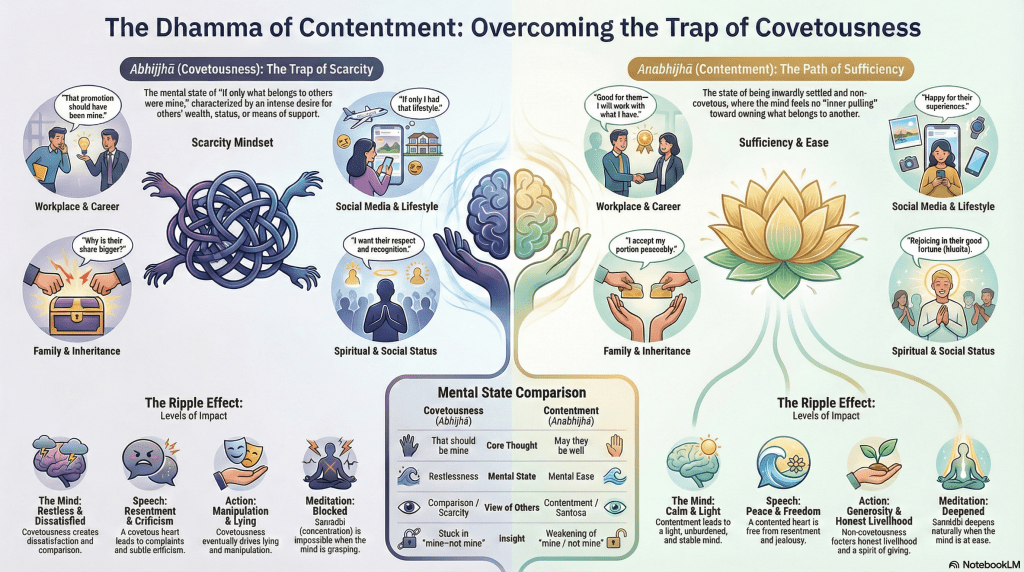
ekacco abhijjhālu hoti. Yaṁ taṁ parassa paravittūpakaraṇaṁ taṁ abhijjhātā hoti: ‘aho vata yaṁ parassa taṁ mamassā’ti
Here, a certain person is covetous. Whatever belongs to another — their property and possessions —
that person covets, thinking: ‘Oh, if only what belongs to others were mine!’
| Pāli Text | Meaning | Practical, Day-to-Day Example |
|---|---|---|
| Ekacco abhijjhālu hoti | A person is covetous | Constant dissatisfaction with what one has |
| Yaṁ taṁ parassa | Whatever belongs to another | Looking at others’ possessions, position, or status |
| Paravittūpakaraṇaṁ | Others’ wealth and means | Salary, property, gadgets, influence |
| Taṁ abhijjhātā hoti | He intensely desires that | Repeatedly imagining owning it |
| ‘Aho vata yaṁ parassa taṁ mamassā’ti | “Oh, if only what belongs to another were mine!” | Thinking: “That promotion / house / respect should have been mine” |
| Situation | Example Thought / Behavior | Why This Is Abhijjhā |
|---|---|---|
| Workplace | “My colleague doesn’t deserve that promotion — it should have been mine.” | Desiring what belongs to another |
| Money / Property | “If only I could somehow get his land or house.” | Mental appropriation of others’ wealth |
| Family / Relatives | “Why did they get more inheritance? I should have it.” | Grasping at others’ share |
| Social Media | Constantly comparing lifestyle, travel, gadgets | Feeding desire through comparison |
| Spiritual Circles | “Why does he get more respect or followers?” | Craving for others’ status |
| Daily Life | Feeling irritated when someone else succeeds | Inability to rejoice in others’ good fortune |
| Level | What Happens |
|---|---|
| Mind | Restlessness, dissatisfaction, comparison |
| Speech | Complaints, jealousy, subtle criticism |
| Action | Lying, manipulation, theft (eventually) |
| Meditation | Samādhi becomes impossible |
| Insight | Mind stuck in “mine–not mine” |
Solution or antidote to Insatiability or Covetousness
Idha, cunda, ekacco anabhijjhālu hoti. Yaṁ taṁ parassa paravittūpakaraṇaṁ taṁ anabhijjhitā hoti: ‘aho vata yaṁ parassa taṁ mamassā’ti.
a certain person is not covetous. Whatever wealth or means of support belongs to another, that person does not covet it, [and does not think:] ‘Oh, if only what belongs to another were mine
| Pāli Phrase | Clear Meaning | Day-to-Day Practical Example |
|---|---|---|
| Ekacco anabhijjhālu hoti | A person is non-covetous | Feeling inwardly settled and content |
| Yaṁ taṁ parassa | Whatever belongs to another | Others’ money, job, respect, possessions |
| Paravittūpakaraṇaṁ | Others’ wealth or means | House, salary, influence, opportunities |
| Taṁ anabhijjhitā hoti | Does not mentally crave it | No inner pulling toward ownership |
| ‘Aho vata … mamassā’ti (na hoti) | Does not think “may it be mine” | No comparison-based wishing |
| Situation | Mental Response | Why This Is Anabhijjhā |
|---|---|---|
| Workplace | “Good for them — I’ll work with what I have.” | No appropriation of others’ success |
| Family property | Accepting one’s share peacefully | Absence of grasping |
| Social media | Seeing others’ lifestyle without envy | No comparison-driven craving |
| Spiritual circles | Rejoicing in others’ recognition | Mudita replaces jealousy |
| Daily mind | Gratitude for sufficiency | Contentment stabilizes the mind |
| Level | Effect of Anabhijjhā |
|---|---|
| Mind | Calm, light, unburdened |
| Speech | Free from complaint and resentment |
| Action | Honest livelihood, generosity |
| Meditation | Samādhi deepens naturally |
| Insight | Weakening of “mine / not mine” |
| Abhijjhā | Anabhijjhā |
|---|---|
| “That should be mine” | “May they be well” |
| Comparison | Contentment (santosa) |
| Scarcity mindset | Inner sufficiency |
| Restlessness | Mental ease |

Byāpannacitto hoti paduṭṭhamanasaṅkappo: ‘ime sattā haññantu vā bajjhantu vā ucchijjantu vā vinassantu vā mā vā ahesun’ti.
One has a mind afflicted with ill will; one’s mental intentions are corrupted, thinking:
May these beings be killed, or may they be bound (imprisoned), or may they be cut off (exterminated),
or may they be destroyed, or may they not exist at all.
Byāpannacitto → a mind overcome or pervaded by ill will
Paduṭṭhamanasaṅkappo → intentions of the mind that are polluted or defiled
Haññantu / bajjhantu / ucchijjantu / vinassantu → increasing degrees of harm
Mā vā ahesuṁ → complete negation of existence (“may they never be”)
What is the etymological meaning of Byāpāda?
Byāpāda = vi + ā + pāda / pad – shown as Byā + pāda
It comes from the verbal root: √pad / √pād = to go, to step, to strike, to move toward
With prefixes: vi / byā = apart, against, in opposition, hostile direction and ā = toward, intensifying
So structurally: Byāpāda = moving strongly against something or stepping on others
At mental level it is about wanting to dominate, crush, humiliate.
| Pāli Phrase | Meaning | Day-to-Day Practical Example |
|---|---|---|
| Byāpannacitto hoti | One has a mind filled with ill will | Constant inner hostility toward people |
| Paduṭṭhamanasaṅkappo | Thoughts are mentally corrupted / polluted | Replaying hurtful thoughts again and again |
| Ime sattā | “These beings…” | A specific person, group, colleague, community |
| Haññantu vā | “May they be killed” | Wishing someone would die in an accident |
| Bajjhantu vā | “May they be imprisoned” | Wanting someone falsely trapped in legal trouble |
| Ucchijjantu vā | “May they be wiped out” | Hoping a rival’s career or family collapses |
| Vinassantu vā | “May they be ruined” | Wishing financial or social destruction |
| Mā vā ahesuṁ | “Or may they not exist at all” | Thinking: “I wish I never had to see them again” |
| Situation | Inner Thought Pattern | Why This Is Byāpāda |
|---|---|---|
| Workplace | “I hope he gets fired” | Mental violence toward livelihood |
| Family conflict | “She deserves to suffer” | Intention of harm |
| Social media | Enjoying others’ downfall | Pleasure in destruction |
| Politics / groups | “They should all be eliminated” | Collective hatred |
| Spiritual circles | “I hope his practice collapses” | Corruption of Dhamma intention |
| Private mind | Repeated revenge fantasies | Sustained ill will |
| Level | Consequence of Byāpāda |
|---|---|
| Mind | Burning, agitation, insomnia |
| Speech | Harsh words, curses |
| Action | Violence, sabotage |
| Meditation | Samādhi impossible |
| Insight | Compassion completely blocked |
👉 Byāpāda is killing in intention, even before action.
Solution or antidote to Byāpāda
Abyāpannacitto hoti appaduṭṭhamanasaṅkappo: ‘ime sattā averā hontu abyāpajjā, anīghā sukhī attānaṁ pariharantū’ti.
One has a mind free from ill will, with thoughts not corrupted by hostility, thinking:
‘May these beings be without enmity, without oppression, without inner distress and may they take care of themselves happily.
| Pāli Phrase | Meaning | Practical Day-to-Day Example |
|---|---|---|
| Abyāpannacitto hoti | One’s mind is without ill will | Even when mistreated, not wishing harm |
| Appaduṭṭhamanasaṅkappo | Thoughts are uncorrupted, non-hostile | No revenge fantasies or grudges |
| Ime sattā | These beings (all, without exception) | Includes difficult people, not just loved ones |
| Averā hontu | May they be without enmity | Not wanting anyone to be harmed or defeated |
| Abyāpajjā | May they be free from affliction | Not wishing suffering, punishment, or downfall |
| Anīghā | Free from mental distress | Wanting others to be inwardly peaceful |
| Sukhī | Happy, at ease | Genuinely wishing well-being |
| Attānaṁ pariharantū | May they care for themselves | Allowing others autonomy, not control |
| Situation | Unwholesome Reaction | Abyāpāda Response |
|---|---|---|
| Someone insults you | Holding resentment | Letting it pass without replaying |
| Workplace rivalry | Wishing failure | Wishing clarity and fairness |
| Family conflict | Silent hostility | Calm distance without bitterness |
| Traffic / public spaces | Anger at strangers | Neutral patience |
| Spiritual disagreements | Judging or condemning | Respectful non-hostility |
| Aspect | Abhijjhā (Covetousness) | Abyāpāda (Non-ill-will / Goodwill) |
|---|---|---|
| Key Pāli phrase | Ekacco abhijjhālu hoti | Abyāpannacitto hoti |
| Core mental tone | Grasping, wanting to take | Non-hostile, benevolent |
| Underlying thought | “aho vata yaṁ parassa taṁ mamassā” — “If only what is theirs were mine” | “ime sattā averā hontu…” — “May these beings be without enmity” |
| Relation to others | Others are competitors or obstacles | Others are fellow beings deserving peace |
| View of others’ success | Painful, irritating | Neutral or joyful (close to muditā) |
| Direction of mind | Outward grabbing | Outward goodwill |
| Effect on inner peace | Restlessness, comparison | Ease, softness |
| Effect on speech | Complaints, subtle resentment | Gentle, non-reactive speech |
| Effect on action | Manipulation, envy-driven behavior | Non-harm, restraint |
| Meditation impact | Samādhi collapses | Samādhi stabilizes |
| Sense of “mine” | Strong “mine / not mine” | Weakening of ownership |
| Root defilement | Lobha (greed) | Absence of dosa (hatred) |
| Path classification | Micchā-saṅkappa (wrong intention) | Sammā-saṅkappa (right intention) |
| Situation | Abhijjhā Response | Abyāpāda Response |
|---|---|---|
| Colleague promoted | “Why not me?” | “May things work out fairly” |
| Someone has more wealth | Repeated comparison | Contentment with sufficiency |
| Someone insults you | Silent resentment | Non-retaliation |
| Social media scrolling | Envy, dissatisfaction | Neutral observation |
| Spiritual community | Wanting status, recognition | Wishing well without rivalry |
| Mental Check | Indicates Abhijjhā | Indicates Abyāpāda |
|---|---|---|
| Tightness in chest | ✔ | ✘ |
| Replaying comparisons | ✔ | ✘ |
| Calm even in disagreement | ✘ | ✔ |
| Ease with others’ gain | ✘ | ✔ |
Essential Insight
Abhijjhā poisons happiness by wanting more.
Abyāpāda protects peace by wanting no harm.
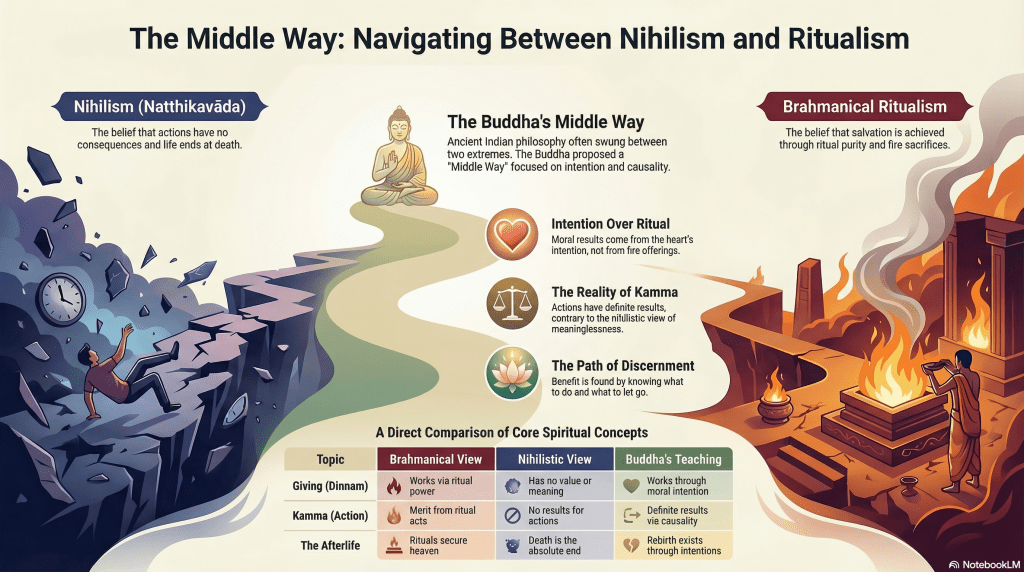
natthi dinnaṁ, natthi yiṭṭhaṁ, natthi hutaṁ, natthi sukaṭadukkaṭānaṁ kammānaṁ phalaṁ vipāko, natthi ayaṁ loko, natthi paro loko, natthi mātā, natthi pitā, natthi sattā opapātikā, natthi loke samaṇabrāhmaṇā sammaggatā sammāpaṭipannā ye imañca lokaṁ parañca lokaṁ sayaṁ abhiññā sacchikatvā pavedentī’ti
There is no meaning in giving.
there is no value in sacrificial rites (homa / yajña)
There is no meaning in fire offerings.
There is no result or ripening of good and bad actions.
There is no this world; there is no other world.
There is no mother; there is no father.
There are no beings who arise spontaneously.
There are no ascetics or brahmins in the world who have gone rightly, practiced rightly, and who, having directly known and realized this world and the other world for themselves, proclaim them.
| Pāli Clause | Correct Meaning | Modern / Practical Example |
|---|---|---|
| Natthi dinnaṁ | Giving has no value | “Charity is pointless — keep your money.” |
| Natthi yiṭṭhaṁ | No value in homa / yajña | “All religious sacrifices are meaningless superstition.” |
| Natthi hutaṁ | No value in fire rituals | “Fire rituals do nothing; they’re useless acts.” |
| Natthi sukaṭadukkaṭānaṁ kammānaṁ phalaṁ vipāko | No karmic result | “Good or bad — nothing comes back to you.” |
| Natthi ayaṁ loko | No moral order here | “Life has no inherent meaning or order.” |
| Natthi paro loko | No rebirth / afterlife | “Once dead, everything ends.” |
| Natthi mātā, natthi pitā | No moral debt to parents | “Parents deserve no special respect.” |
| Natthi sattā opapātikā | No other realms / spontaneous birth | “Devas, hells, rebirth are fiction.” |
| Natthi samaṇabrāhmaṇā… | No realized beings | “No one is awakened — all teachers are frauds.” |
| Buddha | Natthikavāda |
|---|---|
| Rituals don’t lead to liberation | Nothing leads anywhere |
| Ethics matter | Ethics are illusion |
| Kamma works | Kamma is fiction |
| Awakening is possible | Awakening is impossible |
| Topic | Brahmanical View | Natthikavāda | Buddha’s Teaching |
|---|---|---|---|
| Yiṭṭhaṁ (homa / yajña) | Fire sacrifice gives merit and help in liberation | Fire sacrifice is meaningless | Ritual has no liberating power |
| Hutaṁ (fire oblation) | Offering into fire purifies soul through rituals and takes it to heaven | Fire offering is useless | Moral intention matters, not fire |
| Dinnaṁ (giving) | Giving works via ritual and prepares for after human birth | Giving has no value | Giving works through intention |
| Kamma-phala | Merit comes from ritual act alone and morality can be got through rituals of bathing in rivers, cowdung practices and other rituals cleansing the “sin” | No result of good/bad action | Kamma has definite results irrespective whatever is done |
| Ayaṁ loko | World governed by gods and one has to please them through “bali” or sacrifices | No moral order at all | World works by causality |
| Paro loko | Rituals give rights to heaven and skip hell living by pleasing the Gods | No other world | Rebirth exists through intentions |
| Parents (mātā/pitā) | Lineage governs everything and higher lineage is best of father and mother as in Brahmins by birth | No moral debt to parents | Parents are worthy of reverence as they take care of the being from the beginning |
| Samaṇa / Brāhmaṇa | Priests as authorities and they can redeem any soul from bad birth through cleansing rituals | No realized beings exist | Awakened beings do exist |
| Liberation | Possible through proper rituals and meeting the expectations of that | Impossible | Through Eightfold Path |
| Ritual Practice (Pāli) | Literal Meaning | Underlying Assumption | Buddha’s Correction (Principle & Pāli) | What the Buddha Shifts |
|---|---|---|---|---|
| kamaṇḍalukā | Bearers of water-pots where they fill river water | Purity comes from ritual implements | Na udakena suddhi hoti (purity not by water) → saṁvarena suddhi | From objects → to restraint |
| sevālamālikā | Wearers of algae garlands | Ascetic appearance = purification | Na ve vesena suddhi (not by appearance) | From looks → to mind |
| aggiparicārikā | Fire-attendants / fire-worshippers as in agnihotra | Fire burns away impurity | Ātappa replaces aggi (inner heat of effort) | From fire ritual → energy of practice |
| udakorohakā | Water-immersers | Washing removes kamma | Sīla-saṁvara + samādhi purify | From bathing → guarding sense doors |
| samādapenti | They impose instruction | Purity can be instructed externally | Paccattaṁ veditabbo viññūhi (to be known individually by the wise) | From imposed rule → personal seeing |
Fire vs Water vs Mind (Very Sharp Comparison)
| Ritual Claim | Buddha’s Reframing |
|---|---|
| Water cleanses sin | Sīla cleanses action and sin is removed |
| Fire sacrifices as in agnihotra purifies | Ātappa purifies defilements |
| Repetition of hymns and mantras brings merit | Saṁvara prevents akusala and hence becomes meritorious |
| Teacher or priests alone gives purity | One sees purity oneself through cleaning the mind |
Ritual Purity vs Buddha’s Teaching
Purity According to Ritualists vs According to the Buddha
| Ritual Act (Pāli) | Ritual Assumption | Buddha’s Statement | Corrective Principle |
|---|---|---|---|
| pathaviṁ āmasati | Touching earth purifies | Pure whether touching or not | Earth does not cleanse kamma |
| allāni gomayāni āmasati | Cow-dung purifies | Pure whether touching or not | Purity is not material |
| haritāni tiṇāni āmasati | Grass contact purifies | Pure whether touching or not | Symbols ≠ causes |
| aggiṁ paricarati | Fire burns defilements | Pure whether tending fire or not | Ātappa ≠ ritual fire |
| ādiccaṁ namassati | Sun worship purifies | Pure whether worshipping or not | No external deity purifies kamma |
| udakaṁ orohati | Water washes away sin | Pure whether bathing or not | Kamma is not washable |
Solution or antidote to wrong view
The only way one can see it properly is not to follow nihilistic and Brahminical ritual as they do not bring any benefit. Brahminical makes fear as the guideline and way to come out of it is ritual and on the nihilistic side, fearless becomes guideline and one does all wrong things thinking that it is right view.
What brings benefit is proper discernment by knowing what should be done and what should not and let go of both extremes.
If you want to get deeper into this, please click here
Buddha says that one should be in Samādhi and learn how to be in that while in sīla and the process to be followed for five precepts are as follows.
When properly followed, it becomes samvarena-sīla which is indriya-samvara along with satisampajañña
citta-ṭhiti – steadiness of mind
ekaggatā – not splitting into reaction
avikkhepa – non-scattering
upaṭṭhita-sati – mindfulness standing firm
This is pre-jhānic samādhi, but absolutely essential.
The Core Practice (Universal)
🔹 Step 1: Notice the Impulse
An urge arises: to speak falsely, to react harshly, to grasp, to escape and to indulge
👉 This is vedanā + saṅkhāra beginning.
🔹 Step 2: Do Nothing (This is the Practice)
You do not suppress
You do not justify
You do not act but stay with: bodily pressure and heat, tightness and restlessness
👉 This staying is samādhi.
🔹Step 3: Stay Until It Passes
If you remain still: the urge peaks and then it weakens and then it ceases for sure
You have just directly seen: “Saṅkhārā aniccā”
This is not theory — it is lived Dhamma with yoniso-manasikara
| Sīla (Precept) | Where the Precept Breaks | What Samādhi Means Here | How to Practise Samādhi in This Sīla | Direct Insight Gained |
|---|---|---|---|---|
| 1. Pāṇātipātā veramaṇī(Non-harming) | Aversion, irritation, anger arising in body & mind | Non-reactive steadiness (citta-ṭhiti) | When irritation arises, do not discharge it through action or speech. Stay with bodily heat, tightness, pressure until it dissolves. | Aversion is impermanent and not-self; action is optional |
| 2. Adinnādānā veramaṇī(Non-taking) | Craving, urgency, restlessness | Containment samādhi (avikkhepa) | Pause when desire pushes. Delay action. Remain with wanting as a bodily process until it fades. | Craving peaks and ceases on its own |
| 3. Kāmesu micchācārā veramaṇī(Sexual restraint) | Sense pull, fantasy, proliferation (papañca) | Sense-restraint samādhi (indriya-saṁvara) | Do not follow images or stories. Anchor attention in the body or breath until the pull weakens. | Desire depends on attention; it collapses without feeding |
| 4. Musāvādā veramaṇī(Truthful speech) | Fear, self-protection, social pressure | Clarity samādhi (ekaggatā + sati) | When fear arises, do not speak immediately. Stay silent with awareness until mind unifies and clarity returns. | Speech follows mental states; silence reveals truth |
| 5. Surā-meraya-majjapamādaṭṭhānā veramaṇī(Non-intoxication) | Boredom, pain, restlessness, urge to escape | Wakeful samādhi (jāgariya + upekkhā) | Remain fully present with discomfort without escaping into intoxication or dulling habits. | Awareness itself is sufficient; escape is unnecessary |
Notice the impulse → Do not act → Stay fully aware → Let it pass
That staying without acting is samādhi inside sīla.
| Time / Situation | Sīla Touched | Real-Life Example (Today) | Inner Movement Noted | Samādhi Practice at That Moment | What Was Seen (Result) |
|---|---|---|---|---|---|
| Morning routine | 1. Non-harming | Irritation at noise / delay / person | Tight chest, heat, impatience | Pause, keep body still, stay with sensation for 3–5 breaths | Irritation faded without action |
| Commute / errands | 2. Non-taking | Wanting to take shortcut, benefit unfairly | Urgency, leaning forward | Stop movement briefly, feel wanting in body | Desire peaked then dropped |
| Phone / screen time | 3. Sexual restraint | Image, memory, or fantasy appears | Pulling sensation, restlessness | Cut imagery, return to breath/body | Mind recollected, energy conserved |
| Conversation | 4. Truthful speech | Urge to exaggerate, hide, or soften truth | Fear, throat tension | Stay silent one breath longer, speak slowly | Speech became clean or unnecessary |
| Evening tiredness | 5. Non-intoxication | Want to dull mind (food, media, drink) | Heaviness, boredom | Sit with discomfort without escape | Wakefulness returned |
1️⃣ Eye (Cakkhu) — Seeing
| Precept | Sense-Door Trigger (Seeing) | Samādhi Practice at the Eye |
|---|---|---|
| 1. Non-harming | Seeing someone you dislike | Keep gaze soft, body still; stay with aversion without reacting |
| 2. Non-taking | Seeing something desirable but not yours | Do not lean forward; feel wanting as sensation |
| 3. Sexual restraint | Seeing an attractive form | Break visual feeding; return to breath/body |
| 4. Truthful speech | Seeing something that tempts exaggeration later | Note perception carefully; don’t pre-construct speech |
| 5. Surā-meraya | Seeking visual escape (screens, scrolling) | Stay with boredom; don’t dull attention |
👉 Key insight: seeing itself is innocent — reaction is the danger.
2️⃣ Ear (Sota) — Hearing
| Precept | Sense-Door Trigger (Hearing) | Samādhi Practice at the Ear |
|---|---|---|
| 1. Non-harming | Harsh words, criticism | Let sound pass without tightening the chest |
| 2. Non-taking | Hearing opportunity for unfair gain | Pause; don’t act on auditory suggestion |
| 3. Sexual restraint | Hearing seductive tone / talk | Stay with sound only; cut imagination |
| 4. Truthful speech | Hearing gossip or half-truth | Hold silence; don’t join reaction |
| 5. Surā-meraya | Using noise/music to numb | Remain in quiet awareness |
👉 Samādhi here = unmoved listening
3️⃣ Nose (Ghāna) — Smell
| Precept | Sense-Door Trigger (Smell) | Samādhi Practice at the Nose |
|---|---|---|
| 1. Non-harming | Smell causing irritation | Stay with aversion without comment |
| 2. Non-taking | Smell stimulating craving | Let desire complete itself |
| 3. Sexual restraint | Smell linked to attraction | Anchor attention in breath |
| 4. Truthful speech | Smell triggering judgement | Note perception; don’t verbalise |
| 5. Surā-meraya | Smell associated with intoxication | Stay alert; don’t romanticise |
👉 Often subtle — but excellent for refining samādhi
4️⃣ Tongue (Jivhā) — Taste
| Precept | Sense-Door Trigger (Taste) | Samādhi Practice at the Tongue |
|---|---|---|
| 1. Non-harming | Irritation from taste | Eat without reaction |
| 2. Non-taking | Wanting more than given | Pause between bites |
| 3. Sexual restraint | Taste linked to indulgence | Keep awareness bodily |
| 4. Truthful speech | Complaining or praising food | Eat silently, mindfully |
| 5. Surā-meraya | Taste used to dull mind | Stop at clarity, not fullness |
👉 Eating is a daily samādhi test
5️⃣ Body (Kāya) — Touch
| Precept | Sense-Door Trigger (Touch) | Samādhi Practice at the Body |
|---|---|---|
| 1. Non-harming | Physical irritation / pain | Stay with sensation; don’t strike back |
| 2. Non-taking | Reaching habitually | Freeze movement briefly |
| 3. Sexual restraint | Pleasant bodily contact | Keep attention whole-body |
| 4. Truthful speech | Bodily fear before speaking | Let body settle first |
| 5. Surā-meraya | Restlessness in body | Stay upright and awake |
👉 Kāya is the strongest samādhi anchor
6️⃣ Mind (Mano) — Thinking
| Precept | Sense-Door Trigger (Mind) | Samādhi Practice at the Mind |
|---|---|---|
| 1. Non-harming | Angry thoughts | Don’t continue the story |
| 2. Non-taking | Scheming thoughts | Drop planning temporarily |
| 3. Sexual restraint | Fantasy proliferation | Cut image; return to breath |
| 4. Truthful speech | Inner rehearsals of lying | Let thought die unspoken |
| 5. Surā-meraya | Wanting mental escape | Stay present with unease |
👉 Mind-door restraint = real sila
Crucial Realisation
Precepts are not broken at the body level and are always broken at the sense-door level.
When sense restraint + samādhi are present: sila becomes effortless and remorse disappears while sitting meditation deepens naturally
Guard the sense door — the precept guards itself.
So iminā ca ariyena sīlakkhandhena samannāgato, imāya ca ariyāya santuṭṭhiyā samannāgato iminā ca ariyena indriyasaṁvarena samannāgato, iminā ca ariyena satisampajaññena samannāgato (MN27)
What is sampajañña that helps in increasing sati and inturn works with sīla and completes sīlakkhandha?
There are FOUR modes of sampajañña which is enumerated below;
sātthaka-sampajañña — clear knowing of purpose – “Is this action speech / movement purposeful for the path, or merely worldly drift?”
sappāya-sampajañña — clear knowing of suitability – “Is this suitable/right-timed/right-measured for calm, restraint, non-harm?”
gocara-sampajañña — clear knowing of domain/pasture – “Am I staying within the proper ‘pasture’—sense restraint, satipaṭṭhāna territory—rather than roaming into unguarded sense-fields?” (The cow-pasture nuance is important.)
asammoha-sampajañña — clear knowing of non-delusion – seeing the process as process:
“just rūpa/vedanā/saññā/saṅkhārā/viññāṇa arising & passing; not self; not mine.”
| Aspect | Sātaccakārī | Sappāyakārī |
|---|---|---|
| Root meaning | Continuous effort | Suitable conduct |
| Focus | Persistence | Appropriateness |
| Concern | How consistently you practice | Whether conditions support practice |
| Main quality | Diligence | Wisdom in choosing conditions |
| Example | Practicing every day | Choosing a quiet meditation place |
Where this way of seeing is covered in sutta?
1. sātthaka-sampajañña – Sutta reference: Sātaccamūlakasappāyakārīsutta along with MN53 – Sekhasutta
2. sappāya-sampajañña – Same as above
3. gocara-sampajañña – MN152 – Indriyabhāvanāsutta
4. asammoha-sampajañña – Khandavagga in SN
Simple Analogy – Think of meditation like growing a plant.
Sātaccakārī = watering the plant regularly
Sappāyakārī = placing the plant in good sunlight and soil as both are necessary.
If one waters daily but keeps the plant in darkness → it dies.
If sunlight is perfect but watering is irregular → it dies.
Thus: Progress requires both
Sātacca (continuity of effort)
Sappāya (supportive conditions)
If “sampajāno” is present, then during walking / standing / eating / speaking, you can detect:
Purpose: “Is this leading to dispassion or to proliferation?”
Suitability: “Does this increase calm/restraint or agitation?”
Domain: “Are the senses guarded or wandering?”
Non-delusion: “Am I seeing khandhas as khandhas (not ‘I’ / ‘mine’)?”
Conclusion: Establish yoniso-manasikara involving these steps
1. Recognize what is present – state of mind
2. See it as dependently arisen and not independent – Idappaccayatā
3, Apply Tilakkhaṇa
4. Seeing danger of association with sights, sounds, taste, touch, smell and thoughts which is ādīnava-dassana
5. See the escape from it which is nissaraṇa-dassana
6. Replace a-yoniso with yoniso and establish satisampajañña
🌿 Six Sense Doors × Ten Unwholesome Deeds (AN 11.2 Practice Map)
Use: When any of these arise at any sense door → pause → restrain → AN 11.2 unfolds.
👁️ EYE (Seeing / Cakkhu)
| Akusala (Immoral Act) | How It Arises When Seeing | Saṁvara Practice | AN 11.2 Result |
|---|---|---|---|
| Pāṇātipāta (Harming) | Anger seeing enemy | Soften gaze | Avippaṭisāra |
| Adinnādāna (Stealing) | Wanting others’ property | No mental grasping | Pāmojja |
| Kāmesu micchācāra (Sexual misconduct) | Attractive form | Cut visual feeding | Passaddhi |
| Musāvāda (Lying) | Seeing mistake | No cover-up | Sukha |
| Pisuṇāvācā (Divisive speech) | Comparing people | No rivalry | Passaddhi |
| Pharusāvācā (Harsh speech) | Judging looks | Gentle perception | Passaddhi |
| Samphappalāpa (Idle talk) | Visual gossip | Don’t collect stories | Samādhi |
| Abhijjhā (Coveting) | Envy of wealth | Let go | Pāmojja |
| Byāpāda (Ill will) | Hatred on sight | Neutral awareness | Passaddhi |
| Micchādiṭṭhi (Wrong view) | Misinterpretation | Investigate | Yathābhūta |
👂 EAR (Hearing / Sota)
| Akusala | How It Arises When Hearing | Practice | Result |
|---|---|---|---|
| Pāṇātipāta | Rage at insults | Don’t react | Avippaṭisāra |
| Adinnādāna | Fraud ideas | Drop plan | Pāmojja |
| Kāmesu micchācāra | Seductive talk | Guard mind | Passaddhi |
| Musāvāda | Pressure to lie | Pause | Sukha |
| Pisuṇāvācā | Gossip | Silence | Samādhi |
| Pharusāvācā | Abuse | No retaliation | Passaddhi |
| Samphappalāpa | Meaningless chatter | Withdraw | Samādhi |
| Abhijjhā | Hearing success | No jealousy | Pāmojja |
| Byāpāda | Criticism | Let pass | Passaddhi |
| Micchādiṭṭhi | False doctrine | Reflect | Yathābhūta |
👃 NOSE (Smell / Ghāna)
| Akusala | Triggered by Smell | Practice | Result |
|---|---|---|---|
| Pāṇātipāta | Irritation | Endure | Avippaṭisāra |
| Adinnādāna | Food craving | Moderate | Pāmojja |
| Kāmesu micchācāra | Attraction | Ground body | Passaddhi |
| Musāvāda | Judgement | Silence | Sukha |
| Pisuṇāvācā | Dislike groups | Neutral | Passaddhi |
| Pharusāvācā | Complaints | Restrain | Passaddhi |
| Samphappalāpa | Talk impulse | Still | Samādhi |
| Abhijjhā | Desire | Let fade | Pāmojja |
| Byāpāda | Aversion | Observe | Passaddhi |
| Micchādiṭṭhi | Ritual view | Reflect | Yathābhūta |
👅 TONGUE (Taste / Jivhā)
| Akusala | Triggered by Taste | Practice | Result |
|---|---|---|---|
| Pāṇātipāta | Anger at food | Accept | Avippaṭisāra |
| Adinnādāna | Taking extra | Stop | Pāmojja |
| Kāmesu micchācāra | Indulgence | Mindful eating | Passaddhi |
| Musāvāda | False praise | Truth | Sukha |
| Pisuṇāvācā | Criticising cook | Silence | Passaddhi |
| Pharusāvācā | Harsh remarks | Soft speech | Passaddhi |
| Samphappalāpa | Food gossip | Reduce | Samādhi |
| Abhijjhā | Greed | Contentment | Pāmojja |
| Byāpāda | Dislike | Equanimity | Passaddhi |
| Micchādiṭṭhi | Hedonism view | Reflect | Yathābhūta |
✋ BODY (Touch / Kāya)
| Akusala | Triggered by Touch | Practice | Result |
|---|---|---|---|
| Pāṇātipāta | Violence | Restrain | Avippaṭisāra |
| Adinnādāna | Automatic grabbing | Pause | Pāmojja |
| Kāmesu micchācāra | Sensual contact | Guard | Passaddhi |
| Musāvāda | Hiding actions | Transparency | Sukha |
| Pisuṇāvācā | Rivalry | Neutral | Passaddhi |
| Pharusāvācā | Aggression | Relax | Passaddhi |
| Samphappalāpa | Fidgeting | Stillness | Samādhi |
| Abhijjhā | Possessiveness | Let go | Pāmojja |
| Byāpāda | Hostility | Soften | Passaddhi |
| Micchādiṭṭhi | Materialism | Reflect | Yathābhūta |
🧠 MIND (Thinking / Mano)
| Akusala | How It Arises in Mind | Practice | Result |
|---|---|---|---|
| Pāṇātipāta | Revenge fantasy | Drop | Avippaṭisāra |
| Adinnādāna | Scheming | Stop | Pāmojja |
| Kāmesu micchācāra | Lust fantasy | Cut | Passaddhi |
| Musāvāda | Rehearsed lies | End | Sukha |
| Pisuṇāvācā | Divisive plans | Abandon | Passaddhi |
| Pharusāvācā | Angry dialogue | Calm | Passaddhi |
| Samphappalāpa | Mental chatter | Return breath | Samādhi |
| Abhijjhā | Coveting | Contentment | Pāmojja |
| Byāpāda | Resentment | Mettā | Passaddhi |
| Micchādiṭṭhi | Fixed wrong views | Investigate | Yathābhūta |
Each time you stop one akusala at one sense door, you generate:
Sīla → Avippaṭisāra → Pāmojja → Pīti → Passaddhi → Sukha → Samādhi → Paññā
🌿 Modern Life × 10 Immoral Deeds × Practice Guide
Key principle: Every scroll, click, glance, and purchase is a moral–meditative test.
📱 1. Social Media (YouTube, WhatsApp, Instagram, Facebook, X)
👉 Samādhi practice: Pause before every scroll.
| Akusala | Daily Example | Inner Movement | Right Practice |
|---|---|---|---|
| Pāṇātipāta | Rage comments | Aggression | Stop typing |
| Adinnādāna | Pirated content | Greed | Don’t download |
| Kāmesu micchācāra | Erotic reels | Lust | Close immediately |
| Musāvāda | Fake persona | Dishonesty | Be authentic |
| Pisuṇāvācā | Forward gossip | Division | Don’t share |
| Pharusāvācā | Troll replies | Harshness | Stay silent |
| Samphappalāpa | Endless scrolling | Distraction | Time limit |
| Abhijjhā | Envy posts | Jealousy | Gratitude |
| Byāpāda | Hate news | Ill will | Equanimity |
| Micchādiṭṭhi | Fake gurus | Confusion | Verify |
🧍 2. People Interaction (Family, Work, Public)
| Akusala | Example | Inner Movement | Practice |
|---|---|---|---|
| Pāṇātipāta | Shouting | Violence | Soft voice |
| Adinnādāna | Taking credit | Stealing merit | Honesty |
| Kāmesu micchācāra | Flirting | Lust | Boundaries |
| Musāvāda | Excuses | Fear | Truth |
| Pisuṇāvācā | Complaints | Division | Don’t repeat |
| Pharusāvācā | Sarcasm | Cruelty | Gentle speech |
| Samphappalāpa | Small talk | Waste | Meaningful speech |
| Abhijjhā | Comparing | Envy | Contentment |
| Byāpāda | Resentment | Hatred | Mettā |
| Micchādiṭṭhi | Blaming fate | Wrong view | Responsibility |
👉 Samādhi practice: Speak only after one breath.
🔞 3. Porn Videos, Sexual Images, Fantasies
| Akusala | Example | Inner Movement | Practice |
|---|---|---|---|
| Kāmesu micchācāra | Watching porn | Obsession | Close tab |
| Abhijjhā | Craving bodies | Greed | Ground body |
| Byāpāda | Frustration | Anger | Acceptance |
| Samphappalāpa | Erotic fantasy | Proliferation | Cut imagery |
| Micchādiṭṭhi | “It’s harmless” | Delusion | See damage |
👉 Samādhi practice: Return to breath + body immediately.
🍽️ 4. Restaurants, Food, Delivery Apps
| Akusala | Example | Inner Movement | Practice |
|---|---|---|---|
| Adinnādāna | Extra portions | Greed | Moderate |
| Kāmesu micchācāra | Overindulgence | Sensuality | Mindful eating |
| Musāvāda | Fake praise | Dishonesty | Sincere |
| Pharusāvācā | Complaining | Irritation | Patience |
| Samphappalāpa | Food gossip | Distraction | Silence |
| Abhijjhā | Wanting others’ food | Envy | Contentment |
| Byāpāda | Anger at delay | Hatred | Calm |
| Micchādiṭṭhi | “Live to eat” | Wrong view | Eat to live |
👉 Samādhi practice: Put spoon down between bites.
🛍️ 5. Malls, Clothing, Accessories
| Akusala | Example | Inner Movement | Practice |
|---|---|---|---|
| Abhijjhā | “I need this” | Greed | Delay 24 hrs |
| Adinnādāna | Cheating offers | Dishonesty | Fairness |
| Kāmesu micchācāra | Showing off | Vanity | Simplicity |
| Musāvāda | Brand lies | Self-deception | Reality check |
| Samphappalāpa | Window shopping | Restlessness | Purposeful visit |
| Byāpāda | Crowd anger | Irritation | Patience |
| Micchādiṭṭhi | Status belief | Delusion | Impermanence |
👉 Samādhi practice: Ask: “Do I truly need this?”
💻 6. Computers, Gadgets, Peripherals
| Akusala | Example | Inner Movement | Practice |
|---|---|---|---|
| Abhijjhā | Upgrade obsession | Greed | Gratitude |
| Adinnādāna | Software piracy | Stealing | Pay fair |
| Samphappalāpa | Tab overload | Scatter | One task |
| Musāvāda | Fake profiles | Dishonesty | Integrity |
| Byāpāda | Tech frustration | Anger | Patience |
| Micchādiṭṭhi | “More tech = happy” | Delusion | Wisdom |
👉 Samādhi practice: One screen, one task.
🛒 7. Compulsive Shopping (Amazon, Flipkart, Apps)
| Akusala | Example | Inner Movement | Practice |
|---|---|---|---|
| Abhijjhā | Impulse buying | Greed | Wait |
| Adinnādāna | Fake returns | Stealing | Honesty |
| Kāmesu micchācāra | Pleasure buying | Sensuality | Restraint |
| Musāvāda | Hiding purchases | Deception | Transparency |
| Samphappalāpa | Browsing endlessly | Restlessness | Log out |
| Byāpāda | Buyer’s regret | Anger | Acceptance |
| Micchādiṭṭhi | “Buying cures stress” | Delusion | Awareness |
👉 Samādhi practice:
No purchase when emotionally disturbed.
🔄 How This Generates AN 11.2 Automatically
Each time you restrain:
✔ No wrong action → Avippaṭisāra
✔ Clear heart → Pāmojja
✔ Lightness → Pīti
✔ Relaxation → Passaddhi
✔ Ease → Sukha
✔ Stability → Samādhi
✔ Clarity → Yathābhūtañāṇa
No forcing. Natural law.
Let us now take up duccaritavipakasutta(AN8.40) which shows what happens when one does bad deeds especially not following the five precepts which one has promised to do with samādhi.
Below are key terms we need to know: Āsevito – bhāvito – bahulīkato
Āsevito – repeatedly engaged in,
Bhāvito – cultivated as a habit,
Bahulīkato – made abundant / dominant
| Unwholesome Action (Pāli) | Meaning (English) | Result when frequently practiced | Lightest Result (Human Rebirth) |
|---|---|---|---|
| Pāṇātipāto | Killing living beings | Leads to hell (niraya), animal womb (tiracchānayoni), or ghost realm (pettivisaya) | Short life span (appāyuka) |
| Adinnādānaṁ | Taking what is not given (stealing) | Leads to hell, animal womb, or ghost realm | Loss of wealth / financial ruin (bhogabyasana) |
| Kāmesumicchācāro | Sexual misconduct | Leads to hell, animal womb, or ghost realm | Hostility, rivalry, enmity (sapattavera) |
| Musāvādo | False speech / lying | Leads to hell, animal womb, or ghost realm | Being falsely accused / slandered (abhūtabbhakkhāna) |
| Pisuṇā vācā | Divisive speech (backbiting) | Leads to hell, animal womb, or ghost realm | Separation from friends (mittehi bhedana) |
| Pharusā vācā | Harsh / abusive speech | Leads to hell, animal womb, or ghost realm | Hearing unpleasant sounds / words (amanāpasadda) |
| Samphappalāpo | Idle chatter / meaningless talk | Leads to hell, animal womb, or ghost realm | Speech not taken seriously (anādeyyavācā) |
| Surāmerayapānaṁ | Intoxicant consumption (alcohol, drugs) | Leads to hell, animal womb, or ghost realm | Madness, mental instability (ummattaka) |
Let us now take up MN135 – Culakammavipakasutta which gives us information on why things seem this way when we see people suffering or in happy condition.
| Unwholesome / Wholesome Conduct | Result in Rebirth (if human) | Why this Result Follows |
|---|---|---|
| Killing living beings (cruel, bloody-handed, without mercy) | Short life (appāyuko) | Habitual destruction of life conditions the mind toward cutting life-force |
| Abstaining from killing, compassionate to all beings | Long life (dīghāyuko) | Protecting life strengthens vitality and continuity |
| Harassing beings (by hand, stone, stick, weapon) | Much illness (bavhābādho) | Causing pain conditions the body to experience pain |
| Not harassing beings | Few illnesses (appābādho) | Non-violence conditions bodily ease |
| Anger, irritability, quick to rage | Ugly appearance (dubbaṇṇo) | Inner heat and hostility distort expression and physiology |
| Non-angry, patient, gentle | Pleasant appearance (pāsādiko) | Calm mind manifests as harmony in form |
| Envy of others’ gains, honors, respect | Lack of influence (appesakkho) | Resentment blocks social and karmic support |
| Non-envious, rejoicing in others’ success | Great influence (mahesakkho) | Joy supports authority and respect |
| Not giving to ascetics or the needy | Poverty (appabhogo) | Withholding conditions scarcity |
| Giving food, drink, clothing, shelter, light | Wealth (mahābhogo) | Generosity conditions abundance |
| Arrogant, disrespectful (no greeting, no seat, no honor) | Low birth (nīcakulīno) | Disrespect conditions loss of dignity |
| Humble, respectful, honoring the worthy | High birth (uccākulīno) | Respect conditions elevation |
| Not asking what is wholesome/unwholesome | Lack of wisdom (duppañño) | Disinterest in truth blocks understanding |
| Questioning wisely about good and harm | Great wisdom (mahāpañño) | Inquiry conditions discernment |
Let us now take up Samādhi and Pañña section in certain detail.
After establishing sila completely as indicated above, one can look into getting samādhi which includes following:
1. Samatha
2. Jhānas
3. Vipassana
4. Anupassana
Under samathā, we should be taking breath as the object of meditation. Once that is established, we can see it in 3 parts:
1. Physical
2. Mental
3. Energetic
These are explained below:
1️⃣ Physical Sensations (Kāyika vedanā — bodily feelings)
These are the most immediate sensations you perceive as the breath moves in and out:
| Sensation | Possible Experience | Where Felt |
|---|---|---|
| Temperature | Coolness (in-breath), warmth (out-breath) | Nostrils, upper lip |
| Movement | Slight touch, brushing, vibration | Tip of nostrils, upper lip |
| Pressure | Expansion, contraction | Chest, abdomen |
| Stretching | Gentle stretching | Diaphragm, ribs, abdomen |
| Tingling | Light tickling, subtle vibration | Nose, throat |
| Flow sensation | Air flowing in/out | Nasal passages, windpipe |
| Pulsation | Subtle rhythmic beats | Around nostrils or chest |
| Contact points | Awareness of air touching skin | Upper lip, nostrils |
2️⃣ Mental Sensations (Cetasika vedanā — mental perception)
While observing the breath, you may also notice:
| Sensation | Possible Experience |
|---|---|
| Pleasantness | The breath feels calming, soothing |
| Unpleasantness | The breath feels tight, irregular, forced |
| Neutrality | Breath feels natural, effortless |
| Subtle joy | Light sense of comfort arising as concentration deepens |
| Mental quietness | Reduced thoughts, calm background awareness |
| Alertness | Bright clarity in watching the breath |
| Dullness | Feeling sleepy or hazy as you follow breath |
3️⃣ Energetic Sensations (Sometimes described as pranic or subtle energy)
As concentration deepens:
| Sensation | Possible Experience |
|---|---|
| Spreading lightness | Whole body feels lighter |
| Wave-like movements | Subtle flow or current in body |
| Vibration | Fine rapid pulses in whole body |
| Stillness | Body feels unified, immobile but vivid |
After doing that, one is ready to undertake jhānas as indicated in jhānasutta and complete it fully and know for oneself that he/she has reached it. While one is doing it, Vipassana also starts in parallel which would then allow looking everything differently taking further into anupassana.
To reach Sotapanna, Sakadagami, Anāgami and Arahat, the same process is mentioned in SN22.122 Silavantasutta which is the one we are going to refer again and again
All 5 khandas should be seen as:
| # | Pāli Term | Literal Meaning | Insight Function |
|---|---|---|---|
| 1 | aniccato | as impermanent | Breaks continuity-view |
| 2 | dukkhato | as unsatisfactory / burdensome | Breaks attachment to pleasure |
| 3 | rogato | as disease | Sees instability as sickness |
| 4 | gaṇḍato | as a boil / swelling | Reveals internal corruption |
| 5 | sallato | as a dart / thorn | Shows piercing affliction |
| 6 | aghatō | as a calamity / affliction | Reveals inherent danger |
| 7 | ābādhato | as illness / oppression | Continuous pressure |
| 8 | parato | as alien / not-self | Breaks ownership |
| 9 | palokato | as disintegrating | Sees ongoing collapse |
| 10 | suññato | as empty | Sees lack of core |
| 11 | anattato | as not-self | Destroys sakkāyadiṭṭhi |
| Aggregate | What is examined |
|---|---|
| Rūpa | Jhānic body / form-dependence |
| Vedanā | Jhānic sukha / upekkhā |
| Saññā | Jhānic perception |
| Saṅkhārā | Volitional formations sustaining jhāna |
| Viññāṇa | Jhānic consciousness |
Jhāna-wise Summary (What changes, what does not)
| Attainment | What changes | What does NOT change |
|---|---|---|
| 1st Jhāna | Vitakka–vicāra present | 11-fold khandha insight |
| 2nd Jhāna | Thought silenced | Same 11 insights |
| 3rd Jhāna | Sukha refined | Same 11 insights |
| 4th Jhāna | Pure upekkhā | Same 11 insights |
| Ākāsānañcāyatana | Rūpa dropped | 4 khandhas still examined |
| Viññāṇañcāyatana | Space dropped | Consciousness examined |
| Ākiñcaññāyatana | “Nothingness” | Subtle saññā remains |
| Nevasaññānāsaññā | Ultra-subtle | Insight only on emergence |
| Nirodha | No vedanā/saññā | Insight after emergence |
| Group | Purpose |
|---|---|
| anicca–dukkha–anattā | General marks |
| roga–gaṇḍa–salla | Affective revulsion |
| agha–ābādha | Existential danger |
| parato–paloka | De-appropriation |
| suññatā | Final hollowing out |
Result Stated by the Buddha (Exact)
If āsavas are destroyed there → arahant
If not → anāgāmī, spontaneously arisen, non-returner
This passage shows vipassanā is not done after jhāna
It is done inside each jhāna, on the aggregates that remain there.
In the next tab, you will look into anupassana which is key to success
It’s time for anupassana which means knowing things as it is and not what is presented. In pali, it is yathābhūtaṁ ñāṇa. Let us see how vipassana turns into anupassana as indicated in mahasatipatthana sutta. Let’s start with practical dhatu watching in daily activities and have chosen some of the things any person will do daily Dhātu–Breath Observation in Daily Activities
| Activity | Mental Reaction | Dhātu Shift | Body Signs | Breath Pattern | What to Note | Insight to Develop |
|---|---|---|---|---|---|---|
| Political Debate (Anger) | Aversion, Judgment | Tejo ↑, Vāyo ↑ | Jaw tight, face hot | Fast, shallow | “Heat… tight” | Dosa = heat process |
| Political Debate (Excitement) | Partisanship | Vāyo ↑, Tejo ↑ | Leaning forward | Rapid | “Rising… speeding” | Identification |
| Porn / Erotic Content | Lust, Craving | Tejo ↑, Āpo ↑, Vāyo ↑ | Body warmth, tension | Irregular, held | “Heat… pull” | Rāga = body reaction |
| Attractive Person/Image | Desire | Tejo ↑, Vāyo light | Chest expansion | Quick | “Pulling… light” | Vedanā → taṇhā |
| Junk / Tasty Food | Greed | Āpo ↑, Tejo ↑ | Salivation | Deep inhaling | “Wanting… wet” | Food = fuel only |
| Overeating | Sluggishness | Paṭhavī ↑, Tejo ↓ | Heaviness | Slow, dull | “Heavy… dull” | Pleasure → dukkha |
| Scrolling Social Media | Restlessness | Vāyo ↑↑ | Finger twitch | Irregular | “Jumping… moving” | Moha in action |
| News / Tragedy | Sadness | Paṭhavī ↑, Tejo ↓ | Chest sinking | Sighing | “Heavy… sinking” | Conditioned sorrow |
| Arguments Online | Aggression | Tejo ↑↑ | Neck stiff | Forceful | “Burning… pushing” | Ego-process |
| Entertainment / Movies | Absorption | Vāyo steady | Still posture | Shallow | “Absorbing” | Hypnosis of mind |
Things to watch is the breath changing along with actions that are both body and speech based due to impressions appearing in the mind. Let us dissect each one of them
1️⃣ Watching Political Debates
What happens is identification either for or against: “My side vs theirs”. As soon as side is taken, irritation turns into anger leading to heat in the body and breath shortens.
Vipassana is all about watching this heat arising and instead of following words, notice heat-pressure-breath speeding. You can infact check through Apple Watch or any other gadgets how the BPM is increasing. This watching leads to anupassana when then shows what actually is happening.
You will get an insight that: Politics = dosa generator. and not “truth vs lie” is just dhātu disturbance which is anupassana
2️⃣ Watching Erotic / Sexual Content on internet / social media
What happens is that eyes and ears get in contact with content and mind starts to lurk on the bodies or parts that are shown by man/woman and can give a pleasant/unpleasant feeling based upon type of bodies one is trying to watch. As the journey continues, body becomes tight and restless, tejo rises considerably and there is change in breathing pattern and BPM goes up considerably.
Vipassana would be looking at “pulling-warmth-tightening-restlessness-speeding of breath/BPM
Anupassana would be lust having conditioned body reflex due to visual/auditory contact and no love nor happiness is present and just anxiety and stress due to biological and chemical factors.
4️⃣ Scrolling / YouTube / Reels / TV serials/series etc.,
What happens is that there is constant sensual stimulation resulting in change in breath pattern (vayu), followed by heating up of body which then triggers sweat or apo, changing the pathavi or earth element state making it much more unstable. Mentally, one sees anxious and fear appearing as these dhatu goes on changing based upon the situation presented
Vipassana would be to observe the changes in body & mind and anupassana would be to note the changing dhatu and how they are completely unstable causing deep anguish in the mind.
5️⃣ Online Arguments / Comments
Basically same kind of structure as above and the only addition is that ego is threatened and that triggers changes in vayo, tejo and apo leading to pathavi being unstable. This creates more anxious conditions and increases the heat into anger/rage leading to defending aspects. Thus, me and myself is temporary heat when done with vipassana & anupassana
Wisdom consist of seeing things as they are and best sutta that can do the trick is phenāpinduppamasutta (SN22.95) which takes one from Sotapanna to Arahat level if one were to penetrate through it.
| Aggregate | Simile | What it Destroys | Insight Gained |
|---|---|---|---|
| Rūpa | Foam | “Body = self” | No solidity |
| Vedanā | Bubble | “Feeling = happiness” | No duration |
| Saññā | Mirage | “Perception = truth” | No reliability |
| Saṅkhārā | Banana trunk | “I am the doer” | No core |
| Viññāṇa | Magic | “I am the witness” | No owner |
Pheṇapiṇḍūpamaṁ rūpaṁ – pheṇa-piṇḍa-upamaṁ – “like a lump of foam”
pheṇa = foam, froth (root √sphā / sphena → swollen, airy, hollow)
piṇḍa = lump, mass, aggregate
upamaṁ = comparison, simile (upa “near” + √mā “to measure”)
rūpaṁ – material form, physical appearance (√rup “to form, to be shaped”)
→ “Form is like a lump of foam.”
vedanā bubbuḷūpamā – vedanā – feeling, sensation (√vid “to know, experience”)
bubbuḷa / pubbuḷa – bubble, water-blister
onomatopoeic, indicating fragility and instant bursting
upamā – comparison → “Feeling is like a bubble.”
Marīcikūpamā saññā – marīcikā – mirage, heat-shimmer, illusion
from marīci = ray of light
saññā – perception, recognition saṁ (together) + √ñā (to know)
→ “Perception is like a mirage.”
saṅkhārā kadalūpamā – saṅkhārā – volitional formations, fabrications
saṁ (together) + √kar (to make, construct)
kadalu / kadalī – banana plant (no solid core)
→ “Formations are like a banana trunk.”
Māyūpamañca viññāṇaṁ – māyā – illusion, conjuring, deception
root √mā “to measure / fabricate” → false construction
viññāṇaṁ – consciousness
vi (dividing) + √ñā (knowing)
→ “Consciousness is like a magic trick.”
desitādiccabandhunā desita – taught, pointed out (√dis “to show”)
ādiccabandhu – “Kinsman of the Sun” → the Buddha → “Thus taught by the Buddha.”
Yathā yathā nijjhāyati – yathā yathā – “in whatever way / again and again”
nijjhāyati – examines deeply, contemplates
ni (down) + √jhā (to burn, meditate)
yoniso upaparikkhati
yoniso – wisely, from the source
yoni = womb, origin, matrix
upaparikkhati – investigates thoroughly
upa (near) + pari (around) + √ikkh (to see) → “When one examines wisely and deeply…”
Rittakaṁ tucchakaṁ hoti
rittakaṁ – empty (√ric “to be empty”)
tucchakaṁ – hollow, void, worthless
hoti – becomes
yo naṁ passati yoniso
yo – whoever
naṁ – it
passati – sees
yoniso – wisely → “It appears empty and hollow to one who sees wisely.”
Imañca kāyaṁ ārabbha
imaṁ – this
kāyaṁ – body (√ci “to pile up”)
ārabbha – with reference to, concerning
bhūripaññena desitaṁ
bhūri-paññā – vast wisdom; bhūri = abundant; paññā = wisdom (√ñā)
desitaṁ – taught
Pahānaṁ tiṇṇaṁ dhammānaṁ
pahānaṁ – abandoning (pa + √hā “to abandon”)
tiṇṇaṁ – three
dhammānaṁ – phenomena / principles (traditionally rāga, dosa, moha)
rūpaṁ passatha chaḍḍitaṁ
passatha / passetha – see! behold!
chaḍḍitaṁ – discarded, thrown away (√chaḍḍ) → “See form as something to be discarded.”
Āyu usmā ca viññāṇaṁ
āyu – life faculty
usmā – heat, warmth
viññāṇaṁ – consciousness
yadā kāyaṁ jahantimaṁ
yadā – when
jahanti – abandon, leave (√hā)
imaṁ kāyaṁ – this body
Apaviddho tadā seti
apaviddho / apaviṭṭho – cast away, flung aside
tadā – then
seti – lies
parabhattaṁ acetanaṁ
parabhattaṁ – after the meal → metaphor for death
acetanaṁ – without consciousness → “Then it lies discarded, unconscious, like waste.”
Etādisāyaṁ santāno
etādisā – such as this
santāna – continuity, stream
māyāyaṁ bālalāpinī
māyāyaṁ – in illusion
bāla-lāpinī – spoken of by fools
bāla = foolish; lāpin = one who talks
Vadhako esa akkhāto
vadhaka – killer, slayer
esa – this
akkhāto – declared
sāro ettha na vijjati
sāra – essence, core
na vijjati – is not found → “No essence is found here.”
Evaṁ khandhe avekkheyya
evaṁ – thus
khandhe – aggregates (√khand “to heap”)
avekkheyya – should contemplate
bhikkhu āraddhavīriyo
bhikkhu – mendicant
āraddha-vīriya – aroused energy
Divā vā yadi vā rattiṁ
divā – by day
rattiṁ – by night
sampajāno paṭissato
sampajāna – fully aware
paṭissata – mindful, recollected
Jaheyya sabbasaṁyogaṁ
jaheyya – should abandon
sabba-saṁyoga – all bindings, all associations
kareyya saraṇattano
kareyya – should make
saraṇa-attano – oneself as refuge
Careyyādittasīsova
careyya – should walk/live
āditta-sīsa – like one whose head is on fire
patthayaṁ accutaṁ padaṁ
patthayaṁ – aspiring to
accutaṁ – unshaken, deathless
padaṁ – state, footing → “Aspiring for the Deathless state.”
Tayome, bhikkhave, dhammā loke na saṁvijjeyyuṁ, na tathāgato loke uppajjeyya arahaṁ sammāsambuddho, na tathāgatappavedito dhammavinayo loke dibbeyya. Katame tayo? Jāti ca, jarā ca, maraṇañca— ime kho, bhikkhave, tayo dhammā loke na saṁvijjeyyuṁ, na tathāgato loke uppajjeyya arahaṁ sammāsambuddho, na tathāgatappavedito dhammavinayo loke dibbeyya. Yasmā ca kho, bhikkhave, ime tayo dhammā loke saṁvijjanti tasmā tathāgato loke uppajjati arahaṁ sammāsambuddho, tasmā tathāgatappavedito dhammavinayo loke dibbati.
“Bhikkhus, if these three phenomena were not found in the world, a Tathāgata would not arise in the world—an Arahant, a Perfectly Awakened One—and the Dhamma-and-Discipline proclaimed by the Tathāgata would not shine in the world.
What three? Birth, aging, and death.
Indeed, bhikkhus, if these three phenomena were not found in the world, a Tathāgata would not arise… and the Dhamma-Vinaya proclaimed by him would not shine.
But because, bhikkhus, these three phenomena are found in the world, therefore a Tathāgata arises… therefore the Dhamma-Vinaya proclaimed by him shines in the world.”
This is a world-diagnosis. The Buddha says: the very reason an awakening-teaching becomes necessary is because the world is marked by jāti (birth), jarā (aging), maraṇa (death). If existence were not pressured by decay and death, there would be no urgency for final liberation.
Tayome, bhikkhave, dhamme appahāya abhabbo jātiṁ pahātuṁ jaraṁ pahātuṁ maraṇaṁ pahātuṁ. Katame tayo? Rāgaṁ appahāya, dosaṁ appahāya, mohaṁ appahāya— ime kho, bhikkhave, tayo dhamme appahāya abhabbo jātiṁ pahātuṁ jaraṁ pahātuṁ maraṇaṁ pahātuṁ.
“Bhikkhus, without abandoning these three things, one is incapable of abandoning birth, of abandoning aging, of abandoning death.
What three? Without abandoning lust/greed (rāga), without abandoning hatred (dosa), without abandoning delusion (moha)—without abandoning these three, one is incapable of abandoning birth, aging, and death.”
Here the Buddha states the root engine of continuation: rāga–dosa–moha. These are not merely “bad emotions”; they are the forces that keep appropriation going, and appropriation is what keeps “I become” going.
Tayome, bhikkhave, dhamme appahāya abhabbo rāgaṁ pahātuṁ dosaṁ pahātuṁ mohaṁ pahātuṁ. Katame tayo? Sakkāyadiṭṭhiṁ appahāya, vicikicchaṁ appahāya, sīlabbataparāmāsaṁ appahāya— ime kho, bhikkhave, tayo dhamme appahāya abhabbo rāgaṁ pahātuṁ dosaṁ pahātuṁ mohaṁ pahātuṁ.
“Bhikkhus, without abandoning these three things, one is incapable of abandoning lust, hatred, and delusion.
What three? Without abandoning personality-view (sakkāyadiṭṭhi), without abandoning doubt (vicikicchā), without abandoning clinging to rules-and-rituals (sīlabbataparāmāsa)—without abandoning these three, one is incapable of abandoning lust, hatred, and delusion.”
This is a very precise claim: deep defilements cannot end unless the wrong stand is removed:
Sīlabbataparāmāsa: thinking liberation comes through mere external observance/rites (without penetrative understanding).
Sakkāyadiṭṭhi: the “I am” position built on aggregates.
Vicikicchā: paralyzing doubt about Buddha/Dhamma/Path.
Tayome, bhikkhave, dhamme appahāya abhabbo sakkāyadiṭṭhiṁ pahātuṁ vicikicchaṁ pahātuṁ sīlabbataparāmāsaṁ pahātuṁ. Katame tayo? Ayonisomanasikāraṁ appahāya, kummaggasevanaṁ appahāya, cetaso līnattaṁ appahāya— ime kho, bhikkhave, tayo dhamme appahāya abhabbo sakkāyadiṭṭhiṁ pahātuṁ vicikicchaṁ pahātuṁ sīlabbataparāmāsaṁ pahātuṁ.
“Bhikkhus, without abandoning these three things, one is incapable of abandoning personality-view, doubt, and clinging to rules-and-rituals.
What three? Without abandoning unwise attention (ayoniso manasikāra), without abandoning association with a wrong path (kummagga-sevana), without abandoning mental sluggishness/sinking (cetaso līnatta)—without abandoning these three, one is incapable of abandoning those three fetters.”
This gives the causal layer below the fetters:
Cetaso līnatta: the mind’s “sagging” — dullness, collapsing energy, sinking.
Ayoniso manasikāra: attending in a way that feeds delusion (wrong framing).
Kummagga-sevana: repeatedly following wrong methods, wrong guides, wrong aims.
Tayome, bhikkhave, dhamme appahāya abhabbo ayoniso manasikāraṁ pahātuṁ kummaggasevanaṁ pahātuṁ cetaso līnattaṁ pahātuṁ. Katame tayo? Muṭṭhassaccaṁ appahāya, asampajaññaṁ appahāya, cetaso vikkhepaṁ appahāya— ime kho, bhikkhave, tayo dhamme appahāya abhabbo ayonisomanasikāraṁ pahātuṁ kummaggasevanaṁ pahātuṁ cetaso līnattaṁ pahātuṁ.
“Bhikkhus, without abandoning these three things, one is incapable of abandoning unwise attention, association with wrong paths, and mental sluggishness.
What three? Without abandoning lost mindfulness (muṭṭhassati), without abandoning lack of clear comprehension (asampajañña), without abandoning distraction/scattering of mind (cetaso vikkhepa)—without abandoning these three, one is incapable of abandoning unwise attention, wrong-path association, and mental sluggishness.”
Muṭṭhassati: mindfulness dropped.
Asampajañña: not knowing what you’re doing while doing it.
Vikkhepa: mind thrown outward in many directions.
When these dominate, the mind naturally shifts into ayoniso thinking, seeks quick fixes, and becomes dull.
Tayome, bhikkhave, dhamme appahāya abhabbo muṭṭhassaccaṁ pahātuṁ asampajaññaṁ pahātuṁ cetaso vikkhepaṁ pahātuṁ. Katame tayo? Ariyānaṁ adassanakamyataṁ appahāya, ariyadhammassa asotukamyataṁ appahāya, upārambhacittataṁ appahāya— Variant: ariyadhammassa → ariyadhammaṁ (sya-all, pts1ed) ime kho, bhikkhave, tayo dhamme appahāya abhabbo muṭṭhassaccaṁ pahātuṁ asampajaññaṁ pahātuṁ cetaso vikkhepaṁ pahātuṁ.
“Bhikkhus, without abandoning these three things, one is incapable of abandoning lost mindfulness, lack of clear comprehension, and mental distraction.
What three? Without abandoning the wish not to see the Noble Ones (ariyānaṁ adassanakamyatā), without abandoning the wish not to listen to the Noble Dhamma (ariyadhammassa asotukamyatā / ariyadhammaṁ asotukamyatā), without abandoning a fault-finding / disparaging mind (upārambha-cittatā)—without abandoning these three, one is incapable of abandoning lost mindfulness, lack of clear comprehension, and distraction.”
This is brutal and accurate: when the mind is in avoidance + cynicism, mindfulness does not stabilize.
“I don’t want to meet serious practitioners.”
“I don’t want to hear Dhamma talks.”
“I look for faults; I compare; I attack.”
This produces inner agitation and deflection, which becomes muṭṭhassati and vikkhepa.
Tayome, bhikkhave, dhamme appahāya abhabbo ariyānaṁ adassanakamyataṁ pahātuṁ ariyadhammassa asotukamyataṁ pahātuṁ upārambhacittataṁ pahātuṁ. Katame tayo? Uddhaccaṁ appahāya, asaṁvaraṁ appahāya, dussilyaṁ appahāya— ime kho, bhikkhave, tayo dhamme appahāya abhabbo ariyānaṁ adassanakamyataṁ pahātuṁ ariyadhammassa asotukamyataṁ pahātuṁ upārambhacittataṁ pahātuṁ.
“Bhikkhus, without abandoning these three things, one is incapable of abandoning: the wish not to see the Noble Ones, the wish not to hear the Noble Dhamma, and a fault-finding mind.
What three? Without abandoning restlessness (uddhacca), without abandoning lack of restraint (asaṁvara), without abandoning bad conduct (dussīlya)—without abandoning these three, one is incapable of abandoning those three.”
A person avoids noble influence when: they are restless,, unrestrained at the sense doors, and their life is morally shaky. Then noble people feel “too bright”, and Dhamma feels “too sharp”, so the mind turns cynical.
Tayome, bhikkhave, dhamme appahāya abhabbo uddhaccaṁ pahātuṁ asaṁvaraṁ pahātuṁ dussilyaṁ pahātuṁ. Katame tayo? Assaddhiyaṁ appahāya, avadaññutaṁ appahāya, kosajjaṁ appahāya— ime kho, bhikkhave, tayo dhamme appahāya abhabbo uddhaccaṁ pahātuṁ asaṁvaraṁ pahātuṁ dussilyaṁ pahātuṁ.
“Bhikkhus, without abandoning these three things, one is incapable of abandoning restlessness, lack of restraint, and bad conduct.
What three? Without abandoning lack of faith/confidence (assaddhiya), without abandoning ungenerosity (avadaññutā), without abandoning laziness (kosajja)—without abandoning these three, one is incapable of abandoning restlessness, lack of restraint, and bad conduct.”
This points to nutrients of instability:
No confidence in the Path → practice doesn’t start.
Ungenerous heart → mind contracts.
Laziness → no sustained training.
Result: sense indulgence + shaky virtue → agitation.
Tayome, bhikkhave, dhamme appahāya abhabbo assaddhiyaṁ pahātuṁ avadaññutaṁ pahātuṁ kosajjaṁ pahātuṁ. Katame tayo? Anādariyaṁ appahāya, dovacassataṁ appahāya, pāpamittataṁ appahāya— ime kho, bhikkhave, tayo dhamme appahāya abhabbo assaddhiyaṁ pahātuṁ avadaññutaṁ pahātuṁ kosajjaṁ pahātuṁ.
“Bhikkhus, without abandoning these three things, one is incapable of abandoning lack of faith, ungenerosity, and laziness.
What three? Without abandoning disrespect/indifference (anādariya), without abandoning being hard to admonish (dovacassatā), without abandoning bad friendship (pāpamittatā)—without abandoning these three, one is incapable of abandoning lack of faith, ungenerosity, and laziness.”
This is the social-personality layer:
Anādariya: “I don’t care / it’s not important.”
Dovacassatā: cannot take correction; ego resists guidance.
Pāpamitta: company that normalizes heedlessness. These destroy saddhā, generosity, and effort.
Tayome, bhikkhave, dhamme appahāya abhabbo anādariyaṁ pahātuṁ dovacassataṁ pahātuṁ pāpamittataṁ pahātuṁ. Katame tayo? Ahirikaṁ appahāya, anottappaṁ appahāya, pamādaṁ appahāya— ime kho, bhikkhave, tayo dhamme appahāya abhabbo anādariyaṁ pahātuṁ dovacassataṁ pahātuṁ pāpamittataṁ pahātuṁ.
“Bhikkhus, without abandoning these three things, one is incapable of abandoning disrespect/indifference, being hard to admonish, and bad friendship.
What three? Without abandoning shamelessness (ahirika), without abandoning lack of moral dread (anottappa), without abandoning heedlessness (pamāda)—without abandoning these three, one is incapable of abandoning those three.”
This is the rock-bottom:
No shame about wrong → no self-correction.
No fear of consequences → no restraint.
Heedlessness → life runs on habit. From that base, bad friends, stubbornness, and indifference naturally grow.
Ahirikoyaṁ, bhikkhave, anottāpī pamatto hoti. So pamatto samāno abhabbo anādariyaṁ pahātuṁ dovacassataṁ pahātuṁ pāpamittataṁ pahātuṁ. So pāpamitto samāno abhabbo assaddhiyaṁ pahātuṁ avadaññutaṁ pahātuṁ kosajjaṁ pahātuṁ. So kusīto samāno abhabbo uddhaccaṁ pahātuṁ asaṁvaraṁ pahātuṁ dussilyaṁ pahātuṁ. So dussīlo samāno abhabbo ariyānaṁ adassanakamyataṁ pahātuṁ ariyadhammassa asotukamyataṁ pahātuṁ upārambhacittataṁ pahātuṁ. So upārambhacitto samāno abhabbo muṭṭhassaccaṁ pahātuṁ asampajaññaṁ pahātuṁ cetaso vikkhepaṁ pahātuṁ. So vikkhittacitto samāno abhabbo ayonisomanasikāraṁ pahātuṁ kummaggasevanaṁ pahātuṁ cetaso līnattaṁ pahātuṁ. So līnacitto samāno abhabbo sakkāyadiṭṭhiṁ pahātuṁ vicikicchaṁ pahātuṁ sīlabbataparāmāsaṁ pahātuṁ. So vicikiccho samāno abhabbo rāgaṁ pahātuṁ dosaṁ pahātuṁ mohaṁ pahātuṁ. So rāgaṁ appahāya dosaṁ appahāya mohaṁ appahāya abhabbo jātiṁ pahātuṁ jaraṁ pahātuṁ maraṇaṁ pahātuṁ.
“Bhikkhus, one who is shameless, without moral dread, and heedless becomes careless. Being careless, one is incapable of abandoning indifference/disrespect, being hard to admonish, and bad friendship.
Being of bad friendship, one is incapable of abandoning lack of faith, ungenerosity, and laziness.
Being lazy, one is incapable of abandoning restlessness, lack of restraint, and bad conduct.
Being of bad conduct, one is incapable of abandoning the wish not to see the Noble Ones, the wish not to hear the Noble Dhamma, and a fault-finding mind.
Being fault-finding, one is incapable of abandoning lost mindfulness, lack of clear comprehension, and distraction.
Being distracted, one is incapable of abandoning unwise attention, association with wrong paths, and mental sluggishness.
Being sluggish, one is incapable of abandoning personality-view, doubt, and clinging to rules-and-rituals.
Being doubtful, one is incapable of abandoning lust, hatred, and delusion.
Without abandoning lust, hatred, and delusion, one is incapable of abandoning birth, aging, and death.”
This is a complete samsāric cascade:
ethical collapse → social collapse → mental collapse → view collapse → defilement persistence → rebirth persistence.
It also teaches a practical diagnostic: if someone is stuck in rāga/dosa/moha, don’t merely fight the top—trace downwards to the supporting causes.
Tayome, bhikkhave, dhamme pahāya bhabbo jātiṁ pahātuṁ jaraṁ pahātuṁ maraṇaṁ pahātuṁ. Katame tayo? Rāgaṁ pahāya, dosaṁ pahāya, mohaṁ pahāya— ime kho, bhikkhave, tayo dhamme pahāya bhabbo jātiṁ pahātuṁ jaraṁ pahātuṁ maraṇaṁ pahātuṁ.
“Bhikkhus, having abandoned these three things, one is capable of abandoning birth, aging, and death.
What three? Having abandoned lust, hatred, and delusion—having abandoned these three, one is capable of abandoning birth, aging, and death.”
Same logic reversed: remove the roots, the tree (jāti–jarā–maraṇa) cannot stand.
Tayome, bhikkhave, dhamme pahāya bhabbo rāgaṁ pahātuṁ dosaṁ pahātuṁ mohaṁ pahātuṁ. Katame tayo? Sakkāyadiṭṭhiṁ pahāya, vicikicchaṁ pahāya, sīlabbataparāmāsaṁ pahāya— ime kho, bhikkhave, tayo dhamme pahāya bhabbo rāgaṁ pahātuṁ dosaṁ pahātuṁ mohaṁ pahātuṁ.
“Bhikkhus, having abandoned these three things, one is capable of abandoning lust, hatred, and delusion. What three? Having abandoned personality-view, doubt, and clinging to rules-and-rituals—having abandoned these three, one is capable of abandoning lust, hatred, and delusion.”
This is why sotāpatti is such a turning point: the view-basis collapses, making the deeper uprooting realistic and inevitable.
Tayome, bhikkhave, dhamme pahāya bhabbo sakkāyadiṭṭhiṁ pahātuṁ vicikicchaṁ pahātuṁ sīlabbataparāmāsaṁ pahātuṁ. Katame tayo? Ayonisomanasikāraṁ pahāya, kummaggasevanaṁ pahāya, cetaso līnattaṁ pahāya— ime kho, bhikkhave, tayo dhamme pahāya bhabbo sakkāyadiṭṭhiṁ pahātuṁ vicikicchaṁ pahātuṁ sīlabbataparāmāsaṁ pahātuṁ.
“Bhikkhus, having abandoned these three things, one is capable of abandoning personality-view, doubt, and clinging to rules-and-rituals.
What three? Having abandoned unwise attention, association with wrong paths, and mental sluggishness—having abandoned these three, one is capable of abandoning those three fetters.”
The fetters are not removed by argument alone.
Buddha points to practice causes: uplift energy (remove līnatā), train attention (yoniso) and correct the “path-choice” (kummagga avoided),
Tayome, bhikkhave, dhamme pahāya bhabbo ayonisomanasikāraṁ pahātuṁ kummaggasevanaṁ pahātuṁ cetaso līnattaṁ pahātuṁ. Katame tayo? Muṭṭhassaccaṁ pahāya, asampajaññaṁ pahāya, cetaso vikkhepaṁ pahāya— ime kho, bhikkhave, tayo dhamme pahāya bhabbo ayonisomanasikāraṁ pahātuṁ kummaggasevanaṁ pahātuṁ cetaso līnattaṁ pahātuṁ.
“Bhikkhus, having abandoned these three things, one is capable of abandoning unwise attention, association with wrong paths, and mental sluggishness.
What three? Having abandoned lost mindfulness, lack of clear comprehension, and mental distraction—having abandoned these three, one is capable of abandoning unwise attention, wrong-path association, and mental sluggishness.”
This is the core meditation triad:
keep mindfulness, keep comprehension, and gather the mind from scattering.
From that, wisdom-attention becomes possible.
Tayome, bhikkhave, dhamme pahāya bhabbo muṭṭhassaccaṁ pahātuṁ asampajaññaṁ pahātuṁ cetaso vikkhepaṁ pahātuṁ. Katame tayo? Ariyānaṁ adassanakamyataṁ pahāya, ariyadhammassa asotukamyataṁ pahāya, upārambhacittataṁ pahāya— ime kho, bhikkhave, tayo dhamme pahāya bhabbo muṭṭhassaccaṁ pahātuṁ asampajaññaṁ pahātuṁ cetaso vikkhepaṁ pahātuṁ.
“Bhikkhus, having abandoned these three things, one is capable of abandoning lost mindfulness, lack of clear comprehension, and distraction.
What three? Having abandoned the wish not to see the Noble Ones, the wish not to hear the Noble Dhamma, and a fault-finding mind—having abandoned these three, one is capable of abandoning lost mindfulness, lack of clear comprehension, and distraction.”
Meeting noble influence and listening to Dhamma is not “optional decoration”; it is a direct condition for mindfulness to be restored and maintained.
Tayome, bhikkhave, dhamme pahāya bhabbo ariyānaṁ adassanakamyataṁ pahātuṁ ariyadhammassa asotukamyataṁ pahātuṁ upārambhacittataṁ pahātuṁ. Katame tayo? Uddhaccaṁ pahāya, asaṁvaraṁ pahāya, dussilyaṁ pahāya— ime kho, bhikkhave, tayo dhamme pahāya bhabbo ariyānaṁ adassanakamyataṁ pahātuṁ ariyadhammassa asotukamyataṁ pahātuṁ upārambhacittataṁ pahātuṁ.
“Bhikkhus, having abandoned these three things, one is capable of abandoning the wish not to see the Noble Ones, the wish not to hear the Noble Dhamma, and a fault-finding mind.
What three? Having abandoned restlessness, lack of restraint, and bad conduct—having abandoned these three, one is capable of abandoning those three.”
Ethics and restraint are not merely “morality”; they create the inner brightness where one naturally respects ariyā and enjoys hearing Dhamma.
Tayome, bhikkhave, dhamme pahāya bhabbo uddhaccaṁ pahātuṁ asaṁvaraṁ pahātuṁ dussilyaṁ pahātuṁ. Katame tayo? Assaddhiyaṁ pahāya, avadaññutaṁ pahāya, kosajjaṁ pahāya— ime kho, bhikkhave, tayo dhamme pahāya bhabbo uddhaccaṁ pahātuṁ asaṁvaraṁ pahātuṁ dussilyaṁ pahātuṁ.
“Bhikkhus, having abandoned these three things, one is capable of abandoning restlessness, lack of restraint, and bad conduct.
What three? Having abandoned lack of faith, ungenerosity, and laziness—having abandoned these three, one is capable of abandoning restlessness, lack of restraint, and bad conduct.”
Confidence + generosity + energy are stabilizers. They reduce agitation and strengthen restraint.
Tayome, bhikkhave, dhamme pahāya bhabbo assaddhiyaṁ pahātuṁ avadaññutaṁ pahātuṁ kosajjaṁ pahātuṁ. Katame tayo? Anādariyaṁ pahāya, dovacassataṁ pahāya, pāpamittataṁ pahāya— ime kho, bhikkhave, tayo dhamme pahāya bhabbo assaddhiyaṁ pahātuṁ avadaññutaṁ pahātuṁ kosajjaṁ pahātuṁ.
“Bhikkhus, having abandoned these three things, one is capable of abandoning lack of faith, ungenerosity, and laziness.
What three? Having abandoned disrespect/indifference, being hard to admonish, and bad friendship—having abandoned these three, one is capable of abandoning lack of faith, ungenerosity, and laziness.”
This emphasizes kalyāṇamitta indirectly: removing pāpamitta is essential before saddhā can become stable.
Tayome, bhikkhave, dhamme pahāya bhabbo anādariyaṁ pahātuṁ dovacassataṁ pahātuṁ pāpamittataṁ pahātuṁ. Katame tayo? Ahirikaṁ pahāya, anottappaṁ pahāya, pamādaṁ pahāya— ime kho, bhikkhave, tayo dhamme pahāya bhabbo anādariyaṁ pahātuṁ dovacassataṁ pahātuṁ pāpamittataṁ pahātuṁ.
“Bhikkhus, having abandoned these three things, one is capable of abandoning disrespect/indifference, being hard to admonish, and bad friendship.
What three? Having abandoned shamelessness, lack of moral dread, and heedlessness—having abandoned these three, one is capable of abandoning disrespect, stubbornness, and bad friendship.”
This is the root turn: establish hiri–ottappa and appamāda.
Hirīmāyaṁ, bhikkhave, ottāpī appamatto hoti. So appamatto samāno bhabbo anādariyaṁ pahātuṁ dovacassataṁ pahātuṁ pāpamittataṁ pahātuṁ. So kalyāṇamitto samāno bhabbo assaddhiyaṁ pahātuṁ avadaññutaṁ pahātuṁ kosajjaṁ pahātuṁ. So āraddhavīriyo samāno bhabbo uddhaccaṁ pahātuṁ asaṁvaraṁ pahātuṁ dussilyaṁ pahātuṁ. So sīlavā samāno bhabbo ariyānaṁ adassanakamyataṁ pahātuṁ ariyadhammassa asotukamyataṁ pahātuṁ upārambhacittataṁ pahātuṁ. So anupārambhacitto samāno bhabbo muṭṭhassaccaṁ pahātuṁ asampajaññaṁ pahātuṁ cetaso vikkhepaṁ pahātuṁ. So avikkhittacitto samāno bhabbo ayonisomanasikāraṁ pahātuṁ kummaggasevanaṁ pahātuṁ cetaso līnattaṁ pahātuṁ. So alīnacitto samāno bhabbo sakkāyadiṭṭhiṁ pahātuṁ vicikicchaṁ pahātuṁ sīlabbataparāmāsaṁ pahātuṁ. So avicikiccho samāno bhabbo rāgaṁ pahātuṁ dosaṁ pahātuṁ mohaṁ pahātuṁ. So rāgaṁ pahāya dosaṁ pahāya mohaṁ pahāya bhabbo jātiṁ pahātuṁ jaraṁ pahātuṁ maraṇaṁ pahātun”ti.
“Bhikkhus, one who has moral shame (hirī), moral dread (ottappa), and heedfulness (appamāda) becomes diligent. Being diligent, one is capable of abandoning indifference/disrespect, being hard to admonish, and bad friendship.
Being a good friend (kalyāṇamitta), one is capable of abandoning lack of faith, ungenerosity, and laziness.
Being one of aroused energy (āraddhavīriya), one is capable of abandoning restlessness, lack of restraint, and bad conduct.
Being virtuous (sīlavā), one is capable of abandoning the wish not to see the Noble Ones, the wish not to hear the Noble Dhamma, and a fault-finding mind.
Being not fault-finding (anupārambhacitta), one is capable of abandoning lost mindfulness, lack of clear comprehension, and distraction.
Being not distracted (avikkhittacitta), one is capable of abandoning unwise attention, association with wrong paths, and mental sluggishness.
Being not sluggish (alīnacitta), one is capable of abandoning personality-view, doubt, and clinging to rules-and-rituals.
Being without doubt (avicikiccha), one is capable of abandoning lust, hatred, and delusion.
Having abandoned lust, hatred, and delusion, one is capable of abandoning birth, aging, and death.” Thus he said.
This is the entire Noble training expressed as a causal staircase:
Bottom foundation: hirī–ottappa–appamāda (conscience, moral fear, heedfulness)
Social support: abandoning pāpamitta → becoming kalyāṇamitta
Energetic support: āraddhavīriya (aroused effort)
Ethical stabilization: sīla → sense restraint → calm
Mental purification: no fault-finding → mindfulness returns → attention becomes yoniso
Wisdom breakthrough: fetters fall → rāga/dosa/moha fade → jāti/jarā/maraṇa end.
This discourse is not merely listing “bad things.” It gives a complete causal model:
Downward: Ahirika–anottappa–pamāda → everything collapses until jāti–jarā–maraṇa
Upward: Hirī–ottappa–appamāda → everything rises until jāti–jarā–maraṇa is abandoned
Positive chain:
| Stage | Factor |
|---|---|
| 1 | Hiri–Ottappa (moral conscience) |
| 2 | Appamāda (heedfulness) |
| 3 | Kalyāṇamitta (good friends) |
| 4 | Saddhā (faith) |
| 5 | Viriya (energy) |
| 6 | Sīla (morality) |
| 7 | Listening to Dhamma |
| 8 | Mindfulness |
| 9 | Wise attention |
| 10 | Right view |
| 11 | End of rāga–dosa–moha |
| 12 | End of birth & death |
Practice in day to day transactions
| Daily Habit | Leads To |
|---|---|
| Careless media use | Pamāda |
| Toxic friends | Pāpamitta |
| Skipping Dhamma | Asotukamyatā |
| Mind wandering | Vikkhepa |
| Ego views | Sakkāyadiṭṭhi |
| Clinging | Rāga |
| Stress | Jāti-cycle |
Reversing this effect
| Practice | Result |
|---|---|
| Ethical life | Calm |
| Good friends | Inspiration |
| Study | Wisdom |
| Meditation | Clarity |
| Insight | Freedom |