
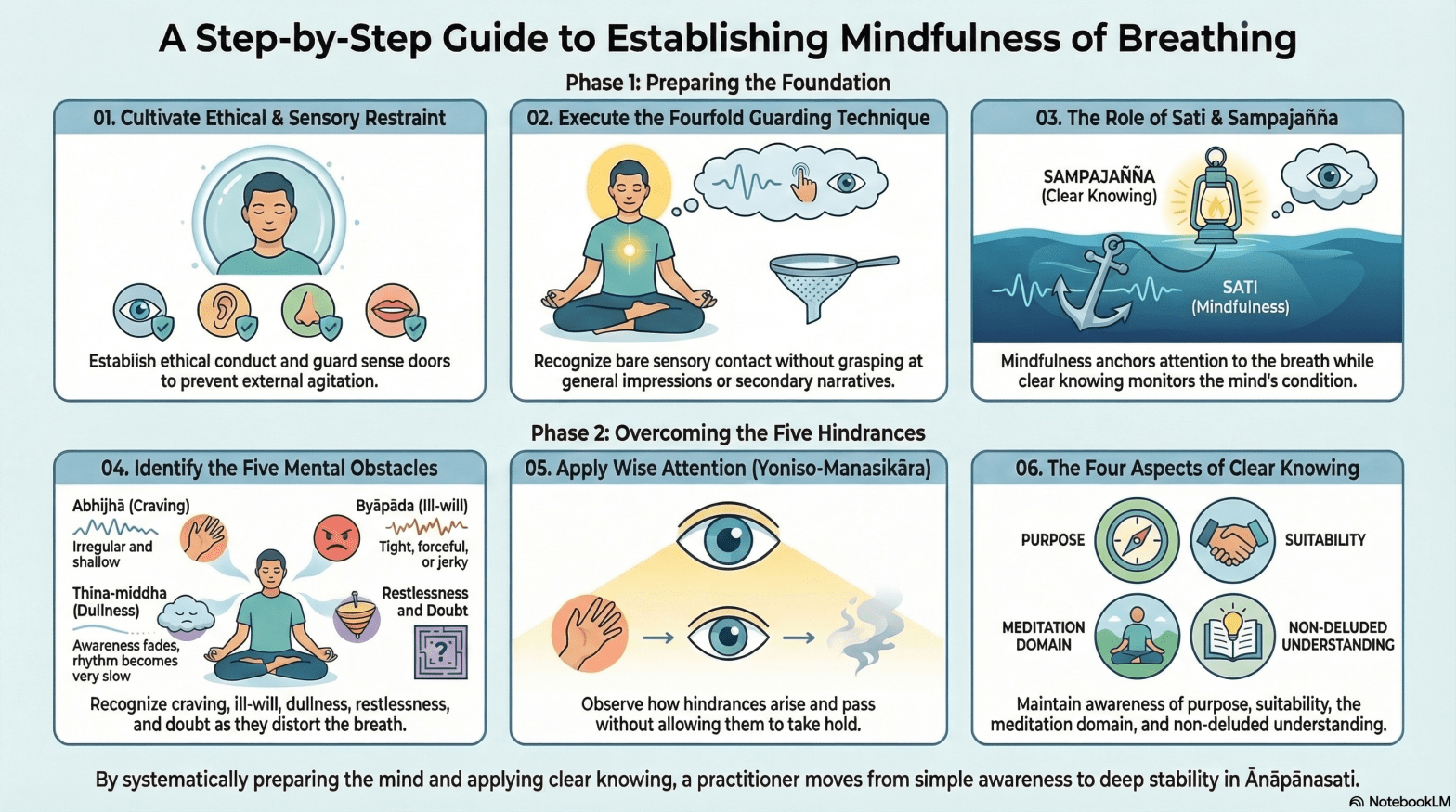
Mindfulness of breathing does not become stable immediately because the mind is usually covered by the five hindrances (pañca nīvaraṇāni) — abhijjhā (craving), byāpāda (ill-will), thīna-middha (sloth and torpor), uddhacca-kukkucca (restlessness and remorse), and vicikicchā (doubt). These mental obstacles disturb attention, making the breath difficult to observe continuously. Therefore, establishing mindfulness of the breath requires a gradual process in which these hindrances are recognized and weakened step by step. As craving pulls the mind toward pleasant objects, ill-will pushes it away from unpleasant ones, dullness sinks the mind into heaviness, restlessness scatters attention, and doubt disrupts confidence in the practice.
By patiently observing the breath and understanding these disturbances as they arise, the meditator gradually calms the body, steadies the mind, and purifies awareness. When the hindrances begin to fade, mindfulness becomes stable, the breath becomes smooth and subtle, and the mind naturally gathers into collectedness (samādhi). In this way, removing the hindrances step by step forms the essential foundation for the practice of Ānāpānasati, leading from simple awareness of breathing toward deeper concentration and insight.
Before mindfulness of breathing can become stable and removal of hindrances can happen, the mind must first be prepared through sīla (ethical conduct), indriya-saṁvara (guarding of the sense faculties), sati-sampajañña (mindfulness with clear knowing) and santuṭṭhiyā (contentment)
So iminā ca ariyena sīlakkhandhena samannāgato, iminā ca ariyena indriyasaṁvarena samannāgato, iminā ca ariyena satisampajaññena samannāgato, imāya ca ariyāya santuṭṭhiyā samannāgato, (DN2)
Without this foundation, the mind remains easily disturbed by sights, sounds, thoughts, and memories, allowing the five hindrances to arise repeatedly and scatter attention away from the breath. Ethical conduct quiets gross agitation and remorse, guarding the sense doors prevents the mind from constantly chasing external objects, and clear knowing maintains awareness of one’s bodily and mental activities throughout the day. When these supports are present, the mind becomes lighter, less reactive, and naturally inclined toward steadiness. In such a prepared state, establishing mindfulness of breathing (ānāpānasati) becomes possible, and the meditator can gradually recognize and abandon the hindrances step by step, allowing the breath to become calm and the mind to settle into collectedness (samādhi).
Before attempting to establish mindfulness of breathing, the Buddha repeatedly emphasizes the need to guard the sense doors (indriya-saṁvara). In many suttas, including the Sāmaññaphala Sutta, the training of a practitioner begins with ethical conduct and careful restraint at the six sense bases.
Buddha explains that when a practitioner sees a form with the eye, hears a sound with the ear, smells an odor, tastes a flavor, feels a touch, or cognizes a mental object, one does not grasp its sign (nimitta) or secondary details (anubyañjana) that give rise to attraction or aversion.
If the sense faculties remain unguarded, craving, irritation, and other unwholesome states quickly arise and disturb the mind. Therefore, by carefully observing how the mind reacts to sensory contact and by preventing it from chasing pleasant objects or resisting unpleasant ones, the practitioner protects the mind from agitation. When the sense doors are guarded in this way, the mind becomes calmer and less scattered, creating the proper foundation upon which mindfulness of breathing (ānāpānasati) can be established and developed.
In the training described in many suttas, including the Sāmaññaphala Sutta, Buddha explains that guarding the sense doors begins with not grasping the sign (nimitta) and not grasping the details or features (anubyañjana) of what is perceived. This means that when a form is seen with the eye, a sound heard with the ear, or a thought arises in the mind, the practitioner does not allow the mind to elaborate upon the object through liking, disliking, or imagination. The practice unfolds in a simple sequence.
First, one recognizes the bare contact at the sense door—seeing, hearing, smelling, tasting, touching, or thinking.
Second, one refrains from fixing attention on the sign (nimitta), which is the general impression that captures the mind and begins attraction or aversion.
Third, one avoids pursuing the secondary characteristics (anubyañjana)—the descriptive details, comparisons, memories, and narratives that the mind constructs around the object.
Fourth, one returns attention to the present awareness, preventing the mind from being carried away by excessive desire or irritation. By repeatedly practicing in this way, the senses remain guarded, the mind does not become overwhelmed by sensory impressions, and unwholesome states such as excessive desire and ill-will do not gain strength.
This restraint gradually creates the calm and clarity necessary for establishing mindfulness of breathing (ānāpānasati) and for weakening the five hindrances.
In the training described by Buddha, sati (mindfulness) and sampajañña (clear knowing) function together. When practicing mindfulness of breathing (ānāpānasati), sati keeps the attention anchored to the present experience of breathing, while sampajañña ensures that the mind clearly understands what is happening, why it is happening, and whether the practice is proceeding correctly. Thus breath meditation is not merely watching the breath mechanically; it is observing the breath with continuous knowing and wise awareness.
In practical terms, sati means maintaining steady awareness of the inhalation and exhalation—knowing when the breath begins, continues, and ends. The mind remains present with the natural rhythm of breathing without drifting into thoughts about the past or future. At the same time, sampajañña observes the condition of the mind during this process. It notices whether the mind is attentive or distracted, calm or agitated, dull or bright. When distraction, desire, irritation, or dullness arises, sampajañña recognizes it immediately, and mindfulness gently brings the attention back to the breath.
Buddha also describes four aspects of sampajañña, which can be applied while watching the breath. First is sātthaka-sampajañña, understanding the purpose of the practice—knowing that observing the breath is undertaken to calm the mind and weaken the hindrances. Second is sappāya-sampajañña, recognizing what is suitable—maintaining a posture, environment, and mental attitude that supports steady breathing awareness. Third is gocara-sampajañña, keeping the mind within its proper domain—the breath itself—without allowing attention to wander to external objects or internal narratives. Fourth is asammoha-sampajañña, non-deluded understanding—clearly seeing that the breath, the body, and the mental states arising around them are impermanent processes rather than something to cling to as “self.”
When sati and sampajañña work together, the meditator continuously knows: “Breathing in, I know I am breathing in; breathing out, I know I am breathing out.” At the same time, there is clear understanding of the state of the mind observing the breath. Through this balanced awareness, the practitioner prevents the five hindrances from taking hold, and mindfulness of breathing gradually becomes stable, calm, and deeply collected.
Once the mind is supported by sīla, indriya-saṁvara, and sati-sampajañña, the practitioner becomes ready to establish mindfulness of breathing (ānāpānasati).
The Four Aspects of Sampajañña with Breath
Sātthaka-sampajañña – Clear knowing the purpose of breath watching
Sātthaka means purposeful or meaningful. While breathing and moving through different postures, the practitioner knows: “I am watching the breath to calm the mind and weaken hindrances.”
The breath is not observed mechanically but for liberation from craving and agitation.
Application in postures
| Posture | Practice |
|---|---|
| Walking | know: “Walking with awareness of breathing to maintain mindfulness.” |
| Standing | maintain breath awareness instead of drifting into thoughts. |
| Sitting | observe inhalation and exhalation for calming the mind. |
| Lying down | remain aware of breathing instead of falling into unconscious sleep. |
Thus every posture is understood as supporting the purpose of mindfulness.
Sappāya-sampajañña: Clear knowing of suitability
Sappāya means what is beneficial or suitable. The practitioner observes whether conditions support breath awareness and questions internally noticed:
1️⃣ Is this posture supporting alert breathing awareness?
2️⃣ Is the mind becoming dull or restless?
Application with breath
| Situation | Adjustment |
|---|---|
| Breath becomes dull | straighten posture |
| Sleepiness while sitting | walk while observing breath |
| Restlessness | return to calm breathing |
Thus sampajañña continuously checks: “Is this helping mindfulness of breathing or weakening it?”
Gocara-sampajañña
Clear knowing of the meditation domain. Gocara means proper field or pasture.
For breath meditation the proper field is: the breathing body (assāsa-passāsa). Thus the practitioner keeps the mind within this domain.
Practical method: While performing daily activities:
walking → feel breathing while walking like puppet
standing → breathing awareness continues while one notices weight and pressure of standing
sleeping → aware of body touching bed and breath
sitting → awareness of body touching the pillow or floor or mat and breath entering and exiting
The mind does not wander into external objects or mental stories. Thus the breath remains the home base of awareness.
Asammoha-sampajañña – Clear knowing without delusion
Asammoha means non-confusion or clear understanding.
While breathing and moving through activities, the practitioner sees:
1️⃣ breathing arises and passes
2️⃣ bodily movements arise and pass
3️⃣ mental states arise and pass
Thus the practitioner understands:
this is just a process
not “I” or “mine” or “myself”
Insight during breathing
inhalation arises → passes
exhalation arises → passes
sensations on the body change moment by moment
feelings of senses change moment by moment based upon situations
Thus sampajañña becomes wisdom within mindfulness.
However, even after preparing this foundation, the mind may still be disturbed by the five hindrances (pañca nīvaraṇāni). These are the mental obstacles that prevent the mind from remaining steadily with the breath. The Buddha repeatedly explains that unless these hindrances are recognized and gradually abandoned, the mind cannot settle into collectedness (samādhi). Therefore, the meditator begins breath observation with a clear understanding of these hindrances and learns to identify them as soon as they arise.
The first hindrance is abhijjhā, the tendency of the mind to move toward pleasant objects with desire or covetousness. When this arises during breath watching, the attention leaves the breath and begins to imagine or pursue something attractive. The practitioner recognizes this movement of the mind and gently brings attention back to the breath, allowing the present experience of breathing to replace the pull of craving.
The second hindrance is byāpāda, ill-will or aversion. When the mind encounters something unpleasant—such as discomfort in the body, external sounds, or disturbing memories—it may react with irritation or resistance. This agitation disturbs the breath and scatters attention. By noticing this reaction and returning calmly to the natural rhythm of breathing, the meditator gradually softens the tendency toward aversion.
The third hindrance is thīna-middha, sloth and torpor. Here the mind becomes dull, heavy, or sleepy, and awareness of the breath fades. Recognizing this condition, the meditator brightens attention, straightens posture, and renews alert observation of the breathing process so that mindfulness becomes clear again.
The fourth hindrance is uddhacca-kukkucca, restlessness and remorse. In this state the mind jumps from one thought to another or repeatedly recalls past actions with regret. The breath becomes irregular and attention unstable. By patiently returning to the breath and allowing the body and mind to settle, this agitation gradually subsides.
The fifth hindrance is vicikicchā, doubt. The mind begins to question the practice, the method, or one’s own ability. Instead of directly observing the breath, the mind becomes caught in analysis and uncertainty. By returning again and again to the simple experience of inhalation and exhalation, confidence grows through direct observation.
Thus, in the practice of ānāpānasati, the meditator repeatedly observes the breath while recognizing and abandoning these five hindrances whenever they arise. As the hindrances gradually weaken, the breath becomes smooth and subtle, mindfulness becomes continuous, and the mind naturally gathers into calm and stability. In this way, the removal of the hindrances forms the essential step toward success in breath watching and the development of deeper concentration.
Let us build the framework of liberation through removal of hindrances in steps mentioned below by understanding the nature and how one need to let go.
Working with the Five Hindrances (pañca nīvaraṇāni) directly on the breath (ānāpānasati) is a very practical way to train the mind. Instead of treating hindrances as abstract concepts, the Buddha’s method allows us to observe how each hindrance distorts the breath, attention, and perception.
The five hindrances are:
1️⃣ Abhijjhā – covetousness / grasping desire
2️⃣ Byāpāda – ill-will / aversion
3️⃣ Thīna-middha – sloth and torpor
4️⃣ Uddhacca-kukkucca – restlessness and remorse
5️⃣ Vicikicchā – doubt
Let us begin with Abhijjhā
Etymology: abhi = toward, intensely or higher and ijjhati = to desire, to long for, to strive for
Thus: Abhijjhā = the mind leaning strongly toward an object wanting to possess it no matter how much burdensome it is. Not merely liking — but appropriating desire.
How Abhijjhā appears during breath meditation?
Even while watching the breath, the mind moves outward:
remembering pleasant food, thinking about money or success, imagining future pleasure, desire for praise or recognition or sensual imagery
In subtle meditation stages it may appear as:
desire for pleasant meditation experiences
1️⃣ craving for jhāna
2️⃣ craving for peaceful states
Thus even desire for meditation pleasure can become abhijjhā.
Abhijjhā changes the breathing pattern and typical signs are
| Breath quality | What happens |
|---|---|
| rhythm | becomes irregular |
| depth | becomes shallow |
| speed | often faster |
| attention | moves away from nostrils |
| body | subtle tension appears |
Buddha repeatedly emphasizes yoniso-manasikāra (wise attention).
During breath meditation check:
1️⃣ Is the mind leaning toward something pleasant?
2️⃣ Has the breath become secondary to imagination?
3️⃣ Is the mind projecting a future experience?
If yes → abhijjhā present.
Remedy – yoniso-manasikāra (wise attention)
Knowing whether it leads to bondage or liberation. Bondage as in “rebirth”
Summary
| Stage | What to do |
|---|---|
| desire appears | recognize |
| mind leaves breath | notice |
| pleasant image arises | observe |
| return | feel breath again |
| repeat | gradually weakens craving |
Byāpāda
vi + ā + pad wherein pad = to strike, step upon, attack and ā = toward whereas vi = in a distorted or hostile manner. Thus: Byāpāda = a mental movement that wants to strike, reject, push away or harm.
How byāpāda appears during breath meditation? While sitting with the breath, the mind may suddenly generate: anger toward someone, resentment from past events, irritation toward sounds, dislike of body pain or resistance toward the meditation itself
Subtle forms: annoyance at small disturbances, judging other meditators, irritation with breathing sensations and rejecting unpleasant thoughts. Aversion changes the breath strongly and common patterns are:
| Breath aspect | Change |
|---|---|
| rhythm | jerky |
| depth | forceful or tight |
| chest | contracted |
| exhalation | stronger than inhalation |
| body | heat and pressure |
Due to this, breath becomes hard, sharp, and irregular.
Early signs of Byāpāda in meditation
Watch for these indicators:
1️⃣ Breath becomes forceful
2️⃣ Face muscles tighten
3️⃣ Jaw or throat contracts
4️⃣ Mind starts arguing internally
5️⃣ Replaying conversations or conflicts
These are clear markers that aversion has entered the mind-field.
Ask internally:
1️⃣ Is the mind rejecting something?
2️⃣ Is there a mental pushing away?
3️⃣ Is irritation building?
Remedy – yoniso-manasikāra (wise attention)
Knowing whether it leads to bondage or liberation. Bondage as in “rebirth”
Also, since it is aversion and anger, need to be aware that it will lead to bad rebirth
Step by step approach
1️⃣ Acknowledge the hostility
2️⃣ What kind of breath is happening
3️⃣ Lengthen the exhalation naturally to let go of aversion/hostility
4️⃣ Observe the fading
Important insight for practitioners – Buddha emphasized that ill-will is extremely harmful because it burns in the mind first before harming others. Thus,
anger hurts the one who holds it
letting go immediately restores calm
The first two hindrances we have covered
| Hindrance | Distortion of breath |
|---|---|
| Abhijjhā | restless and shallow breathing |
| Byāpāda | tight and forceful breathing |
Thīna–Middha (Sloth and Torpor) – This hindrance represents mental dullness and heaviness. and appears when the mind loses sharpness and energy while watching the breath.
This hindrance is actually two closely connected conditions.
Thīna– From the root “thī” which means stiff, inert or sluggish. Thus thīna = inertia of the mind.
Middha which is derived from “mid” which means sleepiness, sinking or drooping and thus middha = heaviness of the body leading toward sleep.
While observing breathing, the following may occur: attention fades, breath becomes vague, mind feels foggy, posture collapses and sleepiness increases
Typical signs: head nodding, blurred awareness, losing track of breaths or drifting into dream-like thoughts and this is the mind sinking into dullness.
What happens to the breath when Thīna–Middha arises
Breath changes significantly and the common pattern are:
| Breath aspect | Change |
|---|---|
| rhythm | very slow |
| clarity | difficult to detect |
| awareness | fades |
| posture | chest collapses |
The breath may become too subtle for a dull mind to detect and a meditator thinks that the breath has become subtle or disappeared, however, his mindfulness is lost
Early warning signs of Thīna–Middha
Before sleepiness fully develops, certain indicators appear:
1️⃣ Awareness becomes blurred
2️⃣ Breath sensation becomes unclear
3️⃣ Thoughts become dream-like
4️⃣ Eyes want to close heavily
These are the first signals of dullness.
Practical way of working based upon sutta
1️⃣ Keep spine straight and don’t keeps eyes closed
2️⃣ Keep mind focussed on breath at entrance of nostril or chest or abdomen and do not change again and again
3️⃣ Bring light by slightly centering the eyes if eyes are closed
4️⃣ Keep awareness of sounds, air touching the body
Uddhacca–Kukkucca (Restlessness and Remorse)
Uddhacca – restlessness and agitation while Kukkucca refers to worries and guilt consciousness. These both create mental instability as uddhacca refers to the future and kukkucca refers to past
Etymology – ud + dhacc where ud = upward, outward while dhacc = shaking or agitation
uddhacca = a mind that jumps upward and outward repeatedly.
kuk + kṛ (kar) means repeated regret, mental self-reproach or worrying about mistakes
kukkucca = the mind repeatedly replaying past actions with regret
While watching the breath, the mind may suddenly begin:
planning future activities, jumping from idea to idea, remembering unfinished work, replaying past conversations, worrying about mistakes
Typical patterns:
planning tomorrow, thinking about responsibilities, revisiting past errors or analyzing meditation progress
The mind cannot stay with the breath for more than a few seconds.
Early signs of Uddhacca
Watch for these indicators:
1️⃣ mind jumps to new topics repeatedly
2️⃣ attention leaves breath every few seconds
3️⃣ body feels slightly restless
4️⃣ urge to move posture
These are early signals that restlessness is forming.
Early signs of Kukkucca
Indicators include:
1️⃣ remembering mistakes
2️⃣ guilt about past actions
3️⃣ regret about speech or behavior
4️⃣ mental self-criticism
Examples:
I should not have said that, why did I do that yesterday? or i wasted time earlier
How to stop both of them through yoniso-manasikara?
1️⃣ Watch the agitation and fear
2️⃣ Narrow the attention to the breath or bring out the qualities of buddha, dhamma and sangha
3️⃣ Slow down the observation – breath or the qualities of buddha, dhamma and sangha
4️⃣ Watch for subtle tension – body and mind and resolve them
5️⃣ Keep promise of not breaking the sila by maintaining hiri and ottappa to stop mental remorse
What do we see in these four hindrances while watching breath?
| Hindrance | Breath pattern |
|---|---|
| Abhijjhā | restless and craving-driven breathing |
| Byāpāda | tight and heated breathing |
| Thīna-middha | fading and dull breathing |
| Uddhacca-kukkucca | irregular and unstable breathing |
Vicikicchā (Doubt)
root: vi + cikicch
cikicchā = examining, investigating
vi = divided, scattered
vicikicchā = a mind divided by excessive uncertainty or indecision
Doubt appears relating to following:
1. Path and how to do it?
2. Traditions and which one is right for me?
3. Process of meditation – closed eyes on cushion and is there any other method?
4. Body sensations
5. Conditions that has to be met?
Buddha explains all of these in 3 parts – doubt on the teacher or teachings or people associated with it – buddha, dhamma and sangha.
How to stop using yoniso-manasikara?
Firstly, we need to know what is yoniso-manasikara. Yoniso means from the matrix or origin and manasikara is to make up the mind along with sati-sampajañña. This is covered in a different essay and can be accessed here