
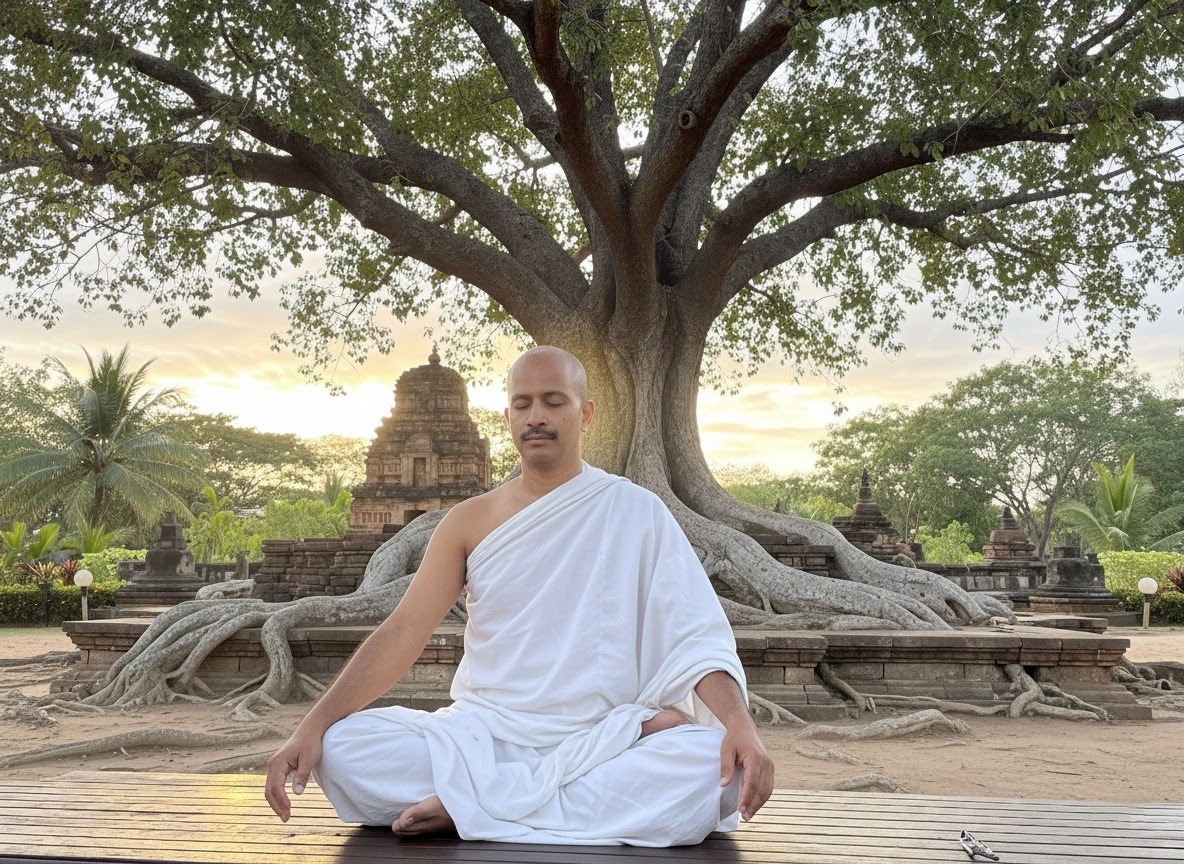
by anagārika Vilas Kadival
- What is jhāna?
- 1st to 8th Jhåna & Nirodha
- Type of happiness
- HRV & Jhana
- Anåpanasati
- Schedule for meditation
- Disorders
- General guidelines & Result
- Detailed Summary
- FAQ
- Book to read
What is meditation or jhāna?
Meditation involves three things:
1. Samatha – Tranquility of mind through breath awareness
2. Vipassana – Insight into the dhamma or things created and seeing the nature as in anicca, dukkha and anattā
3. Anupassana – Deep dive and investigate. When Anupassana happens, the defilements (asavas) get eliminated.
Thus, with meditation, one is able to get rid of greed, hatred and delusion which brings in “voidness” which is when nibbanā is experienced.
This needs to be achieved over a period of 18 hours in a day keeping breath as the object of contemplation.
What is Jhāna?
The Pāli term “Jhāna” (Sanskrit: Dhyāna) is derived from the root “jha-“, meaning “to meditate, contemplate, or burn away mental defilements”.
Thus, jhāna is a state of deep absorption where the mind is fully unified, free from distractions, and intensely focused.
According to the Jhāna Vibhaṅga, jhāna is defined as:
“Mental unification accompanied by the five factors: vitakka (initial debate), vicāra (sustained thought), pīti (joy), sukha (happiness), and ekaggatā (oneness).”
Jhāna arises when these five factors work together, leading to deep and unwavering samādhi.
🔹 The Five Jhāna Factors (Jhānaṅga)
The Jhāna Vibhaṅga explains that five factors (jhānaṅga) must be present for the attainment of first jhāna. Each of these factors removes a corresponding hindrance:
| Jhāna Factor (Jhānaṅga) | Meaning | Function | Overcomes |
|---|---|---|---|
| Vitakka | Internal debate | Directs attention to the breath or meditation object | Sloth & Torpor (Thīna-Middha) |
| Vicāra | Sustained thought | Maintains attention on the object, preventing distraction | Doubt (Vicikicchā) |
| Pīti | Joy | Deep meditative happiness, energizing the mind | Ill Will (Vyāpāda) |
| Sukha | Happiness | Comfortable bliss, stabilizing the meditation | Restlessness & Worry (Uddhacca-Kukkucca) |
| Ekaggatā | Oneness | Total unification of mind in the object | Sensual Desire (Kāmacchanda) |
How the Jhāna Factors Evolve Through the Four Jhānas?
The Jhāna Vibhaṅga explains how these factors change as one progresses deeper:
Jhāna Level Present Factors Absent Factors
1st Jhāna → Vitakka, Vicāra, Pīti, Sukha, Ekaggatā (All five present)
2nd Jhāna → Pīti, Sukha, Ekaggatā Vitakka & Vicāra drop
3rd Jhāna → Sukha, Ekaggatā Pīti fades away
4th Jhāna → Upekkhā, Ekaggatā Sukha fades, replaced by neutral equanimity
✅ First Jhāna → The mind is still coarse and requires mental effort.
✅ Second Jhāna → Thought activity stops, leaving pure joy & happiness.
✅ Third Jhāna → Joy fades, leaving only deep peace.
✅ Fourth Jhāna → Even happiness dissolves, replaced by perfect equanimity.
This progressive refinement is what allows the mind to eventually move into formless jhānas.
Core Principles of Integrating Jhāna with Walking & Standing Meditation
Walking meditation is not a break from jhāna—it is a way to deepen it.
The 2nd, 3rd, and 4th jhānas can be maintained while walking & standing.
The first three formless jhānas (arūpa jhānas)—Infinite Space, Infinite Consciousness, and Nothingness—can also be entered with Walking and Standing apart from Sitting.
📜 Pāli Text (Completed with Explanation from Jhanasutta AN9.36)
Idha, bhikkhave, bhikkhu vivicceva kāmehi, vivicca akusalehi dhammehi, savitakkaṁ savicāraṁ pītisukhaṁ pathamajjhānaṁ upasampajja viharati.
So yadeva tattha hoti rūpagataṁ vedanāgataṁ saññāgataṁ saṅkhāragataṁ viññāṇagataṁ,
te dhamme aniccato dukkhato rogato gaṇḍato sallato aghato ābādhato parato palokato suññato anattato samanupassati.
So tehi dhammehi cittaṁ paṭivāpeti.
So tehi dhammehi cittaṁ paṭivāpetvā amatāya dhātuyā cittaṁ upasaṁharati: ‘etaṁ santaṁ etaṁ paṇītaṁ yadidaṁ sabbasaṅkhārasamatho sabbūpadhipaṭinissaggo taṇhākkhayo virāgo nirodho nibbānan’ti.
So tattha ṭhito āsavānaṁ khayaṁ pāpuṇāti. No ce āsavānaṁ khayaṁ pāpuṇāti, teneva dhammarāgena tāya dhammanandiyā pañcannaṁ orambhāgiyānaṁ saṁyojanānaṁ parikkhayā opapātiko hoti tattha parinibbāyī anāvattidhammo tasmā lokā.
📖 Detailed Explanation
This passage describes the process of attaining the first jhāna, applying insight, and progressing towards liberation. Let’s analyze it line by line.
1️⃣ Entering the First Jhāna
Idha, bhikkhave, bhikkhu vivicceva kāmehi, vivicca akusalehi dhammehi, savitakkaṁ savicāraṁ pītisukhaṁ pathamajjhānaṁ upasampajja viharati.
🔹 Meaning:
“Here, bhikkhus, a monk, having secluded himself from sensual pleasures (kāmehi), having secluded himself from unwholesome states (akusalehi dhammehi), enters and dwells in the first jhāna, which is accompanied by applied thought (vitakka) and sustained thought (vicāra), with rapture (pīti) and pleasure (sukha) born of seclusion.”
🔹 Explanation:
The prerequisite for jhāna is vivicceva kāmehi (seclusion from sensual pleasures) and vivicca akusalehi dhammehi (seclusion from unwholesome states).
The first jhāna is characterized by:
Vitakka (Debated thought) → Directing the mind to the meditation object.
Vicāra (Sustained thought) → Maintaining attention on the object.
Pīti (Joy) → The uplifting happiness of deep meditation.
Sukha (Pleasure) → The blissful bodily ease arising from concentration.
🚀 Key Point:
Jhāna requires strong seclusion and complete withdrawal from external distractions.
2️⃣ Insight into Impermanence and Non-Self
So yadeva tattha hoti rūpagataṁ vedanāgataṁ saññāgataṁ saṅkhāragataṁ viññāṇagataṁ,
te dhamme aniccato dukkhato rogato gaṇḍato sallato aghato ābādhato parato palokato suññato anattato samanupassati.
🔹 Meaning:
“Whatever exists therein (in the jhāna) belonging to form (rūpa), feeling (vedanā), perception (saññā), mental formations (saṅkhāra), and consciousness (viññāṇa), he perceives those phenomena as: impermanent (anicca), suffering (dukkha), a disease (roga), a boil (gaṇḍa), a dart (salla), an affliction (ābādha), alien (parato), disintegrating (palokato), empty (suññato), and non-self (anattato).”
🔹 Explanation:
Even while in jhāna, the meditator analyzes the experience with insight.
The five aggregates (khandhas) present in jhāna are seen as:
Impermanent (anicca) → Even deep concentration states arise and pass.
Suffering (dukkha) → All conditioned states are ultimately unsatisfactory.
A disease (roga) & a dart (salla) → Attachment to these states causes suffering.
Empty (suññato) & Non-Self (anattato) → These states are not “me” or “mine.”
🚀 Key Point:
Deep insight must be applied even in absorption, leading to detachment from conditioned experiences.
3️⃣ Detaching the Mind and Inclining Towards Nibbāna
So tehi dhammehi cittaṁ paṭivāpeti.
So tehi dhammehi cittaṁ paṭivāpetvā amatāya dhātuyā cittaṁ upasaṁharati: ‘etaṁ santaṁ etaṁ paṇītaṁ yadidaṁ sabbasaṅkhārasamatho sabbūpadhipaṭinissaggo taṇhākkhayo virāgo nirodho nibbānan’ti.
🔹 Meaning:
“He withdraws his mind from those phenomena. Having withdrawn his mind from them, he directs his mind towards the deathless element (Nibbāna), thinking: ‘This is peaceful, this is sublime, that is, the calming of all formations (sabbasaṅkhārasamatho), the relinquishing of all acquisitions (sabbūpadhipaṭinissaggo), the destruction of craving (taṇhākkhayo), dispassion (virāgo), cessation (nirodho), Nibbāna.’”
🔹 Explanation:
The meditator lets go of attachment to even the bliss of jhāna.
The mind inclines towards the unconditioned (Nibbāna).
This is the key transition from samatha to insight (vipassanā).
🚀 Key Point:
Jhāna alone does not lead to liberation—it must be combined with insight (paññā).
4️⃣ Final Liberation or Non-Returner Status
So tattha ṭhito āsavānaṁ khayaṁ pāpuṇāti. No ce āsavānaṁ khayaṁ pāpuṇāti, teneva dhammarāgena tāya dhammanandiyā pañcannaṁ orambhāgiyānaṁ saṁyojanānaṁ parikkhayā opapātiko hoti tattha parinibbāyī anāvattidhammo tasmā lokā.
🔹 Meaning:
“Standing there, he attains the destruction of the taints (āsavā) and becomes an Arahant. If he does not attain full destruction of the taints, then, due to his attachment to the Dhamma (dhammarāga) and delight in it (dhammanandi), he destroys the five lower fetters and is reborn spontaneously (in the Pure Abodes) as a Non-Returner (Anāgāmī), never returning to this world.”
🔹 Explanation: If full enlightenment (Arahantship) arises, all āsavas (mental corruptions) are destroyed.
If not, but strong insight develops, he attains Anāgāmī status, bypassing future rebirth in lower realms.
🚀 Key Point:
Jhāna + Insight either leads to full enlightenment or guarantees rebirth in the highest realms.
How to practice until 8th jhanā with breath
Refer to jhanasutta which is very important to get into this practice
Preliminary steps:
Before attempting long-duration meditation, it is crucial to:
Strengthen Sīla (Morality) – Without pure ethical conduct, deep concentration will be unstable.
Follow at least the Five Precepts (pañca-sīla) strictly.
Develop a Supportive Routine
Practice in a quiet, secluded place (like a retreat or monastery).
Minimize distractions (no talking, reading, or engaging with the world).
Eat light and simple food (heavy food makes the mind dull).
Build Up Endurance
Start with 4-6 hours per day in three postures, gradually extending to 10-12 hours before attempting 18+ hours.
Develop sukha (mental joy) in meditation to avoid struggle.
Primary Objective: Establishing unwavering mindfulness on the breath in all 4 postures for 18 hours
✅ Key Steps:
Sit in a comfortable, stable posture with a straight back.
Breathe naturally without forcing it.
Observe the touch of the breath at the nostrils (not the whole body).
Keep the attention on the natural inhalation and exhalation.
If the mind wanders, gently bring it back.
🚀 Signs of Progress:
Breath becomes subtle.
Thoughts slow down.
Distractions reduce.
Primary Objective: Overcoming the Five Hindrances (pañca-nīvaraṇa).
Sensual Desire (kāmacchanda) → Ignore bodily sensations and stay absorbed in breath.
Ill Will (vyāpāda) → Cultivate loving-kindness (mettā).
Restlessness (uddhacca-kukkucca) → Slow down; observe breath with calm patience.
Sloth & Torpor (thīna-middha) → Sit with an upright posture, keep the breath energized.
Doubt (vicikicchā) → Trust the process and continue without evaluation.
🚀 Signs of Progress:
The breath feels light and effortless.
Hindrances no longer disturb the mind.
The mind enjoys deep silence.
Entering into 1st Jhana – Initial Absorption
✅ Signs of Readiness:
The breath becomes subtle and refined.
External sounds and bodily discomfort disappear.
The mind is fully absorbed in the breath.
✅ How to Enter:
Focus entirely on the breath at the nostrils and in the body while sitting / standing / walking
Let go of wandering thoughts.
Experience pīti (joyful rapture) and sukha (happiness) arising naturally.
The five hindrances (sensual desire, ill will, sloth, restlessness, doubt) completely fade.
Stay immersed in pīti and sukha.
✅ Key Features of the 1st Jhāna:
Applied and sustained attention (vitakka & vicāra) which is only on breath
Joy (pīti) and happiness (sukha) dominate.
No distractions from external stimuli.
✅ How to Strengthen:
Continue immersing in joy without excitement.
Remain detached from the pleasure—don’t crave it
2nd Jhāna – Deepening of Absorption
✅ Transition from 1st to 2nd Jhāna:
Drop vitakka & vicāra (applied and sustained thought on breath) in all 3 postures
Stillness deepens, the mind becomes effortless.
Joy (pīti) becomes stronger and more stable.
✅ Key Features of the 2nd Jhāna:
No mental talk—only pure, undistracted joy.
Mind is fully locked into the breath.
Joy (pīti) dominates even more than in 1st Jhāna.
✅ How to Strengthen:
Allow the mind to rest naturally without effort.
Stay centered in joy without getting overexcited.
3rd Jhāna – Tranquility and Contentment
✅ Transition from 2nd to 3rd Jhāna:
Let go of intense joy (pīti).
Experience deep happiness (sukha), but calmer than before in sitting / walking or standing posture
✅ Key Features of the 3rd Jhāna:
Peaceful and quiet, like floating in still water.
Equanimity (upekkhā) begins to develop.
No excitement, just deep happiness and contentment.
✅ How to Strengthen:
Let go of pleasure-seeking.
Rest in subtle happiness without clinging.
4th Jhāna – Perfect Equanimity
✅ Transition from 3rd to 4th Jhāna:
Let go of happiness (sukha).
Replace it with pure equanimity (upekkhā).
The breath almost disappears and can be experienced quite clearly while sitting.
✅ Key Features of the 4th Jhāna:
No more happiness or discomfort—only neutral awareness.
Deep stillness and clarity.
Perfect balance of mind—not excited, not bored.
✅ How to Strengthen:
Rest effortlessly in deep tranquility.
Stay aware of neutral feeling (adukkhamasukha vedanā).
Common Obstacles in all Jhānas & How to Overcome Them
| Obstacle | Solution |
|---|---|
| Restlessness (uddhacca) | Slow down, walk evenly and steadily or sit or stand |
| Drowsiness (thīna-middha) | Increase energy, walk briskly before slowing down and do not sit |
| Distractions | Keep attention anchored on breath by reducing the eye gaze while seeing the road or path |
| Excitement in 1st & 2nd Jhāna | Focus on calmness, not joy in any of the 3 postures |
| Craving for Jhāna states | Stay detached, let things happen naturally. Watch arising and passing away of these feelings |
Understanding the Formless Jhānas (Āruppa Jhānas) in Sitting, Walking, and Standing Meditation
The four formless jhānas (arūpa-jhānas) are deeper absorptions beyond the fourth jhāna, where the mind transcends material perception and enters progressively more refined states of awareness. These can be accessed not only in seated meditation but also while walking and standing if one’s concentration is strong enough.
1️⃣ 5th Jhāna – The Base of Infinite Space (Ākāsānañcāyatana)
✅ Key Shift: Awareness expands infinitely, body awareness disappears.
✅ How to Know You Have Entered?
You no longer feel the body—only vast, open space.
The breath is completely gone.
It feels like floating in endless emptiness.
📍 How to Enter in Sitting:
From 4th Jhāna, drop attention from breath and focus on spaciousness.
Allow awareness to expand outward—like looking at the sky without limits.
Let go of any sensation of “inside” or “outside”—just vast openness.
🚶 How to Enter in Walking:
Focus on the space around you rather than the movement.
Feel as if you are walking inside infinite emptiness.
Let go of all body sensations—just movement within vast space.
🧍 How to Enter in Standing:
Feel your body dissolving into open space while standing still.
Stay aware of the boundless space around you without a fixed reference.
The mind remains fully expansive—not focused on the body.
2️⃣ 6th Jhāna – The Base of Infinite Consciousness (Viññāṇañcāyatana)
✅ Key Shift: Awareness shifts from space to boundless knowing.
✅ How to Know You Have Entered?
The sense of space disappears, leaving only awareness of knowing itself.
There is no external or internal reference—just pure, luminous awareness.
Space was an object before—now, only the knower remains.
📍 How to Enter in Sitting:
From Infinite Space, shift focus to awareness itself.
Instead of expanding space, become aware of the knowing of that space.
Let go of any sense of expansion—just pure boundless consciousness remains.
🚶 How to Enter in Walking:
Instead of focusing on movement or space, shift to pure knowing of each step.
The act of walking becomes secondary—only the knowing of it exists.
The perception of the physical body completely disappears.
🧍 How to Enter in Standing:
Shift from awareness of space to awareness of knowing.
Feel that even the standing posture is “known” rather than experienced.
The mind is fully absorbed in boundless awareness.
3️⃣ 7th Jhāna – The Base of Nothingness (Ākiñcaññāyatana)
✅ Key Shift: Awareness drops into pure nothingness.
✅ How to Know You Have Entered?
No longer aware of consciousness itself—only a vast empty void.
Feels like the mind “falls into” total absence.
Awareness is still present, but there is no content at all.
📍 How to Enter in Sitting:
From Infinite Consciousness, drop all awareness of knowing.
Instead of boundless knowing, focus on “not-knowing” or “nothing there”.
Let everything fade until only an empty void remains.
🚶 How to Enter in Walking:
The sense of consciousness disappears, leaving only movement without identity.
Walking feels like floating inside a void, without reference points.
Let go of even the experience of walking—just void remains.
🧍 How to Enter in Standing:
Let go of even the knowing of standing.
Awareness is not even aware of itself anymore—only an empty vastness remains.
It is like standing inside a total void.
4️⃣ 8th Jhāna – The Base of Neither Perception nor Non-Perception (Nevasaññānāsaññāyatana)
✅ Key Shift: Awareness becomes so subtle that it almost disappears.
✅ How to Know You Have Entered?
No clear sense of perception, yet not totally gone.
Awareness is barely noticeable, as if it is on the edge of existing.
The mind is so still that almost nothing is happening.
📍 How to Enter in Sitting:
From Nothingness, drop even the perception of nothingness.
Awareness becomes so refined that it is nearly imperceptible.
There is neither clear perception nor total non-perception.
🚶 How to Enter in Walking:
Movement happens, but awareness is barely present.
Walking is so refined that it is almost non-existent.
You are walking, but there is almost no one aware of it.
🧍 How to Enter in Standing:
Mind becomes so still that standing is just a concept.
No perception of body, breath, space, or consciousness—just a subtle edge of being.
The experience defies clear description—it is almost nothing, yet still something.
Let us now understand Saññāvedayitanirodhasamāpatti
Saññā (सञ्ञा) → Perception
Vedayita (वेदयित) → Feeling (or Sensation)
Nirodha (निरोध) → Cessation
Samāpatti (समापत्ति) → Attainment
Thus, the term means “the attainment of cessation of perception and feeling.” This is not merely a suppression of the mind but a complete temporary cessation of mental activity—a profound stillness where even the subtlest formations (saṅkhāra) cease.
How is it Attained?
To enter this state, one must fulfill strict prerequisites:
(A) Mastery of Jhānas and Arūpa Jhānas
The meditator must have fully mastered all eight jhānas, including the four rūpa-jhānas (material absorptions) and the four arūpa-jhānas (formless absorptions).
Specifically, one must be proficient in the eighth jhāna (Neither Perception nor Non-Perception), where mental activity is already at an extremely subtle level.
(B) Development of Supramundane Insight (Vipassanā)
Jhānic attainment alone is not enough; the meditator must have deep vipassanā insight into impermanence (anicca), suffering (dukkha), and non-self (anattā).
This means that only an anāgāmī (non-returner) or arahant (fully enlightened being) can enter this state because their insight into reality is fully developed.
(C) The Process of Entry
Before entering nirodha-samāpatti, the meditator resolves to stay in this state for a specific duration (hours or days).
The mental activity (citta) gradually slows down until it completely ceases.
The five aggregates (pañcakkhandha) temporarily stop functioning, meaning there is no perception (saññā) or feeling (vedanā).
What Happens in this State?
No mental formations arise – unlike in even the highest jhāna, where subtle awareness still persists.
The heart and breathing slow down significantly but do not entirely stop.
No consciousness (viññāṇa) is active—it is a state beyond awareness.
The body remains alive due to past karmic energy (kammic force), but the mind is completely shut down.
It is not unconsciousness in the ordinary sense but rather a profound transcendence of conditioned experience.
Exiting from Nirodha-Samāpatti
After the predetermined time, the meditator automatically emerges from this state.
Upon emerging, there is an immediate experience of fruition consciousness (phalasamāpatti), meaning the person experiences nibbānic bliss.
For an arahant, this state is followed by a deep sense of equanimity (upekkhā) and detachment.
The body may feel incredibly light and refreshed, free from the usual burden of mental formations.
Who Can Attain It? Only Anāgāmīs and Arahants:
A stream-enterer (sotāpanna) or once-returner (sakadāgāmī) cannot attain nirodha-samāpatti because their insight is not yet strong enough.
Anāgāmīs and arahants have eliminated sensual craving (kāmarāga), which is a major obstacle.
Mastery of Jhānas:
Even within the category of enlightened beings, only those who have perfected the eight jhānas can attain this state.
Some arahants who follow the wisdom path (who attain enlightenment without jhāna) cannot access nirodha-samāpatti.
How is it Different from Nibbāna?
Nirodha-samāpatti is temporary—it is a cessation state within saṃsāra.
Nibbāna is permanent cessation, where the aggregates never arise again after parinibbāna.
Nirodha-samāpatti does not destroy rebirth—it is a temporary cessation, whereas nibbāna ends all becoming (bhava).
An arahant who enters this state still returns to normal consciousness, whereas after parinibbāna, there is no return.
What is the Significance?
It demonstrates the complete mastery over the mind, where even consciousness itself can be temporarily stopped.
It is a foretaste of parinibbāna (final liberation), where the aggregates fully dissolve permanently.
The Buddha himself praised this attainment as the highest level of peace and bliss in conditioned existence.
🔹 Overview of the Four Formless Jhānas (Arūpa-Jhānas)
| Jhāna | Pāli Name | Experience in Sitting, Walking, and Standing | Key Shift from Previous State |
|---|---|---|---|
| 5th Jhāna | Ākāsānañcāyatana (Base of Infinite Space) | Awareness expands into boundless space | Awareness of body disappears |
| 6th Jhāna | Viññāṇañcāyatana (Base of Infinite Consciousness) | Awareness shifts to boundless knowing | No longer focused on space, only on pure awareness |
| 7th Jhāna | Ākiñcaññāyatana (Base of Nothingness) | Mind lets go of even consciousness and sinks into vast, empty nothingness | Awareness becomes extremely subtle |
| 8th Jhāna | Nevasaññānāsaññāyatana (Base of Neither Perception nor Non-Perception) | Mind reaches an almost imperceptible state | Even the perception of nothingness fades |
Let us understand type of happiness as per Buddha as explained in SN36.31_Nirāmisasutta and its correlation with brain positive chemicals as in Dopamine, Serotonin, Oxytocin and Endorphin.
Let’s first understand about samisa. Samisa = sa + misa; which means combined by and in this, it is sensual.
Explanation of Sensual Joy (Sāmisā Pīti)
“Katamā ca, bhikkhave, sāmisā pīti?”
“And what, O Bhikkhus, is sensual joy?”
“Pañcime, bhikkhave, kāmaguṇā. Katame pañca?”
“There are these five strands of sensual pleasure (kāmaguṇā). What are these five?”
The Buddha explains that sensual joy comes from the five sense objects:
Forms (rūpā)—beautiful and desirable sights perceived through the eyes.
Sounds (saddā)—pleasing and melodious sounds heard through the ears.
Smells (gandhā)—fragrant and enjoyable scents.
Tastes (rasā)—delicious and pleasurable flavors.
Touches (phoṭṭhabbā)—pleasant bodily sensations.
“Yā kho, bhikkhave, ime pañca kāmaguṇe paṭicca uppajjati pīti, ayaṁ vuccati, bhikkhave, sāmisā pīti.”
“The joy that arises dependent on these five sense objects is called sensual joy (sāmisā pīti).”
This joy is worldly and dependent on external stimuli.
Explanation of Non-Sensual Joy (Nirāmisā Pīti)
“Katamā ca, bhikkhave, nirāmisā pīti?”
“And what, O Bhikkhus, is non-sensual joy?”
“Idha, bhikkhave, bhikkhu vivicceva kāmehi vivicca akusalehi dhammehi…”
“Here, a Bhikkhu, having secluded himself from sensual pleasures and unwholesome states…”
The Buddha describes meditative joy (jhānic joy), which arises from deep concentration.
In first jhāna, the joy (pīti) and happiness (sukha) are born from seclusion.
In second jhāna, joy and happiness arise from deeper mental unification, without discursive thought.
“Ayaṁ vuccati, bhikkhave, nirāmisā pīti.”
“This is called non-sensual joy (nirāmisā pīti).”
This joy is inner and independent of external sense pleasures.
Explanation of the Most Refined Non-Sensual Joy (Nirāmisā Nirāmisatarā Pīti)
“Katamā ca, bhikkhave, nirāmisā nirāmisatarā pīti?”
“And what, O Bhikkhus, is the most refined non-sensual joy?”
“Yā kho, bhikkhave, khīṇāsavassa bhikkhuno rāgā cittaṁ vimuttaṁ paccavekkhato…”
“When a Bhikkhu who has destroyed the taints (khīṇāsava) reflects on the liberation of his mind from lust, hatred, and delusion…”
This joy arises from the direct realization of liberation (Arahantship).
It is beyond all attachment and comes from knowing that the mind is fully freed from defilements.
“Ayaṁ vuccati, bhikkhave, nirāmisā nirāmisatarā pīti.”
“This is called the most refined non-sensual joy.”
This is the ultimate, unconditioned joy.
Explanation of Different Types of Happiness (Sukha)
Sensual happiness (sāmisaṁ sukhaṁ) arises from the five sense pleasures.
Non-sensual happiness (nirāmisaṁ sukhaṁ) arises from deep meditation.
The most refined non-sensual happiness (nirāmisā nirāmisataraṁ sukhaṁ) arises from reflecting on liberation.
Explanation of Different Types of Equanimity (Upekkhā)
Sensual equanimity (sāmisā upekkhā) is indifference within worldly pleasures.
Non-sensual equanimity (nirāmisā upekkhā) is developed in the fourth jhāna, where neither pleasure nor pain is felt.
The most refined non-sensual equanimity (nirāmisā nirāmisatarā upekkhā) arises in an enlightened one who has fully eradicated craving.
Explanation of Different Types of Liberation (Vimokkho)
Sensual liberation (sāmiso vimokkho) is associated with form (e.g., celestial realms based on merit).
Non-sensual liberation (nirāmiso vimokkho) is formless meditation attainments (arūpajhāna).
The most refined non-sensual liberation (nirāmisā nirāmisataro vimokkho) is the ultimate freedom of the Arahant, free from all defilements.
Let us now go detailed into the sutta
“Atthi, bhikkhave, sāmisā pīti, atthi nirāmisā pīti, atthi nirāmisā nirāmisatarā pīti; atthi sāmisaṁ sukhaṁ, atthi nirāmisaṁ sukhaṁ, atthi nirāmisā nirāmisataraṁ sukhaṁ; atthi sāmisā upekkhā, atthi nirāmisā upekkhā, atthi nirāmisā nirāmisatarā upekkhā; atthi sāmiso vimokkho, atthi nirāmiso vimokkho, atthi nirāmisā nirāmisataro vimokkho.”
“There is, O Bhikkhus, sensual joy (sāmisā pīti), there is non-sensual joy (nirāmisā pīti), and there is even more refined non-sensual joy (nirāmisā nirāmisatarā pīti). There is sensual happiness (sāmisaṁ sukhaṁ), there is non-sensual happiness (nirāmisaṁ sukhaṁ), and there is even more refined non-sensual happiness (nirāmisā nirāmisataraṁ sukhaṁ). There is sensual equanimity (sāmisā upekkhā), there is non-sensual equanimity (nirāmisā upekkhā), and there is even more refined non-sensual equanimity (nirāmisā nirāmisatarā upekkhā). There is sensual liberation (sāmiso vimokkho), there is non-sensual liberation (nirāmiso vimokkho), and there is even more refined non-sensual liberation (nirāmisā nirāmisataro vimokkho).”
Explanation:
The Buddha introduces a threefold categorization of four mental states: joy, happiness, equanimity, and liberation. Sensual (connected with worldly pleasures).
Non-sensual (arising from meditation).
The highest form (liberation from all defilements).
Sensual Joy (Sāmisā Pīti)
“Katamā ca, bhikkhave, sāmisā pīti? Pañcime, bhikkhave, kāmaguṇā. Katame pañca? Cakkhuviññeyyā rūpā iṭṭhā kantā manāpā piyarūpā kāmūpasaṁhitā rajanīyā …pe… kāyaviññeyyā phoṭṭhabbā iṭṭhā kantā manāpā piyarūpā kāmūpasaṁhitā rajanīyā. Ime kho, bhikkhave, pañca kāmaguṇā. Yā kho, bhikkhave, ime pañca kāmaguṇe paṭicca uppajjati pīti, ayaṁ vuccati, bhikkhave, sāmisā pīti.”
“And what, O Bhikkhus, is sensual joy (sāmisā pīti)? There are these five strands of sensual pleasure (pañca kāmaguṇā). What are these five?
Cakkhuviññeyyā rūpā – Forms that are perceived through the eye, which are:
Iṭṭhā – Pleasing and desirable.
Kantā – Causing affection.
Manāpā – Producing happiness and pleasantness.
Piyarūpā – Generating love or fondness.
Kāmūpasaṁhitā – Stimulating sensual craving.
Rajanīyā – Creating excitement and attachment.
Sotaviññeyyā saddā – Sounds perceived through the ear, which are agreeable, delightful, charming, lovable, connected with sensual desire, and arousing attachment.
Ghānaviññeyyā gandhā – Smells perceived through the nose, which are agreeable, delightful, charming, lovable, connected with sensual desire, and arousing attachment.
Jivhāviññeyyā rasā – Tastes perceived through the tongue, which are agreeable, delightful, charming, lovable, connected with sensual desire, and arousing attachment.
Kāyaviññeyyā phoṭṭhabbā – Tangible objects perceived through the body, which are agreeable, delightful, charming, lovable, connected with sensual desire, and arousing attachment.
These, O Bhikkhus, are the five strands of sensual pleasure (pañca kāmaguṇā). The joy that arises dependent on these five sense objects is called sensual joy (sāmisā pīti).”
This type of joy arises only when sense objects are present and is impermanent, unreliable, and leads to craving and suffering.
We can also go through Ambapali Thera Gatha where she explains her beauty and how it wanes away.

Non-Sensual Joy (Nirāmisā Pīti)
“Katamā ca, bhikkhave, nirāmisā pīti?
Idha, bhikkhave, bhikkhu vivicceva kāmehi vivicca akusalehi dhammehi
savitakkaṁ savicāraṁ vivekajaṁ pītisukhaṁ paṭhamaṁ jhānaṁ upasampajja viharati.
Vitakkavicārānaṁ vūpasamā ajjhattaṁ sampasādanaṁ cetaso ekodibhāvaṁ
avitakkaṁ avicāraṁ samādhijaṁ pītisukhaṁ dutiyaṁ jhānaṁ upasampajja viharati.
Ayaṁ vuccati, bhikkhave, nirāmisā pīti.”
“And what, O Bhikkhus, is non-sensual joy (nirāmisā pīti)?
Here, a Bhikkhu, having secluded himself from sensual pleasures (kāmehi vivicca) and unwholesome states (akusalehi dhammehi vivicca), enters the first jhāna (paṭhamaṁ jhānaṁ), where:
Joy (pīti) and happiness (sukha) arise from seclusion (vivekajaṁ).
The mind is accompanied by applied thought (savitakkaṁ) and sustained thought (savicāraṁ).
With the calming of applied and sustained thought (vitakkavicārānaṁ vūpasamā),
He attains inner tranquility (ajjhattaṁ sampasādanaṁ).
His mind becomes fully unified (cetaso ekodibhāvaṁ).
He enters the second jhāna (dutiyaṁ jhānaṁ), where joy and happiness arise from deep concentration (samādhijaṁ), without applied or sustained thought (avitakkaṁ avicāraṁ).
This is called non-sensual joy (nirāmisā pīti).”
Explanation:
This passage describes the progression from sensual joy to non-sensual joy through meditation (jhāna). Let’s break it down in detail:
Vivicceva kāmehi – “Secluded from sensual pleasures”:
The Bhikkhu has withdrawn from all five strands of sensual pleasure (pañca kāmaguṇā) and renounced worldly attachment.
Vivicca akusalehi dhammehi – “Separated from unwholesome states”:
Not only has he left behind external sensual pleasures, but he has also purified his mind from unwholesome thoughts (akusala dhamma), such as greed, hatred, and delusion.
Savitakkaṁ savicāraṁ vivekajaṁ pītisukhaṁ – “Joy and happiness arise from seclusion, accompanied by thought and reflection”:
In the first jhāna, the mind still engages in directed thought (vitakka) and evaluation (vicāra), meaning it actively examines and contemplates the meditation object which is breath in this case.
The joy (pīti) is no longer dependent on sense objects but comes from seclusion (vivekajaṁ), a peaceful and undistracted state.
Vitakkavicārānaṁ vūpasamā – “With the subsiding of thought and reflection”:
In the second jhāna, the mind becomes even more refined.
The need for applied and sustained thought (vitakka and vicāra) disappears, and the mind becomes completely concentrated (samādhi).
Ajjhattaṁ sampasādanaṁ cetaso ekodibhāvaṁ – “Inner tranquility and unification of the mind”:
The mental turbulence settles, leading to a calm, deep state of absorption.
The mind is unified and unwavering (ekodibhāvaṁ).
Avitakkaṁ avicāraṁ samādhijaṁ pītisukhaṁ – “Joy and happiness born from deep concentration”:
The joy in the second jhāna comes not from seclusion (viveka) but from deep concentration (samādhi).
This is purer than the joy of the first jhāna because it is more stable and undisturbed.
Key Differences Between Sensual Joy and Non-Sensual Joy:
| Sensual Joy (Sāmisā Pīti) | Non-Sensual Joy (Nirāmisā Pīti) |
|---|---|
| Arises from sense objects (forms, sounds, tastes, etc.) | Arises from meditative seclusion |
| Temporary and dependent on external conditions | Inner and independent of the external world |
| Leads to attachment and craving | Leads to detachment and inner peace |
| Unstable, subject to loss and suffering | Stable, progressing toward enlightenment |
This passage describes the gradual purification of joy as a person progresses in meditation.
The first jhāna joy is still connected with mental activity (thinking and examining).
The second jhāna joy is more refined, completely absorbed, and free from mental agitation.
This meditative joy is far superior to the unstable joy of sense pleasures.


The Most Refined Non-Sensual Joy (Nirāmisā Nirāmisatarā Pīti)
“Katamā ca, bhikkhave, nirāmisā nirāmisatarā pīti?
Yā kho, bhikkhave, khīṇāsavassa bhikkhuno
rāgā cittaṁ vimuttaṁ paccavekkhato,
dosā cittaṁ vimuttaṁ paccavekkhato,
mohā cittaṁ vimuttaṁ paccavekkhato
uppajjati pīti, ayaṁ vuccati, bhikkhave, nirāmisā nirāmisatarā pīti.”
“And what, O Bhikkhus, is the most refined non-sensual joy (nirāmisā nirāmisatarā pīti)?
Here, O Bhikkhus, when a Bhikkhu who is free from mental defilements (khīṇāsava)
Reflects on how his mind has been liberated from lust (rāga),
Reflects on how his mind has been liberated from hatred (dosa),
Reflects on how his mind has been liberated from delusion (moha),
At that moment, joy (pīti) arises.
This, O Bhikkhus, is called the most refined non-sensual joy (nirāmisā nirāmisatarā pīti).”
Explanation:
This passage describes the highest level of joy—the joy of full liberation (Arahantship).
This joy does not arise from external objects like sāmisā pīti (sensual joy).
This joy does not arise from meditation absorption (jhāna) alone like nirāmisā pīti (meditative joy).
Instead, it arises from the direct realization of total freedom.
Let’s analyze the key phrases:
Khīṇāsavassa bhikkhuno – “A Bhikkhu who has destroyed the taints (āsavas)”
Khīṇa = “destroyed”
Āsava = “mental defilements” (lust, hatred, delusion, etc.)
This term refers to an Arahant, one who has completely eradicated all defilements and has attained final liberation (Nibbāna).
Rāgā cittaṁ vimuttaṁ paccavekkhato – “Reflecting on how his mind has been freed from lust”
Rāga = “sensual craving, attachment, desire”
Cittaṁ vimuttaṁ = “mind is liberated”
Paccavekkhato = “reflecting, contemplating”
The Arahant knows with direct experience that his mind is free from all desires and sensual desires.
Dosā cittaṁ vimuttaṁ paccavekkhato – “Reflecting on how his mind has been freed from hatred”
Dosa = “anger, hatred, aversion”
Just as he knows he is free from desire, he also realizes that hatred has been uprooted.
There is no more anger, resentment, or ill will toward anyone.
Mohā cittaṁ vimuttaṁ paccavekkhato – “Reflecting on how his mind has been freed from delusion”
Moha = “ignorance, delusion, misunderstanding”
This means the Arahant fully understands the nature of reality.
He sees things as they truly are—impermanent (anicca), unsatisfactory (dukkha), and non-self (anattā).
Uppajjati pīti – “Joy arises”
This purest form of joy is not dependent on any external or meditative state.
It is the joy of complete freedom, knowing that nothing can bind the mind again.
Key Differences Between the Three Types of Joy:
| Type of Joy | Source | Dependent On | Nature |
|---|---|---|---|
| Sāmisā Pīti (Sensual Joy) | Sense Pleasures | External conditions (sights, sounds, etc.) | Temporary, leads to attachment |
| Nirāmisā Pīti (Non-Sensual Joy) | Meditation (Jhāna) | Absorption in concentration | More stable, leads to wisdom |
| Nirāmisā Nirāmisatarā Pīti (Highest Joy) | Full Enlightenment | Liberation from all defilements | Ultimate, unshakable |
The Superiority of Nirāmisā Nirāmisatarā Pīti:
Sāmisā pīti (sensual joy) is unreliable—it depends on sense objects that are always changing.
Nirāmisā pīti (meditative joy) is superior because it is internal, but it still depends on a meditative state (jhāna).
Nirāmisā nirāmisatarā pīti (the joy of enlightenment) is the highest because:
It is permanent—not dependent on conditions.
It is unshakable—not affected by external experiences.
It is completely pure—arising from direct realization of Nibbāna.
This is the ultimate joy known only by Arahants—those who have destroyed all suffering, craving, and attachment.
Next: Sensual Happiness (Sāmisaṁ Sukhaṁ)
We have now fully completed the section on pīti (joy). The next section will analyze happiness (sukha) in the same way:
Sensual happiness (Sāmisaṁ Sukhaṁ)
Non-sensual happiness (Nirāmisaṁ Sukhaṁ)
The highest happiness (Nirāmisā Nirāmisataraṁ Sukhaṁ)
“Katamañca, bhikkhave, sāmisaṁ sukhaṁ?
Pañcime, bhikkhave, kāmaguṇā. Katame pañca?
Cakkhuviññeyyā rūpā iṭṭhā kantā manāpā piyarūpā kāmūpasaṁhitā rajanīyā,
sotaviññeyyā saddā iṭṭhā kantā manāpā piyarūpā kāmūpasaṁhitā rajanīyā,
ghānaviññeyyā gandhā iṭṭhā kantā manāpā piyarūpā kāmūpasaṁhitā rajanīyā,
jivhāviññeyyā rasā iṭṭhā kantā manāpā piyarūpā kāmūpasaṁhitā rajanīyā,
kāyaviññeyyā phoṭṭhabbā iṭṭhā kantā manāpā piyarūpā kāmūpasaṁhitā rajanīyā.
Ime kho, bhikkhave, pañca kāmaguṇā.
Yaṁ kho, bhikkhave, ime pañca kāmaguṇe paṭicca uppajjati sukhaṁ somanassaṁ,
idaṁ vuccati, bhikkhave, sāmisaṁ sukhaṁ.”
“And what, O Bhikkhus, is sensual happiness (sāmisaṁ sukhaṁ)?
There are these five strands of sensual pleasure (pañca kāmaguṇā). What are these five?
Cakkhuviññeyyā rūpā – Forms that are perceived through the eye, which are:
Iṭṭhā – Agreeable, attractive.
Kantā – Delightful, pleasant.
Manāpā – Charming, pleasing.
Piyarūpā – Lovable, dear.
Kāmūpasaṁhitā – Connected with sensual desire.
Rajanīyā – Arousing attachment.
Sotaviññeyyā saddā – Sounds perceived through the ear that are agreeable, delightful, charming, lovable, connected with sensual desire, and arousing attachment.
Ghānaviññeyyā gandhā – Smells perceived through the nose that are agreeable, delightful, charming, lovable, connected with sensual desire, and arousing attachment.
Jivhāviññeyyā rasā – Tastes perceived through the tongue that are agreeable, delightful, charming, lovable, connected with sensual desire, and arousing attachment.
Kāyaviññeyyā phoṭṭhabbā – Tangible objects perceived through the body that are agreeable, delightful, charming, lovable, connected with sensual desire, and arousing attachment.
These, O Bhikkhus, are the five strands of sensual pleasure (pañca kāmaguṇā).
The happiness (sukha) and mental pleasure (somanassa) that arise dependent on these five sense objects is called sensual happiness (sāmisaṁ sukhaṁ).”
Explanation:
This section describes happiness dependent on external sensory pleasures.
It is closely linked to craving and attachment because it arises from objects that stimulate the five senses.
This happiness is temporary and unreliable, as it depends on external conditions.
Key Terms Explained:
Sukha – Happiness or pleasant experience.
Somanassa – Mental pleasure, delight.
Kāmaguṇā – “Strands of sensual pleasure,” referring to the five sense objects.
This type of happiness is worldly and conditioned. It can turn into suffering when the pleasurable experience is lost.

Non-Sensual Happiness (Nirāmisaṁ Sukhaṁ)
“Katamañca, bhikkhave, nirāmisaṁ sukhaṁ?
Idha, bhikkhave, bhikkhu vivicceva kāmehi vivicca akusalehi dhammehi
savitakkaṁ savicāraṁ vivekajaṁ pītisukhaṁ paṭhamaṁ jhānaṁ upasampajja viharati.
Vitakkavicārānaṁ vūpasamā ajjhattaṁ sampasādanaṁ cetaso ekodibhāvaṁ
avitakkaṁ avicāraṁ samādhijaṁ pītisukhaṁ dutiyaṁ jhānaṁ upasampajja viharati.
Pītiyā ca virāgā upekkhako ca viharati sato ca sampajāno sukhañca kāyena paṭisaṁvedeti,
yaṁ taṁ ariyā ācikkhanti: ‘upekkhako satimā sukhavihārī’ti tatiyaṁ jhānaṁ upasampajja viharati.
Idaṁ vuccati, bhikkhave, nirāmisaṁ sukhaṁ.”
“And what, O Bhikkhus, is non-sensual happiness (nirāmisaṁ sukhaṁ)?
Here, a Bhikkhu, having secluded himself from sensual pleasures (kāmehi vivicca) and unwholesome states (akusalehi dhammehi vivicca), enters:
The First Jhāna (paṭhamaṁ jhānaṁ), where joy (pīti) and happiness (sukha) arise from seclusion (vivekajaṁ), accompanied by *applied thought (vitakka) and sustained thought (vicāra).
The Second Jhāna (dutiyaṁ jhānaṁ), where joy and happiness arise from deep concentration (samādhijaṁ), without applied or sustained thought (avitakkaṁ avicāraṁ).
The Third Jhāna (tatiyaṁ jhānaṁ), where:
With the fading of joy (pītiyā ca virāgā),
He abides in equanimity (upekkhako ca viharati),
He is mindful and fully aware (sato ca sampajāno),
He experiences happiness with the body (sukhañca kāyena paṭisaṁvedeti).
The noble ones (ariyā) describe this state as:
“Upekkhako satimā sukhavihārī” – ‘Equanimous, mindful, dwelling in happiness’.
This, O Bhikkhus, is called non-sensual happiness (nirāmisaṁ sukhaṁ).”
Explanation:
Nirāmisaṁ sukhaṁ is internal happiness, arising from meditative absorption (jhāna).
Unlike sāmisaṁ sukhaṁ (sensual happiness), this happiness does not depend on external objects.
It is deeper, purer, and more stable.

The Highest Happiness (Nirāmisā Nirāmisataraṁ Sukhaṁ)
“Katamañca, bhikkhave, nirāmisā nirāmisataraṁ sukhaṁ?
Yā kho, bhikkhave, khīṇāsavassa bhikkhuno
rāgā cittaṁ vimuttaṁ paccavekkhato,
dosā cittaṁ vimuttaṁ paccavekkhato,
mohā cittaṁ vimuttaṁ paccavekkhato
uppajjati sukhaṁ somanassaṁ,
idaṁ vuccati, bhikkhave, nirāmisā nirāmisataraṁ sukhaṁ.”
“And what, O Bhikkhus, is the highest non-sensual happiness (nirāmisā nirāmisataraṁ sukhaṁ)?
Here, O Bhikkhus, when a Bhikkhu who is free from mental defilements (khīṇāsava)
Reflects on how his mind has been liberated from lust (rāga),
Reflects on how his mind has been liberated from hatred (dosa),
Reflects on how his mind has been liberated from delusion (moha),
At that moment, happiness (sukha) and mental pleasure (somanassa) arise.
This, O Bhikkhus, is called the highest non-sensual happiness (nirāmisā nirāmisataraṁ sukhaṁ).”
Explanation:
This passage describes the ultimate form of happiness, experienced by an Arahant (a fully enlightened being). Nirāmisā Sukha (Non-Sensual Happiness) arises in deep meditation (jhāna).
Nirāmisā Nirāmisataraṁ Sukha (The Highest Happiness) arises from complete enlightenment.
Let’s analyze the key phrases:
Khīṇāsavassa bhikkhuno – “A Bhikkhu who has destroyed the taints (āsavas)”
Khīṇa = “destroyed”
Āsava = “mental defilements” (lust, hatred, delusion, etc.)
This term refers to an Arahant, one who has completely eradicated all defilements and has attained final liberation (Nibbāna).
Rāgā cittaṁ vimuttaṁ paccavekkhato – “Reflecting on how his mind has been freed from lust”
Rāga = “sensual desire, attachment, greed”
Cittaṁ vimuttaṁ = “mind is liberated”
Paccavekkhato = “reflecting, contemplating”
The Arahant knows with direct experience that his mind is free from all desires and sensual desires.
Dosā cittaṁ vimuttaṁ paccavekkhato – “Reflecting on how his mind has been freed from hatred”
Dosa = “anger, hatred, aversion”
Just as he knows he is free from desires, he also realizes that hatred has been uprooted.
There is no more anger, resentment, or ill will toward anyone.
Mohā cittaṁ vimuttaṁ paccavekkhato – “Reflecting on how his mind has been freed from delusion”
Moha = “ignorance, delusion, misunderstanding”
This means the Arahant fully understands the nature of reality.
He sees things as they truly are—impermanent (anicca), unsatisfactory (dukkha), and non-self (anattā).
Uppajjati sukhaṁ somanassaṁ – “Happiness and mental pleasure arise”
Sukha = “Happiness, peace, contentment”
Somanassa = “Mental bliss, profound joy”
This purest form of happiness is not dependent on meditative states like jhāna.
It arises from knowing the mind is fully freed from suffering.
Key Differences Between the Three Types of Happiness:
| Type of Happiness | Source | Dependent On | Nature |
|---|---|---|---|
| Sāmisaṁ Sukha (Sensual Happiness) | Sense Pleasures | External conditions (sights, sounds, etc.) | Temporary, leads to attachment |
| Nirāmisaṁ Sukha (Non-Sensual Happiness) | Meditation (Jhāna) | Absorption in concentration | More stable, leads to wisdom |
| Nirāmisā Nirāmisataraṁ Sukha (The Highest Happiness) | Full Enlightenment | Liberation from all defilements | Ultimate, unshakable |
The Superiority of Nirāmisā Nirāmisataraṁ Sukha:
Sāmisaṁ sukha (sensual happiness) is unreliable—it depends on sense objects that are always changing.
Nirāmisaṁ sukha (meditative happiness) is superior because it is internal, but it still depends on a meditative state (jhāna).
Nirāmisā nirāmisataraṁ sukha (the happiness of enlightenment) is the highest because:
It is permanent—not dependent on conditions.
It is unshakable—not affected by external experiences.
It is completely pure—arising from direct realization of Nibbāna.
This is the ultimate happiness, free from all suffering, craving, and attachment.
Next: Equanimity (Upekkhā)
We have now fully completed the section on sukha (happiness).
The next section will analyze equanimity (upekkhā) in the same way:
Sensual equanimity (Sāmisa Upekkhā)
Non-sensual equanimity (Nirāmisa Upekkhā)
The highest equanimity (Nirāmisā Nirāmisatarā Upekkhā)
Sensual Equanimity (Sāmisa Upekkhā)
“Katamā ca, bhikkhave, sāmisā upekkhā?
Pañcime, bhikkhave, kāmaguṇā. Katame pañca?
Cakkhuviññeyyā rūpā iṭṭhā kantā manāpā piyarūpā kāmūpasaṁhitā rajanīyā,
sotaviññeyyā saddā iṭṭhā kantā manāpā piyarūpā kāmūpasaṁhitā rajanīyā,
ghānaviññeyyā gandhā iṭṭhā kantā manāpā piyarūpā kāmūpasaṁhitā rajanīyā,
jivhāviññeyyā rasā iṭṭhā kantā manāpā piyarūpā kāmūpasaṁhitā rajanīyā,
kāyaviññeyyā phoṭṭhabbā iṭṭhā kantā manāpā piyarūpā kāmūpasaṁhitā rajanīyā.
Ime kho, bhikkhave, pañca kāmaguṇā.
Yā kho, bhikkhave, ime pañca kāmaguṇe paṭicca uppajjati upekkhā,
ayaṁ vuccati, bhikkhave, sāmisā upekkhā.”
“And what, O Bhikkhus, is sensual equanimity (sāmisa upekkhā)?
There are these five strands of sensual pleasure (pañca kāmaguṇā). What are these five?
Cakkhuviññeyyā rūpā – Forms that are perceived through the eye, which are:
Iṭṭhā – Agreeable, attractive.
Kantā – Delightful, pleasant.
Manāpā – Charming, pleasing.
Piyarūpā – Lovable, dear.
Kāmūpasaṁhitā – Connected with sensual desire.
Rajanīyā – Arousing attachment.
Sotaviññeyyā saddā – Sounds perceived through the ear that are agreeable, delightful, charming, lovable, connected with sensual desire, and arousing attachment.
Ghānaviññeyyā gandhā – Smells perceived through the nose that are agreeable, delightful, charming, lovable, connected with sensual desire, and arousing attachment.
Jivhāviññeyyā rasā – Tastes perceived through the tongue that are agreeable, delightful, charming, lovable, connected with sensual desire, and arousing attachment.
Kāyaviññeyyā phoṭṭhabbā – Tangible objects perceived through the body that are agreeable, delightful, charming, lovable, connected with sensual desire, and arousing attachment.
These, O Bhikkhus, are the five strands of sensual pleasure (pañca kāmaguṇā).
The equanimity (upekkhā) that arises dependent on these five sense objects is called sensual equanimity (sāmisa upekkhā).”
Explanation:
Sāmisa upekkhā is indifference or neutrality toward sense objects.
A person experiencing this does not react strongly with pleasure or displeasure toward sensory experiences.
However, this equanimity is still worldly, meaning it is dependent on external conditions.
Even though one might not be overcome by strong desire or aversion, they are still mentally connected to the sense world.
This type of equanimity is unstable because:
It is passive indifference, not deep wisdom-based equanimity.
If circumstances change, equanimity can quickly turn into desires or aversion.
Non-Sensual Equanimity (Nirāmisa Upekkhā)
“Katamā ca, bhikkhave, nirāmisā upekkhā?
Idha, bhikkhave, bhikkhu sukhassa ca pahānā, dukkhassa ca pahānā,
pubbeva somanassadomanassānaṁ atthaṅgamā,
adukkhamasukhaṁ upekkhāsatipārisuddhiṁ catutthaṁ jhānaṁ upasampajja viharati.
Ayaṁ vuccati, bhikkhave, nirāmisā upekkhā.”
“And what, O Bhikkhus, is non-sensual equanimity (nirāmisā upekkhā)?
Here, a Bhikkhu, having abandoned both pleasure (sukha) and pain (dukkha),
And with the complete fading away of joy (somanassa) and sorrow (domanassa),
Enters the fourth jhāna (catutthaṁ jhānaṁ),
Where there is purified equanimity and mindfulness (upekkhāsatipārisuddhiṁ),
A state that is beyond happiness and suffering (adukkhamasukhaṁ).
This, O Bhikkhus, is called non-sensual equanimity (nirāmisā upekkhā).”
Explanation:
This is a far superior type of equanimity than sāmisa upekkhā because:
It is not dependent on external conditions.
It arises from deep meditation (jhāna), where the mind is completely purified.
The practitioner transcends both pain and pleasure, leading to a deep state of balance and stillness.
Key Features of Nirāmisa Upekkhā:
Abandonment of Sukha and Dukkha – The mind is not affected by pleasure or pain.
Complete Fading of Somanassa and Domanassa – No emotional highs or lows.
Fourth Jhāna Equanimity – The mind is in deep balance, completely unshaken.
This equanimity is more refined than the equanimity in the third jhāna, where some joy is still present.
The Highest Equanimity (Nirāmisā Nirāmisatarā Upekkhā)
“Katamā ca, bhikkhave, nirāmisā nirāmisatarā upekkhā?
Yā kho, bhikkhave, khīṇāsavassa bhikkhuno
rāgā cittaṁ vimuttaṁ paccavekkhato,
dosā cittaṁ vimuttaṁ paccavekkhato,
mohā cittaṁ vimuttaṁ paccavekkhato
uppajjati upekkhā,
ayaṁ vuccati, bhikkhave, nirāmisā nirāmisatarā upekkhā.”
“And what, O Bhikkhus, is the highest non-sensual equanimity (nirāmisā nirāmisatarā upekkhā)?
Here, O Bhikkhus, when a Bhikkhu who is free from mental defilements (khīṇāsava)
Reflects on how his mind has been liberated from lust (rāga),
Reflects on how his mind has been liberated from hatred (dosa),
Reflects on how his mind has been liberated from delusion (moha),
At that moment, equanimity (upekkhā) arises.
This, O Bhikkhus, is called the highest non-sensual equanimity (nirāmisā nirāmisatarā upekkhā).”
Explanation:
This passage describes the ultimate form of equanimity, experienced by an Arahant (a fully enlightened being).
Sāmisa Upekkhā (Sensual Equanimity) arises when a person remains indifferent toward external sense objects.
Nirāmisa Upekkhā (Non-Sensual Equanimity) arises in deep meditation (jhāna), where the mind is completely purified and does not react to pleasure or pain.
Nirāmisā Nirāmisatarā Upekkhā (The Highest Equanimity) arises from complete enlightenment, where the mind is free from all defilements (āsava).
Let’s analyze the key phrases:
Khīṇāsavassa bhikkhuno – “A Bhikkhu who has destroyed the taints (āsavas)”
Khīṇa = “destroyed”
Āsava = “mental defilements” (lust, hatred, delusion, etc.)
This term refers to an Arahant, one who has completely eradicated all defilements and has attained final liberation (Nibbāna).
Rāgā cittaṁ vimuttaṁ paccavekkhato – “Reflecting on how his mind has been freed from lust”
Rāga = “sensual desires, attachment, greed”
Cittaṁ vimuttaṁ = “mind is liberated”
Paccavekkhato = “reflecting, contemplating”
The Arahant knows with direct experience that his mind is free from all desires and sensual cravings.
Dosā cittaṁ vimuttaṁ paccavekkhato – “Reflecting on how his mind has been freed from hatred”
Dosa = “anger, hatred, aversion”
Just as he knows he is free from craving, he also realizes that hatred has been uprooted.
There is no more anger, resentment, or ill will toward anyone.
Mohā cittaṁ vimuttaṁ paccavekkhato – “Reflecting on how his mind has been freed from delusion”
Moha = “ignorance, delusion, misunderstanding”
This means the Arahant fully understands the nature of reality.
He sees things as they truly are—impermanent (anicca), unsatisfactory (dukkha), and non-self (anattā).
Uppajjati upekkhā – “Equanimity arises”
Upekkhā = “Supreme mental balance, even-mindedness”
This purest form of equanimity is not dependent on meditative states like jhāna.
It arises from knowing the mind is fully freed from suffering.
The Superiority of Nirāmisā Nirāmisatarā Upekkhā:
Sāmisa upekkhā (sensual equanimity) is unreliable—it depends on sense objects that are always changing.
Nirāmisa upekkhā (meditative equanimity) is superior because it is internal, but it still depends on a meditative state (jhāna).
Nirāmisā nirāmisatarā upekkhā (the equanimity of enlightenment) is the highest because:
It is permanent—not dependent on conditions.
It is unshakable—not affected by external experiences.
It is completely pure—arising from direct realization of Nibbāna.
This is the ultimate equanimity, free from all suffering, craving, and attachment.
Next: Liberation (Vimokkho)
We have now fully completed the section on upekkhā (equanimity).
The next section will analyze liberation (vimokkho) in the same way:
Sensual liberation (Sāmiso Vimokkho)
Non-sensual liberation (Nirāmiso Vimokkho)
The highest liberation (Nirāmisā Nirāmisataro Vimokkho)
Sensual Liberation (Sāmiso Vimokkho)
“Katamo ca, bhikkhave, sāmiso vimokkho?
Rūpappaṭisaṁyutto vimokkho sāmiso vimokkho.”
“And what, O Bhikkhus, is sensual liberation (sāmiso vimokkho)?
That which is connected with form (rūpappaṭisaṁyutto vimokkho) is called sensual liberation (sāmiso vimokkho).”
Explanation:
Sāmiso Vimokkho refers to liberation that is still tied to material existence (rūpa = form, materiality).
This includes temporary forms of freedom, such as:
Attaining higher rebirths in heavenly realms through merit-making (e.g., generosity, morality).
Reaching the form realms (rūpaloka) through meditative absorptions (jhāna).
Experiencing worldly freedom from suffering but without complete detachment.
Since it is dependent on forms, it is not ultimate liberation but a temporary release based on good karma and meditative attainments.
Non-Sensual Liberation (Nirāmiso Vimokkho)
“Katamo ca, bhikkhave, nirāmiso vimokkho?
Arūpappaṭisaṁyutto vimokkho nirāmiso vimokkho.”
Translation:
“And what, O Bhikkhus, is non-sensual liberation (nirāmiso vimokkho)?
That which is connected with formlessness (arūpappaṭisaṁyutto vimokkho) is called non-sensual liberation (nirāmiso vimokkho).”
Explanation:
Nirāmiso Vimokkho refers to liberation beyond material form (arūpa = formless, immaterial).
This includes liberation achieved through deep meditative absorption in the formless realms (arūpajhāna), such as:
The Base of Infinite Space (ākāsānañcāyatana).
The Base of Infinite Consciousness (viññāṇañcāyatana).
The Base of Nothingness (ākiñcaññāyatana).
The Base of Neither Perception Nor Non-Perception (nevasaññānāsaññāyatana).
Even though arūpa vimokkho is a higher and more refined liberation, it is still not the ultimate because it is dependent on meditative states.
A person who reaches these attainments might be reborn in the formless realms, but they will eventually fall back into suffering unless they achieve full enlightenment.
The Highest Liberation (Nirāmisā Nirāmisataro Vimokkho)
“Katamo ca, bhikkhave, nirāmisā nirāmisataro vimokkho?
Yo kho, bhikkhave, khīṇāsavassa bhikkhuno
rāgā cittaṁ vimuttaṁ paccavekkhato,
dosā cittaṁ vimuttaṁ paccavekkhato,
mohā cittaṁ vimuttaṁ paccavekkhato
uppajjati vimokkho,
ayaṁ vuccati, bhikkhave, nirāmisā nirāmisataro vimokkho.”
“And what, O Bhikkhus, is the highest non-sensual liberation (nirāmisā nirāmisataro vimokkho)?
Here, O Bhikkhus, when a Bhikkhu who is free from mental defilements (khīṇāsava)
Reflects on how his mind has been liberated from lust (rāga),
Reflects on how his mind has been liberated from hatred (dosa),
Reflects on how his mind has been liberated from delusion (moha),
At that moment, true liberation (vimokkho) arises.
This, O Bhikkhus, is called the highest non-sensual liberation (nirāmisā nirāmisataro vimokkho).”
Explanation:
This passage describes the ultimate form of liberation, experienced only by an Arahant (a fully enlightened being).
Sāmiso Vimokkho (Sensual Liberation) arises when one is temporarily freed through form-based states (merit, jhāna, heavenly rebirths).
Nirāmiso Vimokkho (Non-Sensual Liberation) arises when one attains the formless jhānas (arūpa jhāna), which are more refined but still conditioned.
Nirāmisā Nirāmisataro Vimokkho (The Highest Liberation) arises from full enlightenment, where the mind is free from all defilements (āsava).
Let’s analyze the key phrases:
Khīṇāsavassa bhikkhuno – “A Bhikkhu who has destroyed the taints (āsavas)”
Khīṇa = “destroyed”
Āsava = “mental defilements” (lust, hatred, delusion, etc.)
This term refers to an Arahant, one who has completely eradicated all defilements and has attained final liberation (Nibbāna).
Uppajjati vimokkho – “Liberation arises”
Vimokkho = “Total freedom, release, emancipation”
This is not a temporary or conditioned freedom like the meditative states.
It is permanent and unshakable—the mind is completely free from suffering.
Key Differences Between the Three Types of Liberation:
| Type of Liberation | Source | Dependent On | Nature |
|---|---|---|---|
| Sāmiso Vimokkho (Sensual Liberation) | Sense-Based Attainments | External conditions (good karma, jhāna, rebirth in heaven) | Temporary, leads to rebirth |
| Nirāmiso Vimokkho (Non-Sensual Liberation) | Formless Meditative Absorptions | Deep concentration (arūpa jhāna) | More stable, but still conditioned |
| Nirāmisā Nirāmisataro Vimokkho (The Highest Liberation) | Full Enlightenment | Liberation from all defilements | Ultimate, unshakable |
The Superiority of Nirāmisā Nirāmisataro Vimokkho:
Sāmiso vimokkho (sensual liberation) is unreliable—it depends on sense-based conditions.
Nirāmiso vimokkho (non-sensual liberation) is superior because it is beyond form, but it still depends on a meditative state (jhāna).
Nirāmisā nirāmisataro vimokkho (the liberation of enlightenment) is the highest because:
It is permanent—not dependent on conditions.
It is unshakable—not affected by external experiences.
It is completely pure—arising from direct realization of Nibbāna.
Let us now look into neuro transmitter and neural pathways that happens when one is moving from default mode network
Introduction: The Brain’s Transformation from Sensual to Meditative to Transcendental States
The Nirāmisasutta describes three progressive levels of mental experiences—Sensual (Sāmisa), Meditative (Jhānic/Nirāmisa), and Transcendental (Nirāmisatarā)—each influencing the brain, neurochemistry, and neural wiring differently.
Understanding how dopamine, serotonin, oxytocin, and endorphins function in these states can help explain why one feels attachment to sensual pleasures, how deep meditation rewires the brain, and how enlightenment results in a permanent shift in perception.
Comparison of Neurochemicals Across Sensual, Jhānic, and Transcendental States
| Mental State | Neurochemical Dominance | Neural Activity | Effect on Neuroplasticity |
|---|---|---|---|
| Sensual (Sāmisa Pīti, Sukha, Upekkhā, Vimokkha) | Dopamine, Oxytocin, Some Serotonin | Reward System (VTA-Nucleus Accumbens), Limbic System (Amygdala, Hypothalamus) | Strengthens habitual reward loops (craving cycles) |
| Jhānic (Nirāmisa Pīti, Sukha, Upekkhā, Vimokkha) | Serotonin, Endorphins, Some Dopamine | Prefrontal Cortex, Default Mode Network (DMN Suppression) | Increases neural stability and deep calm (meditative rewiring) |
| Beyond Jhāna (Nirāmisatarā Pīti, Sukha, Upekkhā, Vimokkha) | Balanced Serotonin, Dopamine Regulation, Endocannabinoid Activation | Frontal Cortex, Insula, Decreased Amygdala Reactivity | Rewires perception of self, dissolves ego, permanent mental equanimity |
Sensual Pleasure and Its Neural Effects (Sāmisa Pīti, Sukha, Upekkhā, Vimokkha)
(Sensory-Induced Joy, Happiness, Equanimity, and Temporary Liberation through Pleasures of Sight, Sound, Smell, Taste, and Touch)
Neurochemicals: Dopamine and Oxytocin Drive Sensory Joy and Attachment
Dopamine: Released in response to pleasurable stimuli (food, sex, music, touch, wealth), reinforcing habit loops and craving.
Oxytocin: Strengthens social bonding and emotional pleasure (romantic love, maternal attachment, group affiliation).
Serotonin (briefly elevated): Provides a momentary sense of well-being but drops when pleasure fades, leading to withdrawal or craving more stimulation.
Neural Networks and Plasticity in Sensual States
Sensory pleasures activate the mesolimbic dopamine system (Ventral Tegmental Area → Nucleus Accumbens → Prefrontal Cortex).
Amygdala engagement: Creates emotional imprinting, reinforcing pleasure-seeking habits.
High craving sensitivity: The brain strengthens reward-seeking pathways, increasing attachment to external gratification.
Over time, hedonic adaptation reduces the brain’s sensitivity, requiring stronger stimuli to achieve the same pleasure level (addiction cycle).
Jhānic Meditation and Its Effects on the Brain (Nirāmisa Pīti, Sukha, Upekkhā, Vimokkha)
(Joy, Happiness, Equanimity, and Liberation through Absorption States – Jhāna 1 to 4)
Neurochemicals: Serotonin and Endorphins Shift Focus from External to Internal Joy
Serotonin Dominance: Enhances long-term contentment and mood stability, reduces impulsivity and craving.
Endorphins Activation: Deep meditation increases natural opioids, inducing pleasurable calm and pain relief.
Reduced Dopamine Dependence: Joy now arises from internal stability rather than external stimulation.
Neural Networks and Plasticity in Jhāna
Prefrontal Cortex activation: Strengthens cognitive control, mindfulness, and non-reactivity to sensory impulses.
Default Mode Network (DMN) Suppression: Decreases self-referential thinking, reducing ego-based craving.
Increased Insula Activation: Enhances body awareness, emotional regulation, and deep relaxation.
Reduced Amygdala Reactivity: Lessens fear, anger, and emotional instability, leading to inner calm.
Diminished Striatum Influence: Weakens craving circuits that drive habitual sensual desire.
Through consistent practice, meditative states begin to rewire the brain away from short-term pleasure-seeking toward long-term stability and inner joy.
Transcendental Liberation and Its Impact on the Brain (Nirāmisatarā Pīti, Sukha, Upekkhā, Vimokkha)
(The Ultimate Joy, Happiness, Equanimity, and Liberation from Complete Cessation of Craving and Self-Identification – Arahantship)
Neurochemicals: Balanced Dopamine, Serotonin, and Endocannabinoids
Dopamine Regulation: No longer driven by craving, now released in measured balance, allowing joy without addiction.
Serotonin Optimization: Provides stable, lasting well-being without fluctuations.
Endocannabinoid Activation: Leads to effortless relaxation, body-mind synchronization, and deep peace.
Neural Networks and Plasticity in Full Liberation
Anterior Cingulate Cortex (ACC) Strengthening: Regulates attention, emotional balance, and cognitive flexibility.
Hyper-Connectivity Between Prefrontal Cortex and Insula: Leads to unshakable equanimity and effortless mindfulness.
Significant Amygdala Shrinkage: Eliminates fear, attachment, and aversion responses.
Decreased Activity in Medial Prefrontal Cortex (Self-Referencing Region): Weakens ego-centered processing, resulting in the experience of non-self (anattā).
Once this transformation occurs, the brain no longer seeks external sources of happiness or security, having found an unconditioned state of peace (Nibbāna).
Progressive Rewiring of the Brain in the Transition from Sensual to Transcendental
| Stage | Primary Neurochemical | Brain Area Activation | Neuroplasticity Effect |
|---|---|---|---|
| Sensual Joy/Happiness (Pīti, Sukha) | Dopamine, Oxytocin | Reward System (Nucleus Accumbens, Amygdala) | Strengthens craving and pleasure-seeking circuits |
| Jhānic Joy/Happiness (Pīti, Sukha) | Serotonin, Endorphins | Prefrontal Cortex, Insula, Default Mode Network Suppression | Enhances self-regulation, contentment, and mindfulness |
| Transcendental Joy/Happiness (Pīti, Sukha) | Balanced Dopamine, Serotonin, Endocannabinoids | Prefrontal Cortex-Insula Synchronization, Amygdala Shrinkage | Creates permanent equanimity and freedom from attachment |
This neuroscientific model of pīti, sukha, upekkhā, and vimokkha explains why sensual pleasures feel rewarding but unstable, why meditation produces deeper joy, and why enlightenment results in a fundamentally different brain state—one free from craving, suffering, and self-referential attachment.
Conclusion
Key Insights from Neuroscience & the Nirāmisasutta
The shift from sensual joy to transcendental liberation is not just philosophical—it is a physical rewiring of the brain.
Dopamine-driven pleasure loops keep people trapped in craving, while serotonin- and endorphin-driven states lead to inner stability.
Jhāna rewires the brain to function independently of external rewards, preparing for the final step—transcendental liberation.
Liberation (Arahantship) corresponds to a complete restructuring of neural networks, leading to an effortless, natural state of peace.
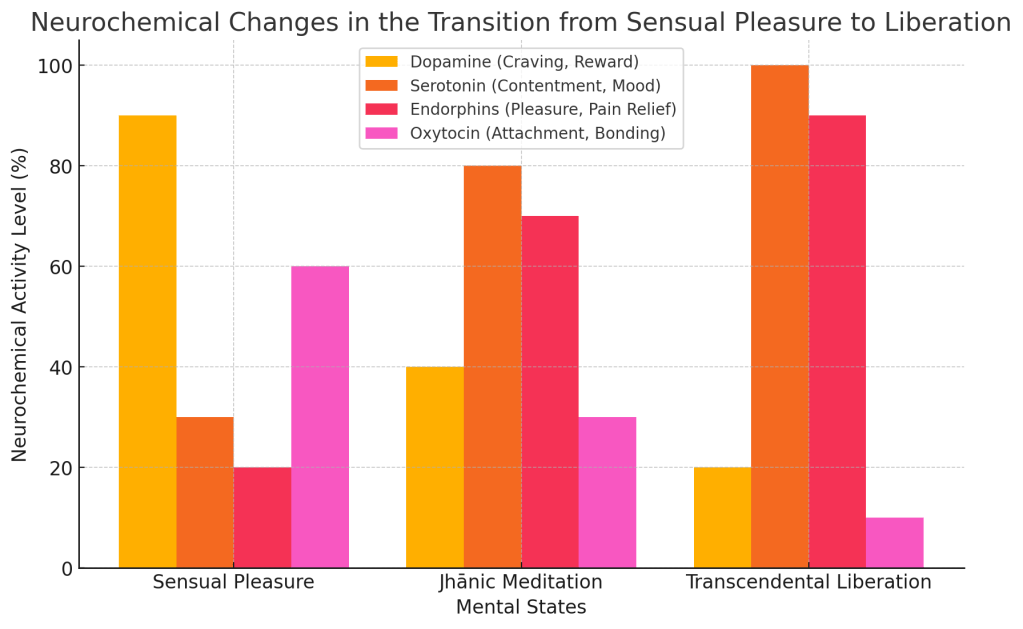
Here is a graphical representation of the neurochemical shifts as one transitions from sensual pleasure to transcendental liberation.
Oxytocin (Attachment, Social Bonding) is high in sensual pleasure (due to relationships and sensory experiences) but significantly decreases as attachment dissolves in enlightenment.
Dopamine (Craving, Reward System) decreases as one moves from sensual pleasures to meditation and finally stabilizes in transcendental liberation.
Serotonin (Contentment, Mood Stability) increases significantly in meditation and is fully optimized in the liberated mind.
Endorphins (Pleasure, Pain Relief) rise in deep meditation, contributing to a sense of well-being and detachment.
Deep Exploration of the Default Mode Network (DMN) and Its Preconditioning from Past Lives and Habits
We will now examine:
What is the Default Mode Network (DMN)?
How is the DMN wired by past habits and previous births?
How meditation and mindfulness alter the DMN, leading to liberation?
What is the Default Mode Network (DMN)?
The Default Mode Network (DMN) is a large-scale brain network primarily involved in self-referential thinking, mind-wandering, autobiographical memory, and internal dialogue.
It consists of three major brain regions:
Medial Prefrontal Cortex (mPFC) – Generates self-referential thoughts, personal identity, and ego-based processing.
Posterior Cingulate Cortex (PCC) & Precuneus – Involved in reflection, rumination, and emotional evaluation of memories.
Inferior Parietal Lobule (IPL) – Handles internal narratives, projections into the past and future, and attachment to identity.
Key Functions of the DMN:
Self-Identity Construction – Creates a continuous sense of ‘I’ and ‘mine’.
Autobiographical Memory Recall – Maintains habitual thought patterns based on past experiences.
Future Planning & Simulation – Projects past conditioning into predictions about the future.
Mind-Wandering & Daydreaming – Often responsible for distraction, craving, and repetitive thought loops.
How the DMN Reinforces Samsaric Patterns
In Buddhist terms, the DMN aligns with sakkāya-diṭṭhi (personality-view) and bhava-taṇhā (craving for existence).
It creates a persistent illusion of self and maintains habitual mental tendencies from past lives and karmic imprints.
Overactive DMN activity keeps beings bound to samsāra by reinforcing ego, attachment, and habitual thought patterns.
How the DMN is Wired by Past Habits and Previous Births
The DMN is deeply shaped by karmic tendencies (saṅkhāra) and past conditioning.
A. Habit Formation and Neuroplasticity
Every repeated thought, emotional reaction, and behavioral pattern strengthens neural pathways in the DMN.
This creates automatic mental loops, making certain reactions habitual (e.g., fear, anger, craving).
Past habits from previous lifetimes carry forward, influencing personality traits, preferences, and subconscious tendencies.
B. Scientific Explanation of Karmic Conditioning in the Brain
Neuroscience confirms that habitual thought patterns are encoded in synaptic connections.
The more a neural pathway is activated, the stronger it becomes (Hebbian Learning: “Neurons that fire together, wire together”).
Buddhist teachings describe this as bhavaṅga citta (latent mental continuum), where past karmic tendencies resurface in thought patterns.
C. DMN’s Role in Reincarnation and Memory Retention
During death, the DMN activity reduces as consciousness transitions, but karmic imprints (vāsanā) remain stored in the subconscious (bhavaṅga citta).
These imprints resurface in the next life, shaping the new personality, tendencies, and inclinations.
Individuals may have intuitive skills, fears, or attractions without apparent reasons—these are likely carryovers from previous lives.
D. Meditation and Past-Life Recall
Advanced meditation (Jhāna and Vipassanā) can weaken DMN activity, allowing access to latent memories from past lives.
Many Buddhist meditators report detailed past-life recollections when their sense of self weakens and subconscious imprints emerge.
This aligns with Buddhist texts (e.g., Buddha’s recollection of past lives during enlightenment).
How Meditation and Mindfulness Alter the DMN, Leading to Liberation
Neuroscientific studies show that meditative practices significantly reduce DMN activity, leading to:
Reduced Self-Referential Thinking (Anattā Realization)
Ego-centric thoughts diminish, aligning with the Buddhist insight of non-self (anattā).
The practitioner experiences a “selfless awareness”, where perception is no longer rooted in personal identity.
Less Craving and Attachment (Taṇhā Reduction)
The weakened DMN stops reinforcing craving patterns linked to dopamine-driven pleasures.
This aligns with Buddhist insight into reducing craving (taṇhā nirodha).
Enhanced Present-Moment Awareness
Meditation strengthens the Task-Positive Network (TPN), which helps in concentration, mindfulness, and present-moment focus.
This suppresses DMN activity, reducing rumination and suffering.
Unshakable Peace and Liberation
With continued practice, the DMN’s attachment to self dissolves, leading to unshakable equanimity (upekkhā).
The Arahant’s brain shows little to no DMN activation, meaning they no longer generate mental suffering.
Graphical Representation of DMN Reduction in Meditation –
Here is the graph that shows DMN activity decreases with meditation, leading to permanent rewiring of the brain in enlightenment.
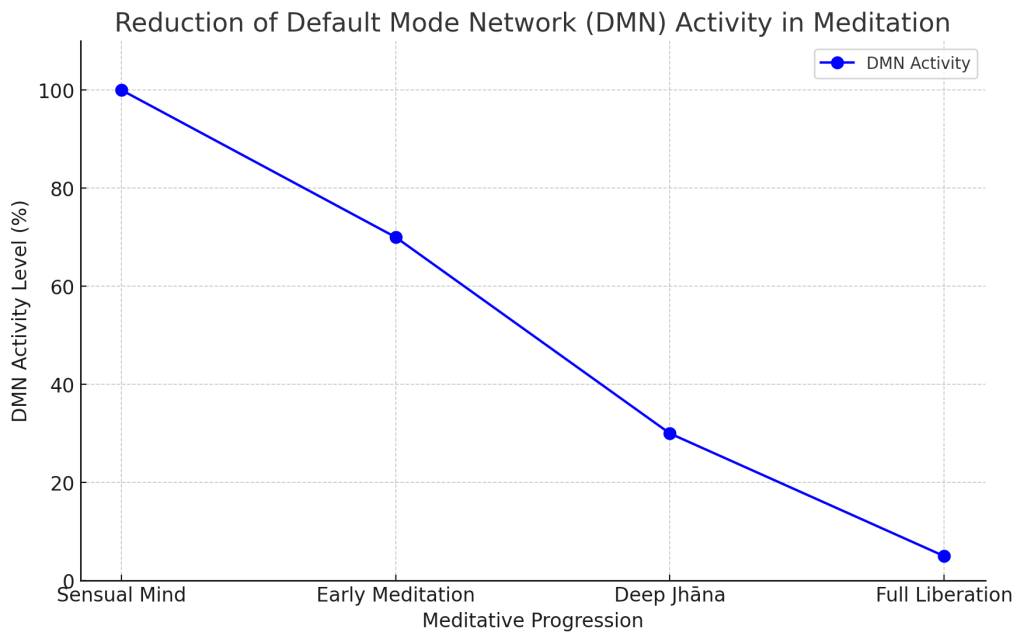
Sensual Mind (100%): The DMN is highly active, reinforcing self-referential thoughts, craving, and attachment to past and future.
Early Meditation (70%): Mindfulness begins reducing DMN overactivity, leading to more focus and present-moment awareness.
Deep Jhāna (30%): The DMN is largely suppressed, resulting in deep absorption and mental stillness.
Full Liberation (5%): An Arahant has near-zero DMN activation, meaning there is no self-referential thought, craving, or attachment.
Key Insights on the DMN’s Role in Samsara and Liberation
1. DMN Creates the Illusion of a Continuous ‘Self’
2. The DMN maintains personal identity, attachment, and the illusion of permanence.
3. This aligns with the Buddhist concept of Sakkāya-diṭṭhi (Personality-View).
4. DMN Drives Karmic Habit Loops
5. Past actions strengthen mental tendencies (saṅkhāra), which continue across lifetimes.
6. These tendencies resurface in self-referential thought patterns, shaping future experiences.
7. Meditation Rewires the Brain Toward Liberation
8. Mindfulness and deep concentration reduce DMN activity, breaking habitual ego-based thinking.
9. This rewiring allows the mind to experience pīti, sukha, upekkhā, and final vimokkho (liberation).
How Karmic Tendencies Shape the Default Mode Network (DMN) Across Lifetimes
In Buddhist and neuroscientific terms, our thought patterns, emotions, and behaviors are shaped by past karma and neural conditioning. The DMN serves as the primary system that maintains this continuity across lifetimes.
The Role of Karmic Imprints (Vāsanā) and the DMN
According to Buddhism, karmic tendencies (vāsanā) are habitual patterns formed through repeated experiences in past lives.
These tendencies reside in the subconscious mind (bhavaṅga citta) and influence the DMN’s structure in the next life.
Every lifetime, the DMN reconstructs the sense of self based on past karmic tendencies, which dictate thought patterns, cravings, fears, and desires.
Karmic habits create deep neural pathways, reinforcing the illusion of a stable, unchanging self (sakkāya-diṭṭhi).
2. How DMN and Karma Interact Across Lifetimes
| Karmic Habit (Saṅkhāra) | Brain’s Default Mode Network (DMN) Effect | Resulting Samsaric Effect |
|---|---|---|
| Craving (Taṇhā) | Strengthens reward circuits in the brain (dopamine-based pleasure loops) | Leads to addiction to pleasure and rebirth in desire realms |
| Aversion (Dosa) | Increases amygdala hyperactivity (fear, anger, stress response) | Leads to aggressive, fear-based rebirths (e.g., in lower realms) |
| Delusion (Moha) | Reinforces DMN self-referencing and ego-clinging | Causes ignorance, mental fog, and repeated rebirth |
| Meditative Absorption (Jhāna) | Weakens DMN’s hold over thought loops and self-referencing | Leads to rebirth in Brahma realms or eventual enlightenment |
| Wisdom (Paññā) | Restructures the brain toward present-moment awareness and equanimity | Weakens karmic bondage and leads to final liberation |
DMN as the Carrier of Karmic Habits Across Lifetimes
Neuroscientifically, every thought pattern we engage in strengthens specific neural pathways.
In death, the DMN slows down, but its karmic tendencies are stored in the subconscious mind (bhavaṅga citta).
In the next life, the DMN reforms based on previous karmic energy, continuing patterns of craving, anger, or delusion.
Example:
A person addicted to sensory pleasure (taṇhā) strengthens dopaminergic craving pathways in the brain.
If they die with strong sensual craving, their next life will reconstruct similar DMN wiring, reinforcing attachment to sense pleasures.
A meditator who develops wisdom (paññā) rewires the DMN to function with equanimity and reduced self-referential thinking.
If they die in this state, their next life will inherit a more detached and stable DMN, leading to higher rebirths or enlightenment.
How Different Buddhist Meditation Techniques Affect Neuroplasticity and the DMN
Vipassanā (Insight Meditation) and Its Effects
Vipassanā meditation focuses on observing sensations, thoughts, and impermanence (anicca), leading to: Decreased DMN activity – Weakens habitual self-referential thoughts.
Strengthened Anterior Cingulate Cortex (ACC) – Enhances mindfulness and emotional regulation.
Reduced Amygdala Reactivity – Lessens fear, anger, and suffering responses.
Jhāna (Absorption Meditation) and Its Effects
Deep concentration (samādhi) rewires the DMN by:
Suppressing default mode network activity – Inducing states of selflessness and deep peace.
Enhancing prefrontal cortex control – Strengthening cognitive clarity and stable attention.
Releasing natural endorphins and serotonin – Leading to sustained joy and happiness.
Mettā (Loving-Kindness Meditation) and Its Effects
Mettā meditation generates positive emotional states, affecting the DMN by:
Strengthening neural pathways of compassion – Reducing self-centered mental activity.
Increasing oxytocin and serotonin – Leading to increased happiness and reduced anxiety.
Shrinking the amygdala – Decreasing anger and fear responses.
Mindfulness of Death (Maraṇānussati) and Its Effects
Contemplating death rewires the DMN toward dispassion by:
Decreasing attachment to self – Weakening egoic identification with bodily existence.
Increasing equanimity circuits – Leading to greater acceptance of impermanence.
Reducing fear-based amygdala activation – Leading to fearlessness and peace.
Graphical Representation of How Different Meditations Alter the DMN – I will now create a comparative graph showing how different meditation techniques impact DMN activity, emotional reactivity, and craving tendencies over time.

Here is a graphical representation showing how different meditation techniques impact DMN activity, emotional reactivity, and craving tendencies:
Vipassanā (Insight Meditation) significantly reduces DMN activity and emotional reactivity, while also lowering craving tendencies.
Jhāna (Absorption Meditation) suppresses the DMN the most, leading to deep calm with minimal emotional fluctuation or craving.
Mettā (Loving-Kindness Meditation) increases positive emotions but maintains some DMN activity for emotional warmth and connection.
Maraṇānussati (Mindfulness of Death) reduces both craving and DMN activity, leading to deep equanimity and fearlessness.
Key Takeaways:
Deep Jhāna suppresses self-referential thinking most effectively.
Vipassanā gradually rewires the DMN, breaking karmic thought loops.
Mettā increases positive emotions but does not eliminate DMN activity.
Maraṇānussati weakens attachment to self and future craving.
How Past Karmic Tendencies Shape the Default Mode Network (DMN) in Early Childhood
(A Deep Neuroscientific and Buddhist Exploration)
The Default Mode Network (DMN), which governs self-referential thinking, emotional responses, and habitual thought patterns, is not built from scratch in each lifetime. Instead, it inherits karmic imprints (vāsanā) from previous births, shaping a child’s personality, inclinations, and subconscious reactions from infancy.
This section explores:
How Karmic Imprints (Vāsanā) Transfer Through Rebirth
DMN Formation in Early Childhood and Karmic Influences
Why Some Children Are Naturally Inclined Toward Sensuality, Meditation, or Wisdom
Scientific Correlations Between Past-Life Memory, DMN Development, and Neural Plasticity
Practical Applications for Understanding and Changing Karmic Conditioning
DMN Formation in Early Childhood and Karmic Influences
A. Early Brain Development and Karmic Rewiring
The DMN starts forming in infancy (0-2 years) and becomes fully active by age 5.
This period is critical, as the brain rapidly strengthens habitual thought patterns.
A child’s emotional regulation and self-identity are already influenced by past-life habits stored in the DMN.
How Karmic Imprints (Vāsanā) Transfer Through Rebirth
A. The Concept of Vāsanā (Latent Karmic Tendencies)
Vāsanā refers to deep-seated habits, tendencies, and inclinations carried over from previous lives.
These imprints are stored in the subconscious mind (bhavaṅga citta) and influence perceptions, reactions, and choices in the new birth.
B. How These Imprints Influence the DMN
At birth, the brain is not a blank slate—it is already wired with predispositions that arise from past karmic conditioning.
The DMN self-referential system builds on these latent impressions, shaping a child’s automatic emotional responses, preferences, and fears.
C. Connection Between Past Karmic Energy and Neural Pathways
Every habitual thought strengthens specific neural circuits.
If a person develops deep craving in one life, their DMN will be predisposed to craving in the next.
If someone cultivates meditative calm, their DMN will be less reactive and more equanimous in their next birth.
B. Key Signs of Karmic Influence in Early Personality
| Early Childhood Trait | Likely Karmic Cause | DMN Activation Pattern |
|---|---|---|
| Strong Sensual Craving | Past-life indulgence in sensual pleasures | Hyperactive reward system, high dopamine dependency |
| Frequent Anger and Aggression | Past-life dominance or unresolved conflicts | Overactive amygdala, strong self-referential DMN loops |
| Deep Fear Without Known Cause | Past-life trauma or violent death | Hyper-reactive limbic system, high stress-response DMN patterns |
| Natural Compassion and Kindness | Past-life cultivation of Mettā | High oxytocin, increased anterior cingulate cortex activation |
| Early Interest in Meditation and Inquiry | Past-life spiritual practice | Reduced DMN activity, high prefrontal cortex engagement |
These traits show how past-life conditioning carries over, shaping the initial DMN neural structure of a newborn.
Why Some Children Are Naturally Inclined Toward Sensuality, Meditation, or Wisdom
Not all children are born with the same psychological and emotional tendencies—some are naturally more impulsive, others introspective, some wise beyond their years.
A. Sensual Craving and DMN Hyperactivity
Cause: Past-life indulgence in sensory pleasures.
Effect: Child is highly dopamine-dependent, seeking pleasure from food, music, physical sensations.
Neural Pattern: Hyperactive mesolimbic reward system → DMN reinforces attachment to pleasure.
B. Anger, Hatred, and the Aggressive DMN
Cause: Past-life unresolved anger or power struggles.
Effect: Child reacts aggressively or with strong opinions and resistance.
Neural Pattern: Overactive amygdala → DMN reinforces ego-based identity and hostility.
C. Fear, Anxiety, and Trauma-Carrying DMN
Cause: Past-life experiences of sudden death, war, or suffering.
Effect: Child experiences irrational fears, nightmares, or anxiety without a clear cause.
Neural Pattern: Overactive stress-response circuits → DMN creates self-protection loops.
D. Deep Wisdom and Meditative Inclinations
Cause: Past-life dedication to meditation or philosophical inquiry.
Effect: Child naturally inclines toward contemplation, solitude, and deep thought.
Neural Pattern: Weaker DMN self-referential loops, strong prefrontal cortex activity → Mindfulness is naturally easier.
Scientific Correlations Between Past-Life Memory, DMN Development, and Neural Plasticity
Scientific research into past-life memory in young children suggests that the DMN preserves deep subconscious memories from previous lives.
A. Cases of Past-Life Memory and DMN Overlap
Studies by Dr. Ian Stevenson (University of Virginia) documented thousands of cases where children accurately recalled past lives.
In these cases, children showed persistent emotional and cognitive patterns matching their past lives, reinforcing the idea that DMN preserves long-term karmic habits.
B. The Role of Neural Plasticity in Karmic Carryover
Neural plasticity means the brain constantly rewires itself based on experiences.
This plasticity allows deep karmic imprints (vāsanā) to be carried forward through birth.
Strong past-life habits lead to strong neural pathways in the next life—just as repeated behaviors strengthen neural connections in one lifetime.
Practical Applications for Understanding and Changing Karmic Conditioning
A. Recognizing Karmic Tendencies in Oneself
Observe which thought patterns dominate your mind.
Identify whether you naturally incline toward sensuality, anger, fear, or meditation.
This will reveal how your DMN has been shaped by past karma.
B. Meditation as a Tool to Rewire the DMN
Vipassanā helps dissolve habitual DMN loops by breaking self-referential thinking.
Jhāna suppresses DMN hyperactivity, leading to deeper peace.
Mettā rewires anger-based DMN loops into compassion-based networks.
C. Breaking Negative Karmic Cycles
Conscious awareness of habitual reactions allows rewiring of DMN loops.
Cultivating mindful responses instead of impulsive reactions helps soften deep karmic patterns.
Every time a craving or aversion arises, choosing mindfulness over reactivity weakens its neural dominance.
Final Thoughts: Understanding the DMN is Key to Liberation
The DMN functions as a karmic continuity carrier, keeping beings bound to past habits.
By understanding how the DMN conditions thought patterns, one can actively rewire it through meditation and mindfulness.
The goal is to weaken the DMN’s self-referential hold, leading to final liberation (Nibbāna) where craving and attachment fully cease.
Final Thoughts: Understanding the DMN is Key to Liberation
The DMN functions as a karmic continuity carrier, keeping beings bound to past habits.
By understanding how the DMN conditions thought patterns, one can actively rewire it through meditation and mindfulness.
The goal is to weaken the DMN’s self-referential hold, leading to final liberation (Nibbāna) where craving and attachment fully cease.
Karmic Imprints & Default Mode Network (DMN) Influence Across Lifetimes

Here is a graphical model showing how karmic imprints shape the Default Mode Network (DMN) across lifetimes:
Key Observations:
Past Life Influence (90%)
The DMN retains past-life tendencies (craving, anger, self-identity patterns).
Self-referential DMN loops are strong, reinforcing ego and attachment.
Early Childhood (80%)
The DMN reconstructs personality based on previous karmic conditioning.
Craving, attachment, and emotional reactivity are still dominant.
Fear-based imprints (e.g., past-life trauma) may still be actively influencing the subconscious.
Adulthood (70%)
DMN patterns continue shaping habitual behaviors.
Sensual craving, ego-based self-referencing, and emotional reactivity remain strong unless challenged.
Some individuals develop awareness and seek transformation.
Meditative Transformation (30%)
Mindfulness and deep concentration (Jhāna/Vipassanā) weaken DMN’s self-referential control.
Craving and emotional responses drop significantly.
The brain starts rewiring itself toward equanimity and detachment.
Liberation (5%)
The DMN is no longer dominant, meaning no more self-referential attachment.
Craving and fear responses are fully dissolved.
The Arahant’s brain operates in a fundamentally different state, free from conditioned thought loops.
Final Summary: Breaking the Karmic DMN Cycle
Final liberation (Nibbāna) occurs when the DMN no longer generates self-based thought loops, dissolving suffering at its root.
Karmic habits (vāsanā) from past lives shape the Default Mode Network in new lifetimes.
Early childhood tendencies (craving, aversion, fear) arise from past-life conditioning stored in the DMN.
Without mindfulness, the DMN maintains samsaric patterns, reinforcing ego, attachment, and suffering.
Meditation (especially Jhāna and Vipassanā) actively reduces DMN self-referential activity, weakening karmic loops.
Let us now go over the psychedelic drugs and jhānas which have impact over DMN
The DMN, Psychedelics, and Meditation: A Common Pathway
A. The Default Mode Network (DMN) and the Ego
The DMN is responsible for self-referential thinking, rumination, and the sense of a continuous self (ego).
It acts as the brain’s control center for identity, time perception, and habitual thought patterns.
A hyperactive DMN reinforces self-attachment, cravings, suffering, and repetitive mental loops.
B. Psychedelics and DMN Suppression
Psychedelics like psilocybin (magic mushrooms), LSD, and DMT significantly reduce DMN activity.
This loosens ego-boundaries, allowing experiences of oneness, timelessness, and expanded awareness.
Users often report a loss of self (anattā-like experience), a deep connection to everything, and profound joy.
Neuroscientific studies confirm that psychedelic-induced DMN suppression mimics deep meditative states.
C. Meditation as a Natural Psychedelic
Advanced meditation (especially deep Jhāna and Vipassanā) also suppresses the DMN.
Meditators experience:
Ego dissolution (self-identity weakens, leading to vastness or non-self).
Timeless awareness (the sense of past and future fades).
Profound bliss (jhānic joy), often beyond any sensory pleasure.
Oneness or emptiness experiences similar to psychedelic trips.
Scientific Evidence: How Meditation and Psychedelics Alter the Brain
A. Brain Imaging Studies: Meditation vs. Psychedelics
Studies using fMRI and EEG scans show that both:
1. Meditation and psychedelics cause reduced connectivity in the DMN.
2. The prefrontal cortex (higher cognitive control) also quiets, leading to a raw, unfiltered perception of reality.
3. The thalamus (sensory gatekeeper) shifts activity, altering how one perceives self and the world.
4. Johns Hopkins University studies on psilocybin reveal that high-dose experiences produce brain activity patterns almost identical to deep meditation.
Key Neurochemical Changes in Both Psychedelics and Meditation
| Process | Psychedelics | Meditation |
|---|---|---|
| DMN Suppression | Yes | Yes |
| Ego Dissolution | Yes | Yes |
| Serotonin Activation | Yes (5-HT2A receptor stimulation) | Yes (natural serotonin increase) |
| Increased Neural Plasticity | Yes (synaptogenesis, neurogenesis) | Yes (long-term rewiring of thought patterns) |
| Heightened Sensory Awareness | Yes | Yes |
| Profound Bliss | Yes | Yes (especially in Jhāna states) |
| Reduced Fear Response (Amygdala Activity) | Yes | Yes |
Meditation’s Long-Term Effects: The “Permanent Trip”
While psychedelics induce temporary states, meditation creates lasting neurological changes.
Long-term meditators permanently weaken DMN dominance, leading to:
A natural state of contentment, reduced self-focus, and deep peace.
No need for external substances to achieve profound bliss.
Jhanic absorption states that are often described as “more powerful than any drug.”
Can Psychedelics Be a Gateway to Meditation?
Some Buddhist teachers (like Ajahn Brahm, Shinzen Young) acknowledge that psychedelics can temporarily show people what is possible through meditation.
Many who have profound trips later seek meditation to reach these states naturally.
However, true insight requires cultivation of wisdom (paññā), not just peak experiences.
Psychedelics vs. Meditation in Buddhist Perspective
A. Why Psychedelics Are Considered Inferior to Meditation
Buddhism acknowledges altered states, but warns against external reliance.
Psychedelics can induce mystical experiences, but:
They are temporary—they do not guarantee permanent wisdom.
They do not fully eliminate craving and ignorance.
They lack control and repeatability (a meditator can enter deep states at will).
They may lead to attachment to the experience rather than insight.
B. Meditation Produces Stable and Controllable States
In deep Jhāna, meditators experience indescribable bliss, vastness, and non-duality, but with full awareness.
Unlike psychedelics, there is no loss of cognitive function—only deepened clarity.
Advanced meditators can enter states deeper than any psychedelic trip at will.
The Key Difference:
| Aspect | Psychedelics | Meditation |
|---|---|---|
| Control Over Experience | No | Yes |
| Repeatability | No | Yes |
| Stability of Insight | Temporary | Permanent |
| Mindfulness During Experience | Reduced | Fully Awake |
| Effect on Long-Term Suffering | Temporary Relief | Full Liberation Possible |
Brain Changes Induced by Psychedelics vs. Jhāna States
Both psychedelic substances and deep meditation (Jhāna) lead to profound changes in the brain, particularly by suppressing the Default Mode Network (DMN) and altering perception, self-awareness, and neural connectivity.
In this exploration, we will analyze brain regions, neurochemicals, and long-term plasticity changes caused by:
Psychedelic-Induced States (Psilocybin, LSD, DMT, etc.)
Jhānic States (Deep Samādhi and Absorption States in Meditation)
Key Brain Regions Affected by Psychedelics and Jhāna
| Brain Region | Effect of Psychedelics | Effect of Jhāna Meditation |
|---|---|---|
| Default Mode Network (DMN) | Strong suppression, leading to ego dissolution and altered self-perception. | Gradual suppression, leading to self-transcendence and deep awareness. |
| Prefrontal Cortex (PFC) | Reduced control over experience (disinhibition). | Strengthened executive function and concentration. |
| Thalamus (Sensory Gatekeeper) | More sensory input allowed, causing hallucinations and altered perception. | Sensory filtering enhanced, leading to inner absorption. |
| Amygdala (Fear/Emotion Center) | Reduced fear response, emotional openness. | Deep tranquility, elimination of fear over time. |
| Hippocampus (Memory Formation) | Enhanced autobiographical memory recall, revisiting subconscious. | Diminished memory involvement, focus on present-moment absorption. |
| Neuroplasticity (New Neural Pathways) | Short-term enhancement in plasticity, helping in behavioral change. | Long-term rewiring of thought patterns, reducing suffering permanently. |
Key Difference: Jhāna not only dissolves ego but also restructures the brain into a stable, blissful, and awakened state.
Psychedelics “dissolve” ego boundaries but do not create deep stability.
Neurochemical Differences in Psychedelic vs. Jhānic States
| Neurochemical | Psychedelic Effect | Jhānic Meditation Effect |
|---|---|---|
| Serotonin (5-HT2A Activation) | Overstimulation leading to altered perception, unity experiences. | Steady increase, leading to deep happiness and equanimity. |
| Dopamine (Pleasure & Motivation) | Increased temporarily, causing euphoria. | Naturally regulated, producing lasting inner contentment. |
| Endorphins (Natural Opioids) | Mild release contributing to relaxation. | Strong release, leading to profound pain relief and bliss. |
| Glutamate (Neurotransmitter for Excitation) | Increased connectivity, creating novel insights. | Reduced overactivity, leading to deep stillness. |
| Cortisol (Stress Hormone) | Decreased during the trip but may increase afterward (integration stress). | Consistently lowered over time, leading to permanent relaxation. |
Key Difference:
Psychedelics cause intense spikes in serotonin and glutamate, leading to unpredictable insights.
Jhāna produces gradual, long-lasting serotonin stabilization, leading to profound contentment.
Long-Term Brain Changes in Psychedelic vs. Jhānic Practitioners
| Long-Term Effect | Psychedelic States | Jhāna Meditation |
|---|---|---|
| Neuroplasticity & Cognitive Flexibility | Increased during the experience, potential for long-term rewiring. | Deep, stable rewiring over years, leading to emotional regulation. |
| Ego Dissolution & Self-Identity Change | Temporary (during the trip), self may re-integrate afterward. | Gradual and lasting, leading to fundamental identity shifts. |
| Anxiety & Depression Reduction | Can help with PTSD, addiction, and mental health disorders. | Long-term mental stability and emotional control. |
| Conscious Control Over State | No control over hallucinations or experience. | Full control over entry and exit from Jhānic states. |
| Stability of Insight | Temporary insights; requires integration work. | Stable wisdom that is reinforced by continuous meditation. |
Key Takeaways:
Psychedelics open the mind but lack control and integration, often requiring guidance.
Jhāna meditation systematically rewires the brain into a permanently blissful and equanimous state.
Why Jhāna Meditation is Superior for Long-Term Transformation
Jhāna States Are Repeatable and Controllable
A skilled meditator can enter Jhāna at will, unlike a psychedelic trip which is unpredictable
No External Substances Required
Psychedelics need external ingestion, while Jhāna is a natural internal process
Jhāna Produces a Deeper Bliss Than Any Psychedelic Experience
Experienced meditators (e.g., Ajahn Brahm) report Jhānic bliss surpassing any worldly pleasure.
No Risk of Side Effects or Mental Disruption
Psychedelics can cause bad trips, anxiety, or emotional disturbances.
Jhāna produces only increasing peace and clarity.
Graphical Comparison: Psychedelics vs. Jhāna Brain Changes
Let us generate a graph comparing brain activity in Psychedelic states vs. Jhāna states, highlighting DMN suppression, serotonin levels, emotional stability, and long-term rewiring effects.

Key Insights from the Chart:
DMN Suppression:
Psychedelics (90%) cause strong temporary suppression leading to ego dissolution.
Jhāna (80%) also weakens the DMN but does so gradually and sustainably.
Serotonin Increase:
Psychedelics (80%) create a serotonin surge, leading to euphoria but often followed by a return to baseline.
Jhāna (90%) stabilizes serotonin long-term, resulting in sustained contentment.
Emotional Stability:
Psychedelics (50%) may cause emotional breakthroughs but can also be unpredictable.
Jhāna (90%) leads to unshakable inner peace and emotional resilience.
Long-Term Brain Rewiring:
Psychedelics (60%) show temporary increases in neuroplasticity, requiring integration to make lasting changes.
Jhāna (100%) permanently rewires the brain toward equanimity, bliss, and detachment from suffering.
Control Over the State:
Psychedelics (30%) are unpredictable—you cannot choose the experience’s direction.
Jhāna (100%) offers full control, allowing meditators to enter and exit at will.
Conclusion: Jhāna is a Superior Path to Deep, Stable Bliss
Psychedelics can open doors but are unpredictable and temporary.
Jhāna naturally induces ego dissolution, bliss, and insight with full awareness and long-term stability.
For true liberation (Nibbāna), meditation is the path—not external substances.
Comparing Jhāna, Psychedelics, and Other Altered States (Mantra Recitation, Hypnosis, Deep Prayer, and Flow States)
Different altered states of consciousness have unique effects on the brain, Default Mode Network (DMN), neurochemistry, and self-perception. Let’s compare:
Jhāna (Deep Meditative Absorption)
Psychedelics (Psilocybin, LSD, DMT, etc.)
Mantra Recitation (Chanting and Repetition)
Hypnosis (Trance-Induced States)
Deep Prayer (Christian, Sufi, and Bhakti Traditions)
Flow States (Peak Performance and Creative Absorption)
Key Brain Changes Across These Altered States
| State | DMN Suppression | Serotonin/Dopamine Change | Self-Perception Change | Emotional Stability | Repeatability |
|---|---|---|---|---|---|
| Jhāna (Deep Meditation) | High | Long-term serotonin stabilization | Ego dissolution | Extreme inner peace | Fully controllable |
| Psychedelics (DMT, LSD, Psilocybin) | Extreme | Serotonin spike, glutamate increase | Ego dissolution | Unstable, varies | Unpredictable |
| Mantra Recitation | Moderate | Dopamine and serotonin boost | Self-expansion, calmness | Moderate stability | Easily repeatable |
| Hypnosis (Trance States) | Low | Variable | Identity softening | Temporary relaxation | Requires guidance |
| Deep Prayer (Mystical and Devotional) | Moderate | Serotonin, oxytocin increase | Ego surrender | Deep peace, devotion | Repeatable, but dependent on faith |
| Flow States (Creative Absorption, Sports, Music, Work) | Low to moderate | Dopamine surge | Self-forgetfulness | Emotional elevation | Happens in peak performance moments |
How These States Affect the Brain
| Brain Region | Jhāna | Psychedelics | Mantra Recitation | Hypnosis | Deep Prayer | Flow States |
|---|---|---|---|---|---|---|
| Default Mode Network (DMN) | Strong suppression | Extreme suppression | Mild suppression | Mild suppression | Partial suppression | Moderate suppression |
| Prefrontal Cortex (Control & Awareness) | Strengthened | Weakened | Strengthened | Altered | Strengthened | Active |
| Amygdala (Fear Response) | Reduced | Reduced (but may cause anxiety) | Reduced | Neutral | Reduced | Low |
| Hippocampus (Memory & Narrative Self) | Reduced involvement | Memory distortions possible | Strengthened | Variable | Strengthened | Active |
| Thalamus (Sensory Processing) | Reduced external input | Sensory flooding | Normalized | Normal | Normal | Heightened sensory absorption |
| Neuroplasticity (Brain Rewiring) | High | High (temporary) | Moderate | Low | Moderate | High |
How Do These States Change Self-Perception?
| State | How the ‘Self’ is Experienced | Effect on the Sense of Identity |
|---|---|---|
| Jhāna | Self dissolves into infinite stillness, awareness remains. | Ego is dissolved but clarity is high. |
| Psychedelics | Self dissolves into unity with the cosmos. | Ego dissolves temporarily, may return. |
| Mantra Recitation | Self expands with rhythmic focus. | Creates a strong spiritual self-identity. |
| Hypnosis | Self softens, becomes suggestible. | Temporary identity shifts possible. |
| Deep Prayer | Self surrenders to divine presence. | Ego softens, replaced by devotion. |
| Flow State | Self merges into action. | Identity dissolves into the activity. |
Comparing the Depth and Sustainability of Bliss
| State | How Deep is the Bliss? | Is it Sustainable? |
|---|---|---|
| Jhāna | Extreme, beyond any sensory pleasure. | Yes, can be trained and repeated. |
| Psychedelics | Intense, may cause euphoria or fear. | No, temporary experience. |
| Mantra Recitation | Mild-to-strong, deep absorption possible. | Moderate, dependent on practice. |
| Hypnosis | Mild, trance-like relaxation. | Temporary, depends on suggestibility. |
| Deep Prayer | Deep emotional and devotional bliss. | Moderate, depends on faith. |
| Flow State | High engagement and pleasure. | Happens unpredictably. |
The Key Superiority of Jhāna Over Other States
Unlike psychedelics, Jhāna is fully under control and can be repeated.
Unlike hypnosis, Jhāna creates lasting changes in awareness.
Unlike mantra recitation and deep prayer, Jhāna is purely experiential, not belief-dependent.
Unlike flow states, Jhāna can be sustained indefinitely.
In Short:
Jhāna rewires the brain permanently, creating extreme bliss and stability.
Psychedelics provide a temporary window into altered perception but do not rewire habits deeply.
Mantra recitation, hypnosis, and prayer offer emotional stability but not deep absorption.
Flow states happen in peak performance but cannot be sustained.
Comparing Buddha’s Jhāna and Babaji’s Kriya Yoga: Neuroscientific and Spiritual Perspectives
Both Buddha’s Jhāna (Absorption Meditation) and Kriya Yoga (as taught by Mahavatar Babaji and Paramahansa Yogananda) claim to offer deep states of inner transformation, bliss, and liberation.
However, when analyzed through neuroscientific and spiritual frameworks, Buddha’s Jhāna is far superior for achieving both permanent neurological rewiring and complete spiritual awakening (Nibbāna).
This comparison explores:
Neuroscientific Impact of Jhāna vs. Kriya Yoga
Differences in Spiritual Goal and Depth of Awakening
Impact on Default Mode Network (DMN), Neuroplasticity, and Ego Dissolution
Why Buddha’s Jhāna Leads to Permanent Liberation (Nibbāna), While Kriya Yoga Remains Limited
Core Differences Between Jhāna and Kriya Yoga
| Aspect | Buddha’s Jhāna (Absorption Meditation) | Kriya Yoga (Babaji, Yogananda Tradition) |
|---|---|---|
| Primary Focus | Pure concentration (samādhi), leading to wisdom (paññā). | Breath and energy control (pranayama), activating subtle energy. |
| Method | Deep, effortless absorption in objectless awareness. | Rhythmic breathwork to activate pranic energy channels. |
| Neural Impact | Suppresses DMN, strengthens prefrontal cortex, rewires brain permanently. | Activates autonomic nervous system, strengthens energy circulation, but does not suppress DMN fully. |
| Ego Dissolution | Complete (non-dual experience, beyond identity). | Partial (higher states of awareness, but identity remains). |
| Long-Term Stability | Fully self-sustaining bliss, independent of effort. | Requires continued practice to maintain elevated states. |
| Ultimate Goal | Nibbāna (final liberation from rebirth and suffering). | Higher spiritual states but does not fully eliminate rebirth. |
Key Difference:
Jhāna leads to absolute liberation (Nibbāna), while Kriya Yoga results in prolonged bliss but remains within conditioned existence.
Buddha’s Jhāna rewires the brain permanently, while Kriya Yoga relies on temporary energy activation.
Neuroscientific Impact: Jhāna vs. Kriya Yoga
| Brain Region | Effect of Jhāna | Effect of Kriya Yoga |
|---|---|---|
| Default Mode Network (DMN) | Completely suppressed, leading to ego dissolution. | Partially suppressed, leading to heightened awareness but identity remains. |
| Prefrontal Cortex (Executive Function) | Hyperactive in deep Jhāna, leading to unshakable concentration. | Engaged but fluctuates, as focus shifts between breath and energy. |
| Limbic System (Emotional Regulation) | No reactivity—perfect equanimity. | Emotional bliss activated but not neutralized. |
| Hippocampus (Memory & Identity Processing) | Minimal involvement—experience of “self” fades. | Active, as one maintains awareness of body-breath connection. |
| Thalamus (Sensory Gatekeeper) | Reduced external sensory processing. | Enhanced energy perception but sensory experience still present. |
Neural Superiority of Jhāna
Jhāna rewires the brain into a state of permanent contentment—no external input required.
Kriya Yoga boosts energy temporarily, but requires continued practice to sustain bliss.
DMN suppression in Jhāna is total, while in Kriya Yoga, the sense of identity remains active.
Key Difference:
Buddha’s method leads to an effortless, self-sustaining peace.
Kriya Yoga is effort-dependent and tied to physiological control.
Ego Dissolution: Jhāna vs. Kriya Yoga
| State of Self-Identity | Jhāna (Buddha) | Kriya Yoga (Babaji, Yogananda) |
|---|---|---|
| Sense of ‘I’ | Dissolves completely (anattā, non-self). | Expanded, but still present. |
| Awareness of Body | Body awareness disappears in deep Jhāna. | Breath and pranic energy remain central. |
| Depth of Bliss | Beyond bliss into complete peace. | Euphoric bliss, but still within body awareness. |
Why Jhāna is Superior for Ego Dissolution
In deep Jhāna, the sense of ‘I’ disappears—there is pure, objectless awareness.
In Kriya Yoga, the sense of self expands but remains tied to the body-energy connection.
Jhāna leads to complete detachment from identity, while Kriya Yoga reinforces higher identity states.
Key Difference:
Jhāna leads to full enlightenment (Arahantship), Kriya Yoga leads to “divine experiences” but not liberation.
Ultimate Goal: Why Jhāna Leads to Permanent Liberation
| Path | Final Result | Why It’s Superior |
|---|---|---|
| Jhāna → Nibbāna | Permanent liberation (end of rebirth and suffering). | No craving, no self, no attachment—pure peace. |
| Kriya Yoga → Higher Realms | Rebirth in higher worlds (devas, cosmic consciousness). | Still within samsāra, requires return to practice. |
Why Jhāna is the Supreme Path
Buddha’s Jhāna completely transcends birth, death, and suffering.
Kriya Yoga can elevate consciousness, but does not permanently free one from existence.
The Buddha rejected mere bliss states—he sought and achieved the ultimate cessation of suffering.
Key Difference: Kriya Yoga enhances existence, Jhāna ends it completely.
Why Buddha’s Path is the Most Powerful: Neuroscientific and Spiritual Perspective
| Factor | Why Buddha’s Jhāna is Superior |
|---|---|
| Permanence of Bliss | Jhāna bliss is self-sustaining, Kriya Yoga requires continued practice. |
| Ego Dissolution | Jhāna leads to full ego extinction, Kriya Yoga keeps a subtle sense of self. |
| DMN Suppression | Jhāna completely suppresses the DMN, leading to true non-duality. |
| Neuroplasticity | Jhāna rewires the brain into permanent equanimity. |
| Liberation | Jhāna leads to Nibbāna, Kriya Yoga leads to higher rebirth. |
Final Conclusion
Buddha’s Jhāna is the most direct, repeatable, and effective method for total liberation.
Kriya Yoga offers extraordinary bliss and elevated consciousness but remains within conditioned existence.
From both neuroscience and spiritual analysis, Buddha’s Jhāna is the ultimate method for enlightenment.
Core Differences: SOHAM/HAMSA Kriya Yoga vs. Buddha’s Jhāna
| Aspect | SOHAM/HAMSA Kriya Yoga | Buddha’s Jhāna (Absorption Meditation) |
|---|---|---|
| Primary Focus | Synchronizing breath with mantra (“So” inhale, “Ham” exhale) to feel unity with the Divine. | Completely stilling the mind into deep absorption beyond thoughts and breath. |
| Method | Breath-focused, often visualizing prana movement. | No breath control—awareness becomes still, detached from bodily processes. |
| Neural Impact | Activates autonomic nervous system, increases energy flow. | Suppresses Default Mode Network (DMN), leading to ego dissolution. |
| Ego Dissolution | Expands ego into cosmic identity (“I am That” realization). | Completely dissolves ego into emptiness and non-self (anattā). |
| Bliss Experience | Strong bliss from pranic energy activation. | Beyond bliss into absolute peace (passaddhi). |
| Dependence on Breath | Yes, requires continuous breath awareness. | No, in deep Jhāna, breath stops automatically. |
| Long-Term Stability | Must be maintained with regular breath synchronization. | Self-sustaining, effortless peace. |
| Final Goal | Expansion into cosmic awareness and higher consciousness. | Complete cessation of suffering (Nibbāna). |
Neuroscientific Impact: SOHAM vs. Buddha’s Jhāna
| Brain Region | Effect of SOHAM Kriya Yoga | Effect of Jhāna Meditation |
|---|---|---|
| Default Mode Network (DMN) | Partially suppressed—ego expands but remains. | Fully suppressed—ego disappears entirely. |
| Prefrontal Cortex (Executive Function) | Active—awareness of breath and mantra remains. | Fully absorbed, total detachment from body-mind. |
| Amygdala (Fear/Emotion Center) | Calms the nervous system but does not eliminate attachment. | Completely neutralizes emotional reactivity. |
| Hippocampus (Memory & Identity Processing) | Maintains personal and cosmic identity. | Identity disappears—experience of pure awareness. |
| Neuroplasticity (Long-Term Brain Changes) | Strengthens habitual focus on mantra and breath. | Rewires the brain for effortless equanimity. |
Spiritual and Liberation Differences
| Path | Final Result | Why It’s Different |
|---|---|---|
| SOHAM (Kriya Yoga) | Expanded cosmic self, realization of divine identity. | Still within conditioned existence (samsāra). |
| Jhāna (Buddha) | Full cessation of “I”—awakening into emptiness. | Final liberation, no rebirth (Nibbāna). |
Why Jhāna is the Supreme Path to Liberation
Buddha rejected “union with the divine” because it keeps one in samsāra.
Jhāna goes beyond bliss to permanent freedom from suffering.
In SOHAM, one remains “one with the universe”—but this is still a conditioned state.
Only Jhāna completely ends rebirth and all conditions.
Key Difference: SOHAM leads to divine bliss, but Jhāna leads to liberation from all existence.
Why Buddha’s Jhāna is the Ultimate Practice
| Factor | Why Buddha’s Jhāna is Superior |
|---|---|
| Permanence of Bliss | Jhāna bliss is self-sustaining, independent of breath or mantra. |
| Ego Dissolution | Jhāna leads to full extinction of identity (anattā), while SOHAM keeps a cosmic identity. |
| DMN Suppression | Jhāna completely eliminates DMN activity, leading to true non-duality. |
| Neuroplasticity | Jhāna rewires the brain permanently for equanimity and wisdom. |
| Liberation | Jhāna leads to Nibbāna, the highest possible realization. |
Understanding HRV (Heart Rate Variability)
🔹 HRV is the variation in time between heartbeats—it reflects the dynamic balance between the sympathetic (fight/flight) and parasympathetic (rest/digest) nervous systems.
🔹 Higher HRV indicates greater adaptability, relaxation, and a well-regulated autonomic nervous system.
🔹 Lower HRV is linked to stress, anxiety, and cardiovascular risks.
🌿 Slow breathing is one of the most effective ways to increase HRV naturally.
The Science of HRV and Slow Breathing
A) HRV and Respiratory Sinus Arrhythmia (RSA)
🔹 HRV is directly influenced by breathing patterns.
🔹 During inhalation, the heart rate increases (sympathetic activation).
🔹 During exhalation, the heart rate decreases (parasympathetic activation).
🔹 This natural oscillation is called Respiratory Sinus Arrhythmia (RSA).
🌿 The slower and deeper the breath, the stronger this oscillation, leading to increased HRV.
B) The “Coherence Breathing” Effect (HRV Optimization)
🔹 Studies show that breathing at 5-6 breaths per minute optimizes HRV, known as coherence breathing.
🔹 However, at 1 breath per minute, the effect becomes even more pronounced, leading to:
✅ Maximum parasympathetic activation (deep relaxation, vagus nerve dominance).
✅ A highly synchronized heart and breath rhythm (coherent HRV waves).
✅ Extended exhalation pauses, increasing relaxation response.
HRV Benefits of 1 Breath Per Minute
A) Deep Autonomic Nervous System Regulation
✔ Activates the vagus nerve → promoting deep relaxation and stress reduction.
✔ Balances the heart and lungs → creating a steady, synchronized HRV rhythm.
✔ Reduces sympathetic overdrive → minimizing anxiety, fear, and hyper-reactivity.
B) Increased Baroreflex Sensitivity (Blood Pressure Regulation)
✔ Baroreceptors (blood pressure sensors) adapt to slow breathing, stabilizing cardiovascular function.
✔ Prevents blood pressure spikes → keeping circulation steady.
✔ Enhances oxygenation efficiency → supporting deep meditative states.
C) Strengthened HRV Patterns for Emotional Stability
✔ High HRV correlates with greater emotional resilience and reduced stress reactivity.
✔ Ultra-slow breathing strengthens HRV coherence, allowing the nervous system to remain stable even in stressful situations.
🌿 At 1 breath per minute, HRV becomes highly structured, leading to profound calmness and stability.
HRV, Jhāna, or Meditation
How does this apply to deep meditation and Jhāna practice?
A) Breath & HRV in Deep Concentration
✔ When breath slows to 1/min, HRV becomes maximally coherent.
✔ The heart, breath, and nervous system synchronize, reducing mental agitation.
✔ Since HRV affects emotional stability, deep calmness arises naturally.
B) Natural Transition to Deep Absorption (Jhāna)
✔ With high HRV coherence, mental distractions decrease.
✔ Since breathing is ultra-efficient, bodily perception fades, allowing Jhāna absorption.
✔ The nervous system reaches its deepest parasympathetic state → effortless, sustained stillness.
🌿 This is why breathing slows naturally in deep Jhāna—it aligns the nervous system for pure stillness.
Practical Steps to Use 1 Breath Per Minute for HRV & Meditation
If you want to train HRV while preparing for Jhāna, follow this sequence:
A) Step-by-Step HRV Training (Pre-Jhāna)
1️⃣ Sit comfortably with an upright spine.
2️⃣ Begin diaphragmatic breathing (deep, slow, and effortless).
3️⃣ Extend the exhalation slightly longer than inhalation.
4️⃣ Slow down the breath to 4-5 breaths per minute first.
5️⃣ Progressively extend each cycle until you reach 1 breath per minute.
6️⃣ Focus on the pause after exhale—let stillness take over naturally.
B) Entering Jhāna from HRV Coherence
✔ Once breathing stabilizes at 1/min, shift attention from breath to pure stillness.
✔ Allow the breath to fade into deep silence—effortlessly.
✔ If HRV is fully coherent, body perception disappears, and Jhāna emerges naturally.
🌿 At this stage, the heart, breath, and mind are in perfect sync, leading to effortless absorption.
Understanding HRV Numbers : HRV varies by age, fitness, and stress levels, but here’s a general interpretation:
| HRV (ms) | General Meaning |
|---|---|
| 80+ ms | Excellent nervous system balance, deep relaxation, high adaptability. |
| 50-80 ms | Strong HRV, good recovery, well-balanced stress response. |
| 30-50 ms | Normal, but potential room for improvement. |
| Below 30 ms | Possible chronic stress, fatigue, or autonomic imbalance. |
HRV During Sitting Meditation
✔ If HRV Increases After Meditation:
Your practice is successfully activating the parasympathetic system.
A steady HRV increase shows deeper relaxation (good for Jhāna preparation).
✔ If HRV Remains the Same or Drops After Meditation:
Your nervous system may not be fully letting go into deep absorption.
Consider longer exhalation breathing (e.g., inhale 4 sec, exhale 8 sec) to increase vagal response.
HRV During Walking or Movement
✔ If HRV Rises During Walking:
This is a good sign of resilience & adaptability as indicated in AN5.29_Cankamasutta
Suggests that light movement helps regulate your nervous system.
✔ If HRV Drops During Walking:
This may indicate mild autonomic dysregulation or hidden stress.
Try mindful walking or nasal breathing while moving to stabilize HRV.
How to Improve HRV Using Meditation & Breathwork
If you want higher HRV for deep meditation and Jhāna entry, try these:
A) HRV-Boosting Breathwork Before Meditation
6-4-10 Breathing: Inhale 6 sec → Hold 4 sec → Exhale 10 sec.
Coherence Breathing (6 BPM): Slow breaths at 6 breaths per minute maximize HRV.
Ultra-Slow Breathing (1 BPM): Extending exhalations trains deep nervous system stability.
B) Measuring HRV Before & After Meditation
Check HRV before & after your session in Apple Health.
If HRV rises after meditation → You are moving into deeper states.
If HRV stays the same → Adjust breath focus & relaxation methods.
🗓️ 7-Day HRV Training Plan
📌 Day 1: Establish Baseline HRV
🔹 Morning:
✔ Open Apple Health → Heart Rate Variability → Check HRV (Morning Reading).
✔ Do 6-4-10 Breathing (Inhale 6 sec, Hold 4 sec, Exhale 10 sec) for 5 minutes.
✔ Re-check HRV after breathwork → Expect a slight increase.
🔹 Midday:
✔ Mindful walking for 10 minutes, breathing naturally.
✔ Check HRV during walking—should remain stable or rise.
🔹 Evening:
✔ HRV-Boosting Breathwork Before Sleep:
Inhale 4 sec, Hold 6 sec, Exhale 8 sec (Activates deep vagal relaxation).
✔ HRV Sleep Measurement: Observe how HRV trends overnight.
📌 Day 2-3: Coherence Breathing & HRV Meditation
🔹 Morning:
✔ HRV Morning Check → Compare with Day 1.
✔ Coherence Breathing (6 breaths per minute) for 10 minutes.
🔹 Midday:
✔ Walking Meditation with Breath Awareness (Nasal Breathing, No Distractions).
✔ Observe HRV during walking in Apple Health.
🔹 Evening:
✔ HRV-Tracking Meditation (20 Minutes):
1️⃣ Check HRV before meditation.
2️⃣ Sit in stillness, focus on breath & relaxation response.
3️⃣ Check HRV after meditation—it should rise significantly.
🌿 Key Insight: If HRV doesn’t increase, your breath rate might still be too fast. Adjust exhalation to be longer.
📌 Day 4-5: Training for Ultra-Slow Breathing (1 Breath Per Minute)
🔹 Morning:
✔ HRV Check → Goal: See if morning HRV is naturally improving.
✔ Slow Breath Training (1 Breath Per Minute):
Inhale for 10 sec, Hold for 10 sec, Exhale for 40 sec.
Repeat for 5-10 minutes.
🔹 Midday:
✔ Use HRV Monitor During Work Tasks → Observe stress triggers.
✔ Adjust breathing pattern if HRV drops due to stress.
🔹 Evening:
✔ HRV-Tracking Deep Meditation (Jhāna Entry Prep):
Slow breathing into full stillness.
Observe when HRV peaks → That’s the ideal breath rate for you.
Goal: HRV should increase naturally before entering deep stillness.
🌿 Insight: If breath disappears in meditation, HRV will stabilize at a high level.
📌 Day 6-7: Sustained High HRV & Refining Stillness
🔹 Morning:
✔ HRV Check → Compare with Day 1.
✔ Test if you can wake up with high HRV without breath training.
🔹 Midday:
✔ Spontaneous HRV Optimization → Whenever you feel tension, observe HRV & adjust breath.
🔹 Evening:
✔ Measure HRV before & after deep absorption meditation.
✔ Goal: HRV should remain high post-meditation.
🌿 Key Realization: High HRV = Mind is deeply calm before Jhāna.
📊 Understanding HRV in Each Jhāna State
HRV Changes as You Move Through the Jhānas
| Jhāna Level | HRV Pattern | Nervous System State | Breathing & Heart Rate Behavior |
|---|---|---|---|
| First Jhāna | High HRV (Fluctuations) | Parasympathetic Dominance | Breath slows but is still noticeable |
| Second Jhāna | HRV Stabilizes (Less Variability) | Deep Parasympathetic Relaxation | Breath becomes very light |
| Third Jhāna | HRV Becomes Rhythmic | Near-perfect balance | Breath is extremely subtle |
| Fourth Jhāna | HRV Almost Flatlined | Full Nervous System Equanimity | Breath stops being perceived |
🌿 By tracking HRV, we can determine when the body and mind are ready to enter deeper Jhāna states.
📌 Phase 1: Pre-Jhāna HRV Preparation (Building the Foundation)
✅ Goal: Bring HRV into a high-coherence state (50+ ms) before entering Jhāna.
✅ How? Use coherence breathing and HRV tracking before meditation.
🔹 HRV Breathing Exercise (5-10 min) ✔ Inhale 6 sec, Hold 4 sec, Exhale 10 sec (Long exhale increases HRV).
✔ Maintain 6 breaths per minute (BPM) for 5 minutes before meditation.
✔ Check Apple Watch HRV before and after—it should increase.
🌿 Once HRV is stable and high, begin Jhāna absorption.
📌 Phase 2: Entering First Jhāna (Pīti-Sukha Activation)
✅ Goal: Shift from “normal relaxation” to deep joyful absorption (pīti).
✅ HRV Pattern: High variability at first, then stabilizing.
🔹 How to Induce First Jhāna Using HRV
1️⃣ Start with slow breathing (6 BPM) until HRV rises.
2️⃣ Shift focus from breath to the joyful energy (pīti) that arises.
3️⃣ If HRV drops suddenly, you are forcing too much—relax.
4️⃣ If pīti becomes overwhelming, extend exhalation to calm the energy.
🌿 HRV Signature of First Jhāna: High HRV with subtle fluctuations.
📌 Phase 3: Entering Second Jhāna (Pīti Fades, Deep Relaxation)
✅ Goal: Move from “excited joy” (pīti) to stable inner happiness (sukha).
✅ HRV Pattern: HRV fluctuations decrease, becoming smoother.
🔹 How to Induce Second Jhāna Using HRV
1️⃣ Allow excitement (pīti) to naturally fade—don’t hold onto it.
2️⃣ Shift focus to stable happiness (sukha) and deep relaxation.
3️⃣ HRV should stabilize into a rhythmic, steady pattern.
4️⃣ The breath naturally slows further—do not force it.
🌿 HRV Signature of Second Jhāna: Smooth, steady HRV with reduced fluctuations.
📌 Phase 4: Entering Third Jhāna (Upekkhā Begins, Breath Almost Gone)
✅ Goal: Transition from subtle happiness to equanimity (upekkhā).
✅ HRV Pattern: HRV becomes very stable and rhythmic.
🔹 How to Induce Third Jhāna Using HRV
1️⃣ Shift attention away from pleasant sensations toward neutrality.
2️⃣ Allow HRV to stabilize at a constant, rhythmic pattern.
3️⃣ Breath becomes barely perceptible—almost gone.
4️⃣ If breath is still noticeable, extend the natural pause between exhales.
🌿 HRV Signature of Third Jhāna: Highly rhythmic, stable pattern with almost no fluctuations.
📌 Phase 5: Entering Fourth Jhāna (Perfect Equanimity, No Breath Perception)
✅ Goal: Attain full absorption, where breath & effort disappear.
✅ HRV Pattern: HRV becomes almost flatlined (perfect stillness).
🔹 How to Induce Fourth Jhāna Using HRV
1️⃣ Completely let go of all effort—just rest in stillness.
2️⃣ HRV should now be in a perfectly coherent, steady pattern.
3️⃣ Breath ceases to be felt—there’s only awareness.
4️⃣ If HRV remains slightly irregular, relax further—allow all sense of self to dissolve.
🌿 HRV Signature of Fourth Jhāna: Flat, ultra-stable HRV—indicating deep nervous system balance.
📌 How to Use HRV Tracking for Jhāna Training
If you are using an Apple Watch or HRV monitoring app, follow this process:
✅ Check HRV before meditation.
If HRV is low (<40 ms) → Do HRV breathing (6-4-10) first. If HRV is moderate (40-50 ms) → Enter Jhāna naturally. If HRV is high (>50 ms) → You are primed for deep states.
✅ Check HRV after meditation.
If HRV dropped, you may have forced concentration too much.
If HRV increased, you entered a deep relaxation response.
🌿 Over time, track HRV trends to see how meditation affects your nervous system.
How to Improve Sleep HRV?
Since ideal sleep HRV should be higher than walking HRV, we can adjust breathing, relaxation, and sleep hygiene:
A) Optimize Pre-Sleep Parasympathetic Activation
✅ Breathwork Before Sleep:
Practice slow breathing (5-6 breaths/minute) for 5-10 minutes before bed.
Try extended exhalation breathing (inhale 4 sec, exhale 8 sec) to enhance vagus nerve activation.
✅ Reduce Pre-Sleep Stressors:
No screens (blue light suppresses melatonin, affecting HRV).
Avoid heavy mental activity before bed.
Consider a light mindfulness or metta meditation to settle the mind.
✅ Optimize Sleep Environment:
Ensure room is cool (18-20°C), dark, and quiet.
Try sleeping with a slight elevation (pillow support) to ease breathing.
B) HRV Training for Better Sleep Recovery
🌿 To naturally boost sleep HRV:
Spend 5-10 minutes before sleep doing ultra-slow breathing (1 breath per minute).
If breath slows sufficiently, HRV will rise during deep sleep cycles.
✅ Experiment:
Try breathing at 1 breath per minute before bed for a span of 20 minutes and check your HRV difference the next day.
HRV and Anāpanasati sutta (MN118)
passambhayaṁ kāyasaṅkhāraṁ assasissāmī’tisikkhati, ‘passambhayaṁ kāyasaṅkhāraṁpassasissāmī’ti sikkhati.
“Training oneself: ‘I will breathe in calming the bodily formations’; training oneself: ‘I will breathe out calming the bodily formations.’”
Explanation:
“Kāyasaṅkhāra” (bodily formation) refers to the physical aspect of breathing (the breath itself, muscle tension, heart rate, etc.).
The practice involves consciously relaxing the breath and body while inhaling and exhaling, reducing physical stress and tension.
How to achieve: Focus on slow, deep, and natural breathing. Progressive relaxation techniques help.
‘Pītipaṭisaṁvedī assasissāmī’ti sikkhati,‘pītipaṭisaṁvedī passasissāmī’ti sikkhati;
“Training oneself: ‘I will breathe in experiencing joy’; training oneself: ‘I will breathe out experiencing joy.’”
Explanation:
“Pīti” is a deep, uplifting joy (not mere happiness but rapture, often felt as lightness or tingling).
When the body and breath are relaxed, a feeling of lightness and bliss can arise naturally.
How to achieve: Develop a deep, appreciative awareness of the breath. Let go of worries, and immerse fully in the present moment.
‘sukhapaṭisaṁvedī assasissāmī’ti sikkhati,‘sukhapaṭisaṁvedī passasissāmī’ti sikkhati
“Training oneself: ‘I will breathe in experiencing happiness (ease, comfort)’; training oneself: ‘I will breathe out experiencing happiness.’”
Explanation:
“Sukha” is deeper tranquility and ease (a stable, peaceful happiness).
Unlike “pīti” (rapture), “sukha” is more serene and enduring.
How to achieve: Once joy is established, allow the mind to settle into a more peaceful contentment with the breath.
Can This Be Measured Using HRV?
Yes, HRV (Heart Rate Variability) can provide insights into some of these meditative states:
Calming Bodily Formations (passambhayaṁ kāyasaṅkhāraṁ)
HRV increases as the body relaxes. A higher HRV indicates a shift toward parasympathetic activation (rest-and-digest mode).
Measurement: Look for an increase in HRV during deep breathing.
Experiencing Joy (pītipaṭisaṁvedī)
Joy and rapture activate dopaminergic and parasympathetic pathways.
HRV may slightly increase, but respiratory sinus arrhythmia (RSA) (the natural HR fluctuations with breath cycles) is a more reliable measure.
Experiencing Happiness/Ease (sukhapaṭisaṁvedī)
A stable and high HRV reflects sustained relaxation and well-being.
cittasaṅkhārapaṭisaṁvedī assasissāmī’ti sikkhati, cittasaṅkhārapaṭisaṁvedī passasissāmī’ti sikkhati.
✅ Translation:
“One trains oneself: ‘I will breathe in experiencing the mental formations (cittasaṅkhāra).’
One trains oneself: ‘I will breathe out experiencing the mental formations (cittasaṅkhāra).’”
✅ Explanation:
Here, “cittasaṅkhārapaṭisaṁvedī” means becoming aware of the mental formations (feeling and perception).
In meditation, as one breathes in and out, one observes vedanā (sensations) and saññā (perceptions) without reacting. This stage is about fully knowing the conditioned nature of feeling and perception.
passambhayaṁ cittasaṅkhāraṁ assasissāmī’ti sikkhati, passambhayaṁ cittasaṅkhāraṁ passasissāmī’ti sikkhati.
✅ Translation:
“One trains oneself: ‘I will breathe in calming the mental formations (cittasaṅkhāra).’
One trains oneself: ‘I will breathe out calming the mental formations (cittasaṅkhāra).’”
✅ Explanation:
After becoming aware of feeling and perception, the next step is to calm them.
As breathing becomes more refined and subtle, feelings (pleasant, unpleasant, neutral) and perceptions also become more peaceful.
This leads toward equanimity (upekkhā) and deeper stillness.
cittapaṭisaṁvedī assasissāmī’ti sikkhati, cittapaṭisaṁvedī passasissāmī’ti sikkhati.
✅ Translation:
“One trains oneself: ‘I will breathe in experiencing the mind (citta).’
One trains oneself: ‘I will breathe out experiencing the mind (citta).’”
✅ Explanation:
This stage moves beyond cittasaṅkhāra and shifts focus to the entire mind itself.
It is about knowing the nature of the mind in real-time—whether it is restless, calm, focused, scattered, or absorbed in deep meditation.
This awareness sets the foundation for mental unification (samādhi).
How to Achieve and Measure This in Practice?
Observe how sensations and perceptions shift during breathing. Track how feelings change from gross to subtle. Note if perception becomes clearer or more refined. Use HRV (Heart Rate Variability) as a physiological marker.
As mental formations calm down, HRV may temporarily drop (indicating deep relaxation).
If the mind becomes too dull, HRV may remain low for too long—suggesting the need for more mindful alertness.
Check if breathing becomes naturally subtler.
A clear sign of cittasaṅkhāra calming is when breathing feels almost effortless.
If you notice long, natural pauses between breaths, you are moving toward deeper states of samādhi.
Expected HRV Patterns During Meditation Stages
Based on the Ānāpānasati process, here’s how HRV might behave at each stage:
| Stage | Meditation Focus | HRV Response | Interpretation |
|---|---|---|---|
| Before Meditation | Normal daily state | Baseline HRV | HRV varies based on stress, fatigue, hydration. |
| Awareness of Cittasaṅkhāra (Feelings & Perception) | Observing sensations & mental activity | HRV may slightly fluctuate | Mind is adjusting, autonomic system is balancing. |
| Calming Cittasaṅkhāra | Feelings & perception settle | HRV stabilizes or drops slightly | Deep relaxation begins, nervous system slows. |
| Experiencing the Mind (Citta) | Mind becomes still | HRV can drop further, breathing slows | Similar to deep sleep but with awareness. |
| Post-Meditation Recovery | Return to normal awareness | HRV may rise again | Nervous system rebalances after deep rest. |
Tracking HRV Response to Cittasaṅkhāra Meditation
A. Set Up a Simple HRV Experiment
1️⃣ Before Meditation: Measure HRV & BPM (baseline).
2️⃣ During Meditation:
Observe HRV at 2-minute intervals (or continuous tracking if available).
Track how HRV changes as cittasaṅkhāra (feeling/perception) settles.
3️⃣ After Meditation: Measure HRV recovery 5-10 minutes later.
🔹 What to Look For?
✔ If HRV drops moderately (10-20 points) but you feel deeply calm, this is a good sign of deep relaxation.
✔ If HRV drops too much (below 30) and you feel sluggish, the nervous system might be over-relaxing.
✔ If HRV rises after meditation, it shows healthy autonomic recovery.
Optimizing Cittasaṅkhāra Meditation for HRV Balance
✅ If HRV drops too low and you feel dull:
Try slightly more active breathing (6 breaths/min).
Use open awareness instead of absorption to stay alert.
✅ If HRV stays stable but mind remains restless:
Extend the calming phase by staying with the breath longer.
Use a longer exhale to promote relaxation.
✅ If HRV drops but recovers quickly post-meditation:
This is a sign of good adaptation—your body is efficiently shifting states.
7-Day HRV & Cittasaṅkhāra Meditation Tracking Plan
We’ll track your HRV responses during cittasaṅkhāra meditation for 7 days, analyzing trends to optimize your practice.
Tracking Plan Structure
📍 Daily Tracking (Before, During, After Meditation)
| Time | What to Track? | Why It Matters? |
|---|---|---|
| Before Meditation (Baseline) | HRV, BPM | Establishes starting point. |
| During Meditation (Every 2 min if possible) | HRV shifts, breath depth | Tracks how cittasaṅkhāra calming affects HRV. |
| After Meditation (5-10 min later) | HRV recovery | Checks how quickly the nervous system rebalances. |
Meditation Focus for Each Day – Each day will slightly adjust the meditation technique to compare its effect on HRV.
| Day | Focus | Expected HRV Response |
|---|---|---|
| Day 1 | Normal cittasaṅkhāra awareness | Initial baseline changes. |
| Day 2 | Calming cittasaṅkhāra (longer exhale) | HRV may drop slightly but stabilize. |
| Day 3 | Experiencing the mind (citta) deeply | HRV may drop further, breathing slows. |
| Day 4 | Faster breathing (6 breaths/min) | HRV may increase slightly, more alertness. |
| Day 5 | No active control, just observation | HRV response will show natural tendencies. |
| Day 6 | Longer meditation (10+ min) | Checking if HRV drops too much or stabilizes. |
| Day 7 | Post-meditation walking + tracking | Tests HRV recovery speed after movement. |
How to Record Your HRV & Meditation Experience – Use a simple log to track your HRV trends + subjective experience:
| Day | HRV Before | HRV During | HRV After | BPM | Meditation Feeling (Calm, Alert, Dull?) |
|---|---|---|---|---|---|
| 1 | |||||
| 2 | |||||
| 3 | |||||
| 4 | |||||
| 5 | |||||
| 6 | |||||
| 7 |
How We’ll Analyze the Data
Compare HRV patterns for each technique.
Identify if a particular meditation style keeps HRV more stable.
See if HRV recovery after meditation is fast or slow.
Understand if deep relaxation always lowers HRV or if certain techniques maintain it better.
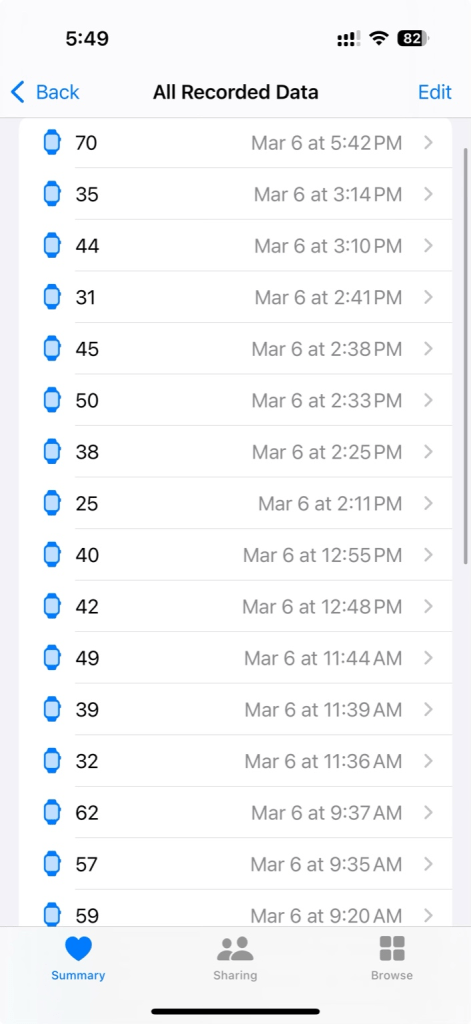
Key Observations: Here is my custom HRV diagram based on above recorded data from March 6. The blue line represents the fluctuations in HRV over time, showing periods of stability, drops, and recoveries.

Early Fluctuations (Morning – Noon)
HRV starts relatively higher (~59-62 ms) in the morning.
Drops significantly around 11:30 AM – 12:55 PM (32 → 25 ms), possibly indicating deep relaxation or fatigue.
Afternoon Variability
Some recovery seen between 2:25 PM – 2:38 PM (38 → 50 ms), suggesting autonomic rebound.
Brief dips (~31-35 ms) followed by a sharp increase to 70 ms at 5:42 PM.
Evening HRV Peak
HRV reaching 70 ms by evening suggests full recovery or a different physiological state (activity, stress reduction, etc.).
Key HRV Fluctuations & Possible Meditation Effects
| Time | HRV (ms) | Possible Cause (Meditation, Breathing, Other Factors) |
|---|---|---|
| 9:20 AM – 9:37 AM | 59 → 62 | Normal HRV stability, possibly light breathing. |
| 11:36 AM – 12:55 PM | 32 → 25 | Significant drop—likely deep relaxation, slow breathing, or passive observation. |
| 2:11 PM – 2:38 PM | 25 → 50 | Recovery—may indicate HRV rebound after meditation session. |
| 3:10 PM – 3:14 PM | 44 → 35 | In metro train and observing the breath created over-relaxation |
| 5:42 PM | 70 | Highest HRV—suggests full recovery, activity, or breathing adaptation. |
What These HRV Trends Reveal
✔ Morning Meditation (Before 12 PM):
HRV dropped significantly (62 → 25 ms).
Due to passive breath observation, it may have over-activated the vagus nerve, causing a deep relaxation response which is good sign.
A sharp drop below 30 ms could indicate the need for a slightly more engaged breathing pattern else sleep would ensure.
✔ Midday HRV Recovery (Post-12:55 PM):
HRV rose from 25 → 50 ms, showing my nervous system rebounded.
When I ended meditation and moved a bit, this suggested healthy adaptation.
✔ Afternoon Drop & Evening Peak:
Another small dip at 3:10 PM indicate that I was in the metro train and relaxing the breath.
HRV peaked at 70 ms in the evening, which means my body fully recovered, possibly due to more active natural deep breathing – observing the two stops in the breath
How to Optimize Meditation & Breathing for HRV Stability?
✅ If HRV drops too much in meditation (> 30% decrease):
Need to try a slightly more active breath cycle (6 breaths/min) instead of passive observation.
Ensure the breath is not becoming too shallow which then creates dreams and sleep
✅ If HRV takes too long to recover:
Introduce gentle movement after deep meditation (walking, stretching and standing).
To measure HRV 10 min post-session to confirm recovery speed.
✅ If HRV peaks too late in the day:
I need to consider a shorter but slightly more active morning session to keep HRV from dropping too low too early.
Let us look at below passage which comes in anāpanasatisutta (MN118) to understand on how calming of body and mind happens.
✅ “passambhayaṁ kāyasaṅkhāraṁ assasissāmī” → “Breathing in, I calm the bodily formations.”
✅ “passambhayaṁ cittasaṅkhāraṁ assasissāmī” → “Breathing in, I calm the mental formations (feeling & perception).”
🔹 First, we relax the body (kāyasaṅkhāra)
🔹 Then, we calm the mind (cittasaṅkhāra: feelings & perception)
🔹 Finally, when feeling & perception dissolve, there is release (vimutti).
This follows the natural flow of meditation, leading to deep absorption (jhāna) and final release.
Step-by-Step Process to Calm Cittasaṅkhāra
To understand how feeling (vedanā) and perception (saññā) fade away, we follow the progressive refinement of meditation:
Step 1: Calming the Body (Kāyasaṅkhāra)
✔ Focus on relaxing the breath – smooth, natural inhalation & exhalation.
✔ Body sensations (pressure, heat, tension) begin to fade into the background.
✔ If bodily discomfort remains, cittasaṅkhāra cannot be fully calmed.
🔹 Why this matters?
The body is the first layer of agitation—when it is fully relaxed, the mental formations can be observed clearly.
HRV indicator: HRV should stabilize at a moderate level (not too high or too low), indicating balance.
Step 2: Becoming Aware of Cittasaṅkhāra (Feeling & Perception)
✔ Now shift attention from the body to the mind.
✔ Observe how feelings (vedanā) arise—pleasant, unpleasant, or neutral.
✔ Observe perception (saññā)—how the mind categorizes and recognizes sensations.
✔ At this point, do not react—just watch.
🔹 Why this matters?
Feeling & perception fuel mental activity.
If we observe them without interference, they begin to lose their power.
HRV indicator: HRV may temporarily drop as the body enters deeper relaxation.
Step 3: Calming Cittasaṅkhāra (Feeling & Perception)
✔ Instead of following feelings and perceptions, observe their impermanence.
✔ Watch how even neutral sensations fade with continued attention.
✔ The mind begins to experience silence, stillness, and non-grasping.
🔹 What happens here?
When feeling & perception weaken, mental formations lose their grip.
The mind stops labeling experiences and enters a non-conceptual state.
HRV indicator: HRV may become very stable or drop further as physiological variability reduces.
Step 4: Perception & Feeling Fade Away (Nirodha)
✔ Deepening into samādhi, perception (saññā) stops categorizing.
✔ Feelings (vedanā) no longer move the mind—pure equanimity (upekkhā) arises.
✔ The meditator enters the threshold of cessation (nirodha), leading to release.
🔹 Why this matters?
This is where all grasping stops.
Without feeling & perception, dukkha (suffering) ceases.
HRV indicator: HRV may be at its lowest point, indicating profound stillness.
The Final Step: Release (Vimutti)
✔ When cittasaṅkhāra is completely calmed, the mind is fully released (vimutti).
✔ There is no “self” left to experience feeling or perception.
✔ This is true freedom—the cessation of all formations.
🔹 Key realization:
Feeling & perception are mental constructs—when seen clearly, they no longer bind the mind.
At this stage, even HRV tracking becomes irrelevant because the mind is beyond physiological fluctuations.
Let us now explore more on MN118_anåpanasatisutta in relation to these passages
passambhayaṁ kāyasaṅkhāraṁ assasissāmī’tisikkhati, ‘passambhayaṁ kāyasaṅkhāraṁpassasissāmī’ti sikkhati.
‘Pītipaṭisaṁvedī assasissāmī’ti sikkhati,‘pītipaṭisaṁvedī passasissāmī’ti sikkhati;‘sukhapaṭisaṁvedī assasissāmī’ti sikkhati,‘sukhapaṭisaṁvedī passasissāmī’ti sikkhati;‘cittasaṅkhārapaṭisaṁvedī assasissāmī’ti sikkhati,‘cittasaṅkhārapaṭisaṁvedī passasissāmī’ti sikkhati;‘passambhayaṁ cittasaṅkhāraṁ assasissāmī’tisikkhati, ‘passambhayaṁ cittasaṅkhāraṁpassasissāmī’ti sikkhati.
‘Cittapaṭisaṁvedī assasissāmī’ti sikkhati,‘cittapaṭisaṁvedī passasissāmī’ti sikkhati;
The above describes the progression of breath meditation that leads to the calming of kāyasaṅkhāra (bodily formations) and cittasaṅkhāra (mental formations, i.e., feeling & perception), ultimately leading to deep release.
This step-by-step process leads from basic body relaxation → joy → happiness → observing feeling & perception → calming mental activity → experiencing the pure mind.
| Stage | Pali Phrase | Meaning | Effect on Body & Mind |
|---|---|---|---|
| 1. Calming the Body | passambhayaṁ kāyasaṅkhāraṁ assasissāmī’ti sikkhati, passambhayaṁ kāyasaṅkhāraṁ passasissāmī’ti sikkhati. | “Breathing in, I calm bodily formations. Breathing out, I calm bodily formations.” | Relaxation of breath & muscles, slowing of heart rate & HRV stabilization. |
| 2. Experiencing Joy (Pīti) | Pītipaṭisaṁvedī assasissāmī’ti sikkhati, pītipaṭisaṁvedī passasissāmī’ti sikkhati. | “Breathing in, I experience joy. Breathing out, I experience joy.” | Activation of bliss (pīti), a positive energy uplift, lightness in body. |
| 3. Experiencing Happiness (Sukha) | Sukhapaṭisaṁvedī assasissāmī’ti sikkhati, sukhapaṭisaṁvedī passasissāmī’ti sikkhati. | “Breathing in, I experience happiness. Breathing out, I experience happiness.” | Deeper tranquility (sukha), pleasant stillness, mental ease. |
| 4. Becoming Aware of Mental Formations (Cittasaṅkhāra) | Cittasaṅkhārapaṭisaṁvedī assasissāmī’ti sikkhati, cittasaṅkhārapaṭisaṁvedī passasissāmī’ti sikkhati. | “Breathing in, I experience the mental formations (feeling & perception). Breathing out, I experience the mental formations.” | Observing vedanā (feeling) and saññā (perception) without reacting. |
| 5. Calming Mental Formations (Cittasaṅkhāra) | Passambhayaṁ cittasaṅkhāraṁ assasissāmī’ti sikkhati, passambhayaṁ cittasaṅkhāraṁ passasissāmī’ti sikkhati. | “Breathing in, I calm the mental formations. Breathing out, I calm the mental formations.” | Feeling & perception fade, leading to profound equanimity (upekkhā). |
| 6. Experiencing the Mind (Citta) | Cittapaṭisaṁvedī assasissāmī’ti sikkhati, cittapaṭisaṁvedī passasissāmī’ti sikkhati. | “Breathing in, I experience the mind. Breathing out, I experience the mind.” | Direct knowledge of mind (citta), leading to deep absorption (jhāna) and insight. |
How Each Stage Brings the Mind Closer to Release
Now, let’s go deeper into each progression step and see how it loosens the grasp of perception and feeling, leading to true liberation.
Step 1: Calming Kāyasaṅkhāra (Bodily Formations)
✔ The breath becomes smooth and refined.
✔ Body tension dissolves, and bodily discomfort no longer distracts the mind.
✔ If kāyasaṅkhāra is not calmed, cittasaṅkhāra cannot be fully perceived.
🔹 Key insight:
By removing bodily agitation, the mind stops identifying with physical sensations.
Step 2: Experiencing Joy (Pīti)
✔ A sense of lightness and uplift fills the body and mind.
✔ The mind is no longer distracted by external stressors—joy sustains focus.
🔹 Key insight:
Joy temporarily overrides craving and aversion, allowing the mind to be fully absorbed in meditation.
Step 3: Experiencing Happiness (Sukha)
✔ Joy (pīti) settles into a stable happiness (sukha).
✔ The breath is effortless, and the mind rests in peace.
✔ No desire remains for external objects—happiness is internal.
🔹 Key insight:
Sukha is not dependent on external conditions—it is self-sustaining.
The mind moves away from the need for perception to construct reality.
Step 4: Becoming Aware of Cittasaṅkhāra (Feeling & Perception)
✔ Now, awareness turns to the deeper mental formations.
✔ The meditator observes how feeling (pleasant, unpleasant, neutral) arises and passes.
✔ Perception (saññā) is seen as a mere mental construct, not reality itself.
🔹 Key insight:
The mind starts to see how perception fabricates experience.
This is the beginning of wisdom (paññā).
Step 5: Calming Cittasaṅkhāra (Feeling & Perception Disappear)
✔ As the urge to perceive fades, the mind becomes silent.
✔ Feeling (vedanā) loses its grip—there is no craving or aversion.
✔ Perception (saññā) no longer categorizes experience.
🔹 Key insight:
When perception stops fabricating reality, the notion of “self” dissolves.
This is where Nirodha (cessation) begins.
Step 6: Experiencing the Mind (Pure Citta)
✔ Without bodily agitation, joy, or perception, only pure awareness remains.
✔ This is deep Jhāna, where the mind is free from fabrication.
✔ The experience is non-dual—nothing is grasped, nothing is pushed away.
🔹 Key insight: This is the doorway to release (vimutti).
When cittasaṅkhāra fully disappears, the conditioned mind collapses, leaving only awareness.
The Final Step: Release (Vimutti)
✔ When feeling & perception fully fade, the mind lets go completely.
✔ There is no “self” left to experience joy, pain, or perception.
✔ This is true Nibbāna—the cessation of all conditioned states.
Breath awareness remains the anchor during all postures and for 18 hours in a day or even more
Sitting and walking complement each other—sitting leads to deeper absorption, walking stabilizes the jhāna in daily activities.
Schedule (Walking, Standing + Sitting Combined)
| Time | Activity | Jhāna Focus |
|---|---|---|
| 4:30 AM – 5:30 AM | Sitting Meditation | Settling the mind, overcoming hindrances (preparing for jhāna entry) |
| 5:30 AM – 6:30 AM | Walking Meditation | Strengthening access concentration |
| 6:30 AM – 7:30 AM | Sitting Meditation | 1st Jhāna (Joy & Happiness Arising) |
| 7:30 AM – 10:00 AM | Breakfast & Rest | Mindful eating, resting, washing etc., in jhānic tranquility |
| 10:00 AM – 11:00 AM | Walking Meditation | Sustaining 2nd & 3rd Jhāna in movement |
| 11:00 AM – 12:00 PM | Walk & Standing Meditation | Transitioning to 4th Jhāna (Equanimity) |
| 12:00 PM – 1:00 PM | Light meal | Minimal food intake, maintaining mindfulness |
| 1:00 PM – 2 PM | Light awareness walk | Awareness of body movement and stabilizing the 4th jhana |
| 2 PM – 3 PM | Sitting meditation | Entering Formless Jhānas while sitting |
| 3 PM – 4:30 PM | Standing and walking Meditation | Stabilizing Arūpa Jhānas (Formless States) |
| 4:30 PM – 6:30 PM | Seated & walking | Entering 5th–7th Jhānas |
| 6:30 PM – 7:30 PM | Seated & walking | Getting into 8th jhāna |
| 7:30 pm to 9 pm | Dinner & Dhamma discussion / study | If hungry, have dinner or else continue to towards Nirodha-Samāpatti through dhamma study |
| 9:00 PM – 10:00 PM | Walking / Light Meditation | Preparing for Nirodha-Samāpatti (Cessation) |
| 10:00 PM – 4:00 AM | Rest & Meditative Sleep | Minimal sleep while maintaining mindfulness |
30-Day Meditation Schedule – Weekwise
🔹 WEEK 1: Establishing Mindfulness & Removing Hindrances
✅ Primary Goal:
Develop strong mindfulness (sati) on the breath.
Eliminate the Five Hindrances (Nīvaraṇa).
✅ Practice Details:
Sitting → Focus on breath at nostrils without controlling it.
Walking → Match steps with breath to stabilize attention.
Standing → Observe the breath in stillness.
🚀 Key Milestones:
The mind stops wandering excessively.
Breath becomes subtle & automatic.
The body feels light & relaxed.
🔹 WEEK 2: Entering First & Second Jhāna
✅ Primary Goal:
Attain First Jhāna (pīti-sukha absorption).
Progress to Second Jhāna (unification of joy).
✅ Practice Details:
Sitting → Absorb into breath fully until joy (pīti) arises.
Walking → Sustain joyful awareness while moving.
Standing → Let joy remain without excitement.
🚀 Key Milestones:
First Jhāna → Pīti & sukha dominate the experience.
Second Jhāna → Mind becomes effortless & deeply joyful.
🔹 WEEK 3: Entering Third & Fourth Jhāna
✅ Primary Goal:
Let go of pīti and settle into deep equanimity (upekkhā).
✅ Practice Details:
Sitting → Drop attachment to joy & settle into deep stillness.
Walking → Move effortlessly in equanimity.
Standing → Rest in neutral, detached awareness.
🚀 Key Milestones:
Third Jhāna → Pure sukha & deep stillness.
Fourth Jhāna → Total equanimity & mental balance.
🔹 WEEK 4: Formless Jhānas & Liberation
✅ Primary Goal:
Expand the mind into limitless awareness.
Develop insight into impermanence, suffering, & non-self.
✅ Practice Details:
5th Jhāna (Infinite Space) → Let body awareness dissolve into vastness.
6th Jhāna (Infinite Consciousness) → Focus on pure knowing.
7th Jhāna (Nothingness) → Let go of even consciousness.
8th Jhāna (Neither Perception nor Non-Perception) → Barely any awareness remains.
🚀 Key Milestones:
The mind is no longer bound to the body.
All perception is seen as impermanent.
The mind lets go of grasping at conditioned existence.
🔹 Final Stage: Nirodha-Samāpatti (Cessation of Perception & Feeling)
Once the 8th Jhāna is fully mastered, the mind can enter:
✅ Total Cessation of Mental Activity → No perception, no feeling, no mind movement.
✅ Upon exiting, the meditator experiences direct insight into Nibbāna.
🔹 How to Enter?
Enter the 8th Jhāna.
Resolve to stop all mental formations.
Consciousness completely ceases.
🔹 How to Know You Have Attained It?
No perception of space, body, or thought.
Upon emerging, perfect clarity & deep insight arise.
🔹 Summary of the 30-Day Jhāna Training Plan
✅ Week 1 → Strengthen mindfulness, remove hindrances.
✅ Week 2 → Attain First & Second Jhāna.
✅ Week 3 → Deepen into Third & Fourth Jhāna.
✅ Week 4 → Enter Formless Jhānas & incline toward Nibbāna.
During January 2013, the company I was working with had been taken over by a Venture Capitalist company and from their way of managing, I was not that keen to continue. One day while pondering over what I should be doing, I got an awakening moment with 4 C’s
1. Comparison
2. Compulsion
3. Competetion
4. Compromise
I felt the deep urge to drop all these four of them and this helped me to progress in my meditation. Recently, have been doing research on Neuro sciences and found that there is correlation between Default Mode Network (DMN) with these 4 C’s and would like to give a brief information on the same.
I. How the DMN Reinforces the 4 C’s Through Neurochemicals
The DMN’s activation is associated with habitual and ego-based thought loops. These loops are reinforced by dopamine, serotonin, cortisol, oxytocin, and endorphins in different ways.
Comparison (Driven by Ego & Social Hierarchy)
Brain regions involved: Medial prefrontal cortex (mPFC), posterior cingulate cortex (PCC), temporoparietal junction (TPJ)
Neurochemicals:
Dopamine (Reward Seeking) → When you compare yourself to someone and “win,” dopamine gives you a reward (reinforcing comparison).
Serotonin (Social Status Regulation) → Low serotonin can make a person feel inferior, increasing the tendency to compare.
Cortisol (Stress Hormone) → If comparison leads to perceived failure, stress increases.
🔹 DMN Effect: When the DMN is overactive, it ruminates on social standing, reinforcing comparison as a survival-based evaluation mechanism.
Compulsive Attitude (Driven by Habitual Reinforcement)
Brain regions involved: Anterior cingulate cortex (ACC), striatum, orbitofrontal cortex (OFC)
Neurochemicals:
Dopamine (Habit Formation) → Reinforces compulsions, especially in addiction-like behaviors.
Cortisol (Anxiety & Stress Response) → A compulsive attitude often emerges as a coping mechanism for stress.
Glutamate (Excitatory Neurotransmitter) → Overactivity in compulsive thought loops.
🔹 DMN Effect: The DMN fuels compulsive behaviors by continuously reactivating past patterns, making it harder to break free from habitual tendencies.
Competition (Driven by Reward & Survival Instinct)
Brain regions involved: mPFC, ACC, amygdala, striatum
Neurochemicals:
Dopamine (Achievement & Motivation) → Competition gives dopamine spikes when winning, reinforcing the behavior.
Testosterone (Dominance & Aggression) → Increases competitiveness, especially in status-driven contexts.
Cortisol (Stress in Losing Situations) → Fear of losing activates the stress response.
🔹 DMN Effect: The DMN fosters internal narratives about superiority/inferiority, which strengthens competition-driven mind loops.
Compromise (Driven by Social Conformity & Avoidance)
Brain regions involved: Anterior insula, mPFC, ACC
Neurochemicals:
Oxytocin (Social Bonding & Conformity) → Encourages compromise to maintain social harmony.
Serotonin (Happiness & Stability) → Low serotonin levels can push people into excessive compromise due to social anxiety.
Cortisol (Stress Response in Conflict Situations) → People may compromise to avoid conflict-related stress.
🔹 DMN Effect: When the DMN is overactive, it can lead to overcompromising as a way to avoid social rejection or maintain relationships.
II. How Jhanas Reduce the DMN Activity & Balance Neurochemicals
Through deep meditation states (Jhana), the DMN activity is downregulated, shifting the brain from habitual reactivity to conscious awareness.
1st Jhana: Dopamine Reset & Cortisol Reduction
Shifts focus away from habitual thought loops, reducing DMN overactivity.
Neurochemical effect:
↓ Dopamine (Craving-based loops reduce)
↓ Cortisol (Reduced stress from comparison & competition)
↑ GABA (Calming neurotransmitter, reducing compulsions)
🔹 Impact on 4 C’s: Less engagement in comparison and compulsive habits.
Overcoming Initial Agitation (Vitakka & Vicara)
How it Helps: The 1st Jhana is characterized by directed thought (Vitakka) and evaluation (Vicara), along with joy (Pīti) and pleasure (Sukha). It stabilizes attention away from external distractions, weakening habitual reactions.
Application:
Comparison & Competition: These arise due to excessive engagement with self-identity. By continuously sustaining focus on a single object (e.g., breath), self-referential thinking starts to fade.
Compulsive Attitude: The act of staying with the breath counters compulsive mental habits by replacing them with deliberate focus.
Compromise (as avoidance): The joy (pīti) in this state helps shift the mind away from external conflict toward internal stability.
2nd Jhana: Serotonin & Endorphins Increase
As thinking quiets, serotonin (happiness) and endorphins (pleasure) increase.
Neurochemical effect:
↑ Serotonin (Reduces the need for competition & social comparison)
↑ Endorphins (Euphoria, reducing stress-driven compulsions)
🔹 Impact on 4 C’s: Less need to compare, more contentment.
Silencing Mental Chatter
How it Helps: Vitakka and Vicara fall away, leaving pure joy (pīti) and happiness (sukha). Mental chatter, which fuels habitual comparison and compulsions, dissolves.
Application:
Comparison & Competition: With the silencing of mental movement, the tendency to compare oneself with others naturally diminishes.
Compulsive Attitude: Joy replaces restlessness, making the mind content without external validation.
Compromise (as avoidance): As the mind enters a deeper state of unification, external negotiations lose their hold.
3rd Jhana: Oxytocin Regulation & Deep Calm
Profound contentment emerges.
Neurochemical effect:
↑ Oxytocin (Social attachment stabilizes, making compromise healthier)
↑ Upekkha (Equanimity reduces reward-seeking behavior)
🔹 Impact on 4 C’s: Competition weakens as dominance-seeking reduces.
Dissolving Emotional Reactivity
How it Helps: Pīti fades, leaving behind deep peace (sukha) and equanimity (upekkhā). Emotional attachment to compulsive thoughts weakens.
Application:
Comparison & Competition: Since these emotions are rooted in craving (tanhā), the diminishing of pīti reduces their pull.
Compulsive Attitude: Sukha’s stability brings ease, preventing mindless pursuits.
Compromise (as avoidance): Deep contentment removes the need for unnecessary negotiations.
Complete DMN Shutdown & Equanimity
The sense of self dissolves, leading to pure equanimity.
Neurochemical effect:
↑ Anandamide (Bliss & complete relaxation)
↓ Dopamine (Craving-based loops disappear completely)
↓ Cortisol (No stress, full detachment from habitual patterns)
🔹 Impact on 4 C’s: No mental engagement with comparison, compulsions, competition, or compromise.
4th Jhana: Pure Equanimity & Full Detachment
How it Helps: Even pleasure (sukha) disappears, leaving pure equanimity (upekkhā). The mind is now fully detached from habitual inclinations.
Application:
Comparison & Competition: Full detachment eliminates the sense of self-importance behind these tendencies.
Compulsive Attitude: No urge remains to act impulsively.
Compromise (as avoidance): True equanimity allows clear discernment rather than avoidance.
Anandamide: The Neurochemical of Bliss
Function: Anandamide plays a role in mood regulation, pain relief, memory, appetite, and neurogenesis.
Origin of Name: Derived from the Sanskrit word “Ananda”, meaning bliss or joy.
System: It interacts with the endocannabinoid system (ECS), particularly CB1 and CB2 receptors, much like THC (the active compound in cannabis).
Synthesis: Anandamide is produced on demand in the brain (not stored like other neurotransmitters).
Enzyme Breakdown: It is broken down by the enzyme fatty acid amide hydrolase (FAAH), which limits its effects.
Neurochemical Effects of Anandamide
Promotes Bliss & Well-being
Activates CB1 receptors in the brain, enhancing pleasure, relaxation, and reduced stress.
Reduces Anxiety & Depression
Modulates serotonin and dopamine levels.
Enhances Focus & Creativity
Improves cognitive flexibility and neurogenesis in the hippocampus.
Pain Relief & Anti-Inflammatory
Activates pain-reducing pathways in the central nervous system.
Exercise-Induced Euphoria (“Runner’s High”)
Anandamide, rather than just endorphins, contributes to the euphoric feeling after prolonged exercise.
Relation to Jhana & Meditation
Deep meditation has been found to increase anandamide levels, leading to a state of blissful absorption.
It deactivates the DMN, reducing habitual thought patterns.
4th Jhana-like states correlate with increased anandamide and reduced dopamine craving, leading to pure equanimity.
Summary of How Jhana Breaks DMN-Driven 4 C’s
| Jhana | DMN Effect | Neurochemical Effect | Impact on 4 C’s |
|---|---|---|---|
| 1st Jhana | Reduces ruminative thinking | ↓ Dopamine, ↓ Cortisol, ↑ GABA | Weakens compulsive thought patterns |
| 2nd Jhana | Reduces mind-wandering | ↑ Serotonin, ↑ Endorphins | Reduces comparison & competition |
| 3rd Jhana | Enhances equanimity | ↑ Oxytocin, ↑ Upekkha | Less emotional reactivity, healthier compromise |
| 4th Jhana | Completely silences DMN | ↑ Anandamide, ↓ Cortisol, ↓ Dopamine | Total detachment from conditioned patterns |
How to Naturally Boost Anandamide & Bypass the Default Mode Network (DMN)
To bypass the DMN, we need to reduce its habitual activity and enhance states of presence, equanimity, and mental absorption. Anandamide, the “bliss molecule,” plays a crucial role in achieving this state by promoting joy, relaxation, and non-attachment. Below are strategies to increase Anandamide naturally and reduce DMN overactivity.
I. Natural Ways to Boost Anandamide
Meditation & Jhana Practice
✅ Effect: Increases Anandamide, reduces DMN, induces bliss states.
Deep meditation silences the DMN and increases Anandamide production.
Studies show that long-term meditators have higher endocannabinoid activity.
Jhana States (especially 2nd & 4th) create a self-sustaining bliss without external stimulation.
🔥 Best Approach:
1st Jhana: Focus on the breath to stabilize attention.
2nd Jhana: Shift from effortful focus to relaxed absorption (activates Anandamide).
4th Jhana: Deepest equanimity, correlating with Anandamide’s role in non-attachment.
Aerobic Exercise (“Runner’s High”)
✅ Effect: Triggers Anandamide release, reduces DMN-driven stress.
Endurance activities (running, cycling, swimming) stimulate Anandamide & Endorphins, causing a natural euphoric high.
Unlike Dopamine-driven rewards (which create cravings), Anandamide promotes a self-sufficient bliss.
🔥 Best Approach:
40–60 min of moderate aerobic exercise (Zone 2 training)
Activities like trail running, dancing, or swimming maximize flow states.
Fasting & Diet Optimization
✅ Effect: Fasting increases Anandamide and reduces overactive DMN.
Intermittent fasting (16:8 or longer) boosts Anandamide levels.
Fasting activates autophagy, which resets the brain’s neurochemical balance.
🔥 Best Foods for Anandamide Boosting:
Dark Chocolate 🍫 – Contains theobromine, which prevents Anandamide breakdown.
Truffles 🍄 – Have naturally occurring Anandamide.
Omega-3 Fatty Acids (walnuts, flaxseeds, salmon) – Improve endocannabinoid function.
Green Tea (EGCG) 🍵 – Prevents FAAH enzyme from breaking down Anandamide.
Cold Exposure & Sauna
✅ Effect: Stress adaptation (cold/hot exposure) raises Anandamide levels.
Cold Showers or Ice Baths ❄️ → Increase dopamine & Anandamide levels.
Sauna Therapy 🔥 → Heat stress boosts Anandamide and endorphins.
🔥 Best Approach:
Cold Shower → 2-5 min daily.
Sauna (Infrared or Traditional) → 15-30 min session.
Psychedelic States & Flow Activities
✅ Effect: Psychedelics (like psilocybin) & Flow States shut down DMN & increase Anandamide.
Psychedelics like Psilocybin, LSD, and DMT reduce DMN overactivity, similar to deep meditation.
Flow States (deep creative work, music, surfing, martial arts) naturally reduce DMN and enhance Anandamide.
🔥 Best Approach:
Engage in activities that require full absorption → playing an instrument, rock climbing, deep conversation.
Laughter & Social Bonding
✅ Effect: Anandamide increases during deep social bonding & laughter.
Laughing with friends activates CB1 receptors, boosting Anandamide.
Oxytocin & Anandamide work together in deep, authentic social connections.
🔥 Best Approach: Watch comedy, spend time with positive people, engage in playful activities.
Summary: Anandamide Boosting & DMN Suppression Techniques
| Method | Effect on Anandamide | Effect on DMN |
|---|---|---|
| Meditation & Jhana | 🚀 Increases Bliss, Reduces FAAH Breakdown | 🔥 Silences DMN |
| Exercise (Runner’s High) | 🚀 Increases Anandamide & Endorphins | 💤 Lowers DMN |
| Fasting & Dark Chocolate | 🚀 Boosts Anandamide | 💤 Resets Brain Patterns |
| Cold Exposure & Sauna | 🚀 Increases Anandamide & Dopamine | 💤 Resets Stress Response |
| Psychedelics & Flow States | 🚀 Anandamide Release & Ego Dissolution | 🔥 Strongest DMN Shutdown |
| Laughter & Social Bonding | 🚀 Anandamide + Oxytocin | 🔥 Reduces Negative Self-Talk |
🔹 Why Quit Tea & Coffee for DMN Suppression?
Caffeine Overstimulates the Prefrontal Cortex (PFC) & DMN
Caffeine increases dopamine and norepinephrine, making the mind more active rather than silent.
This strengthens self-referential thought loops instead of dissolving them.
Makes deep Jhana states harder to enter because focus remains effortful rather than absorbed.
Caffeine Keeps You in a Dopamine-Seeking Cycle
Caffeine spikes dopamine, reinforcing the craving-reward loop.
This contradicts Jhana absorption, which requires detachment from craving.
Bypassing the DMN means reducing habitual thought loops, including those reinforced by caffeine.
Increases Cortisol & Stress Response
Caffeine raises cortisol, which can keep the DMN active by promoting alertness.
Higher cortisol = more comparison, competition, compulsions, and anxiety.
Quitting caffeine lowers baseline stress and helps stabilize Anandamide & Serotonin.
Caffeine Blocks Adenosine (Deep Relaxation)
Adenosine is a neurotransmitter that builds deep relaxation and sleep pressure.
Caffeine blocks adenosine, keeping the mind engaged and active.
To reach 3rd & 4th Jhana, the mind must fully relax, so caffeine can make this harder.
🔹 When Can You Still Use Tea & Coffee?
If quitting completely feels extreme, here’s how you can use it strategically:
✅ Use Tea Instead of Coffee
Green tea has L-Theanine, which promotes calm focus without overstimulating.
Matcha tea has lower caffeine but still offers a slight mental boost.
Herbal teas like Tulsi, Chamomile, or Rooibos support relaxation & Anandamide production.
✅ Drink Caffeine in the Morning Only
Keep it before 10 AM to avoid affecting sleep, deep meditation, and Anandamide cycles.
✅ Microdose Caffeine (Low Doses Only)
If you must drink coffee, reduce intake to ½ cup instead of multiple cups per day.
✅ Use Caffeine for Flow States, Not Meditation
If you want to do deep work, creative activities, or physical training, caffeine can help.
But for Jhana meditation, fasting, and DMN suppression, avoid it.
🔹 Best Alternative Drinks for DMN Suppression
If you want to quit caffeine, here are the best replacements:
Herbal Nootropics (Boost Focus Without DMN Activation)
✅ Lion’s Mane Mushroom Tea → Boosts neurogenesis without overstimulating.
✅ Ashwagandha Tea or Capsules → Reduces cortisol, improves calm alertness.
Anandamide-Boosting Teas (Caffeine-Free)
✅ Tulsi (Holy Basil) Tea → Lowers cortisol, increases Anandamide.
✅ Chamomile Tea → Increases GABA (calm brainwaves).
✅ Valerian Root Tea → Deepens sleep & relaxation.
✅ Rooibos Tea → Reduces inflammation, good for fasting.
Fasting-Friendly Drinks (Non-Stimulant)
✅ Lemon Water → Detoxifies & hydrates.
✅ Salt & Electrolyte Water → Prevents energy crashes in fasting.
✅ Apple Cider Vinegar (ACV) in Water → Stabilizes blood sugar & mental clarity.
🧘♂️ General Retreat Guidelines
🛑 Strict Silence: No talking, reading, watching TV or mobile or distractions.
🥗 Light Diet: Eat just enough for energy but avoid heavy meals.
🚶 Alternating Sitting & Walking Meditation: Prevents dullness and deepens concentration.
💤 Minimal Sleep: Sleep should be 4-6 hours max.
📿 Single Focus: The breath is the only meditation object.
Result of above practice: You can take these seven aspects which should become clear to you as it happened with Buddha.
| nibbidāya | Experiencing foulness in body, breaking of every material object, losing the objects one desires and hence gets “dis-illusioned” of all conditioned things |
| virāgāya | Seeing that senses do not give any lasting pleasure as there is moment to moment arising and passing way which makes mind anxious to get it back, which never happens |
| nirodhāya | Seeing that anything that arises, passes away. Can be seen in breath, person, any objects or things |
| upasamāya | Getting a relief, peaceful, calm feeling due to the above practice |
| abhiññāya | Seeing for oneself what is the truth – Ex: Food is the source of everything – physical and mental instead of treating as a person, as a friend, as a wife, as a son etc., |
| sambodhāya | Penetrating and experiencing for oneself 4 NOBLE TRUTH |
| nibbānāya | Ending of craving, which then removes raga, dvesa and moha and attains nibbanā |
Final Integration and Next Steps
✅ One must move through these states gradually, ensuring each is stable before transitioning.
✅ Walking and standing jhānas strengthen meditative absorption in daily life.
✅ The 8th Jhāna is the final state before entering Nirodha-Samāpatti (Cessation of Perception & Feeling).
We need to note that there are 3 aspects to be developed in Buddha’s method of meditation:
1. Silá – Removal of immoral qualities and developing moral qualities in the mind (citta)
2. Samādhi – Refers to “maintaining a particular state’ where in mind is made to remain tranquil. This would involve being in ‘silá‘ throughout the day where in ‘sati‘- mindfulness / awareness has to be developed
3. Pañña – Got through Vipassanā and Anupassanā practice which happens along with silá and samādhi
Step 1 – For two week period, just focus your attention on the breath – arising and passing away, making sure that mind does not engage in immoral activities or even if it happens, making notes on when it has happened by writing in a diary and fixing it by contemplating on ‘death’ and consequences of bad action. This leads to ‘samādhi’ in ‘silá‘
If you have observed precepts closely, it ends with ‘samādhiyami‘ which means this silá has to be maintaining the state for the day and night.
When we establish silá and samādhi like this, pañña starts to dawn and in this case, fear is reduced as silá takes care of fear and samādhii takes care of any wrong doings and hence wisdom arises that the mind by nature is ‘pure and bright‘ and these wrong beliefs harms it. One can refer to DN2 – Sāmaññaphalasutta for ethics or moral values to be developed.
Breath meditation – 2 hours in a day – just observing the breath as it enters the nostrils and leaves it. One can feel the breath in the nose area, chest and abdomen and discern the arising, staying and departure in the breath. As the breath enters the nostrils, there is a ‘touch’ in the nose, followed by expansion of chest and expansion of abdomen area, while out breath would have contraction of abdomen area followed by chest and air going out of nostrils.
Be in this observation whenever you get time apart from the formal practice of 1 hour in morning and 1 hour in evening. This will help in getting into samathā
Establishing moral values – This has to be done all the time by contemplating on death (tremendous sati is required) or contemplating on consequences of immoral deeds (refer to AN8.40 Duccaritavipākasutta). This itself would be leading to ‘samādhi‘ and pañña
Understand Buddha, Dhamma and Sangha and keep on reflecting as much as possible. Click here to know more
There would be hindrances which one encounters and need to have a look at it and try to remove it or contact the teacher. To deeply understand on the hindrances, click here
Also, would be better to reflect on the four requisites for life ( Paccavekkhaṇā). You may access / download ebook here
Step 2 – For 3 week period, apart from developing the above, one should start contemplating on tilakkhana or three characteristics of all dhamma or things which all made up.
1. aniccā – arising and passing away which leads to decline of previous stage. Can be called as “impermanence”, “not as per one’s choice” “not-lasting” etc.,
2. dukkha – dis-ease, suffering, pain, unsatisfactoriness
3. anatta – no-personality, not personal, non-self
Start with understanding and contemplating of anatta, by seeing what 5 aggregates are through SN22.59 anattalakkhanasutta
For dukkha contemplation, one needs to thoroughly understand AN3.61 Titthāyatanasutta along with MN 13 Mahādukkhakkhandhasutta. Especially MN13 helps in seeing three things in it. assada (pleasure), adinava (danger) nissarna (escape or relief). In seeking pleasure, so much pain is taken and when we deeply contemplate on it, 1st noble truth is penetrated.
This leads to understanding for oneself on “aniccā” irrespective of whether it is called as impermanence, not staying, passing away, declining, not as per one’s choice etc., or whatever meanings that can be given in any language and one sees the relief from not ‘holding onto’ these 5 aggregates at that very moment gets the glimpse of nibbanā.
To understand and contemplate on FIVE aggregates, no sutta is better than SN22.95 Pheṇapiṇḍūpamasutta which has illustration or simile provided by Buddha which helps in seeing things as they are.
This is when the THREE lower fetters are completely eradicated as one let’s go of “sakkāya-diṭṭhi” which then removes the other two fetters of observances and skeptical doubt leading onto sotapatti phala which is one of the key achievement as a Sotapanna.
During this stage, one has penetrated into Yaṃ kiñci samudayadhammaṃ
sabbaṃ taṃ nirodhadhammaṃ
Once this is known or achieved, we need to contemplate on 9 stages of consciousness which helps us to purify the mind and to see how corruption has occurred in the mind until now.
There would be a great improvement in both vipassana & anupassana in this period as the practice intensifies and hindrances keep on reducing making mind firm and stable which leads to investigation into the 5 aggregates, four dhatu’s and 6 ayatanā or sense fields. Thus, the test at this stage is to see whether the SEVEN aspects indicated in the table is being experienced or not.
During this period, one should be able to discern by oneself on how samatha, vipassana and anupassna combine together or becomes unified rather than seeing separately. You would also note that only for explanation and deepening of knowledge, these three are seen separately and in actual, all the three works in unison on any given object of contemplation be it breath, dhatu, ayatana etc.,
Step 3 – For the next 4 week period, one need to intensify practice by referring to MN62 Mahārāhulovādasutta along with AN10.58 Mulakasutta and DN2 Sāmaññaphalasutta. While we are Step 3, it is imperative that Step 1 and 2 has become a new habit thus mind has got that much purified that it is able to stop “possession” of anything thus reaching to the second stage in training which is “sakadagami” or even “anāgami” depending upon the parami or good conditions for the fruit to come through due to practice.
There would be marked changes in one’s attitude as this period helps in intensifying efforts and seeing the five indriya’s of saddha, sati, samādhi, veerya and pañña. This gives rise to five bala, opening up the seven factors of awakening and culminating into ariyo aṭṭhaṅgiko maggo
When this happens, one can see that the mind only stays with the seven aspects indicated in the beginning section starting with nibbidāya, virāgāya, nirodhāya, upasamāya, abhiññāya, sambodhāya, nibbānāya saṁvattati
You would see the cooling effect in the heart. With this one would be able to discern for oneself on the 3 nigho or obstacles.
They are: Rāgo kho, bhante, nīgho, doso nīgho, moho nīgho (SN41,5 Paṭhamakāmabhūsutta)
Moha would be “feeling and perception of I in subtle form”
Dvesha would be “feeling and perception of disliking due to I and mine”
Raga would be “feeling and perception of liking due to I and mine”
If one were to workout as per SN41.5 indicated above, then he/she would reach Anāgami stage since the conceptual reality created by the 6 senses is gone and hence “indriya-samvara” or “guarding of sense doors” has successfully happened.
This leads to raga, devsha and moha disappearing thus leading to nibbanā which can be brought about by the person all the time. and entering into rūpa and arūpa jhāna’s at will.
1. Explain to me what is Samathā and where it is indicated in the sutta?
Samatha is defined as below:
Saman ti ārammaṇassa upaṭṭhānaṁ samaṁ,
cittassa avikkhepo samaṁ,
cittassa adhiṭṭhānaṁ samaṁ,
cittassa vodānaṁ samaṁ.
Attho ti anavajjaṭṭho niklesaṭṭho vodānaṭṭho paramaṭṭho.
Samam / Saman means equal or equanimity
ārammaṇassa – Object that is coming to the mind sense door
upaṭṭhānaṁ – Establishing
Which means, by establishing equanimity in object being sensed
Citta “awareness of object / phenomena / experiencer of emotions, thoughts, feelings”
avikkhepo – undistractedness
adhiṭṭhānaṁ – resolute / commitment / determination – standing firm
vodānaṁ – purification / refinement
attho – refers to “meaning”or “purpose”
anavajjaṭṭho – faultless ; niklesaṭṭho – defilement less vodānaṭṭho – pure
paramaṭṭho – ultimate
Thus, samatha would mean – being equanimous without any fault, defilement, pure and ultimate at all times and that is the purpose. In English it is translated as “tranquility” which fairly meets the overall meaning, but not in-depth.
This is indicated in Patisambiddhamaggapali under Anāpanasatikatha
2. There are various nikaya’s in the dhamma. What is it’s significance?
Nikaya’s are based upon type of indriyas which are of 5 kinds and they are listed below
1. Anguttara Nikaya for samādhi indriya types
2. Samyutta Nikaya for satī indiriya types
3. Majjhima Nikaya for viriya indriya types
4. Digha Nikaya for saddhā indriya types
5. Khuddaka Nikaya for pañña indriya types
Also, it is very much important to understand the meaning of “nikaya“. It is made by two words -“ni” and “kaya“
ni = nirutti or etymology
kaya = collection
Which means, collection by etymology of class of puggala by their nature.
3. I’m following Vipasssana of U Ba Khin & S.N Goenka. What are the similarities and differences?
It is good that you are following Vipassana of U Ba Khin & S.N Goenka. Rather than seeing it as similarities or differences, one should see that it compliments very much. Meaning, sutta knowledge and practice is also as important as watching the body sensations.
There are 6 ayātana and one of the ayātana is kāya which is what Vipassana in Burmese tradition is all about. Once we know how to deal with kāya, we can now move to remaining 5 types in every posture.
4. Is it a must that I need to incorporate sutta way also when I’m happy with doing the Vipassana of Goenka or of Pa Awk Tradition or Ajahn tradition or some other tradition or method?
As an example, in the retreats, Goenkaji also talks about sutta and teaches them too. Thus, you are introduced to Sutta at some point in time in any tradition you are following.
Also, apart from sitting meditation, one should also practice in all postures which is also recommended in all traditions mentioned as a question.
However, one question we need to again and again ask ourselves is whether we are getting nibbida, viraga and nirodha which is disillusionment, dispassion and cessation when the practice is done whether sitting, standing, walking and sleeping or are we NOT getting it. If we are getting it, then the practice is correct irrespective of tradition and if not, then the practice is not correct no matter whether it is sutta way or any other traditions.
For meditation to work, one should exactly follow what is indicated in DN2 Sāmaññaphalasutta under samādhi section and see for oneself whether that is working or not no matter what tradition or approach or method one is following.
5. Can you list or recommend some good sutta which has helped you in the path?
Following are the sutta’s which are recommended as they have cleared many obstacles.
a. SN22.59 Anattalakkhaṇasutta
b. SN46.6 Kuṇḍaliyasutta
c. AN3.61 Titthāyatanasutta
d. MN62 Mahārāhulovādasutta
e. SN22.90 Channasutta
f. SN22.95 Pheṇapiṇḍūpamasutta
g. AN3.70 Uposathasutta
i. MN137 Saḷāyatanavibhaṅgasutta
j. AN8.40 Duccaritavipākasutta
k. DN2 Sāmaññaphalasutta
l. AN10.58 Mulakasutta
m.DN15 Mahānidānasutta
n. DN16 Mahāparinibbānasutta
o. MN13 Mahādukkhakkhandhasutta
Using these sutta’s one should be able to:
1. Establish morality or silā for the entire day / night
2. Establish sense restraint and workout on sense spheres / field for knowing and experience on signless, desireless and void
3. Develop moderation in eating
4. Develop moderation in sleeping
5. Upāsakapaccavekkhaṇā or reflection on four requisites gets developed
6. Fully develop Samadhi
7. Get wisdom or pañña
6. Apart from breath, can we take any other object of meditation?
You would note that Mahasatipatthanasutta provides many different ways in kaya itself. However, one can take below mentioned.
1. Breath – in and out by watching them as arising and passing away
2. Dhatu (Five dhatu’s)
3. Charnel Ground for removing raga for body
4. Asubha Bhavana (body parts)
5. Anussati (Buddha, Dhamma, Sangha, Deva, Marana, Cāga)
6. Establishing of Brahma Vihara
Any one of the above help in establishing Samatha which then gives rise of Vipassana
Whatever object you take, should do in FOUR stages:
1. Focus on that object and nothing else for long period (more than an hour)
2. Attention happens due to that focus (for that hour)
3. Develop awareness of that object without any distraction (till the object fades away)
4. Develop mindfulness which means not allowing any other object taking that space. You can also use Bhante Vimalaramsi 6 R and is very effective.
However, I personally found that if he had included “Remembrance” or “sati” as 1st R, would have been better.
7. I’m confused on this term called. as Vipāssana. What does it means?
Vipāssanā means – investigation / insight / awakening / knowing things as they are.
In Vipassana we are getting into wisdom of the object which then brings us to understand anicca, dukkha and anatta nature. Many people can get anatta experience, some can penetrate dukkha and very few on anicca, This is because there is perception of compactness or “ghana sañña” which makes most of us feel “nicca” instead of “anicca”
Thus, Buddha explained the 5 ascetics after his awakening on “anattalakkhana” where in he covered anicca in brief and anatta in detail and that is the first thing we are going to take in the retreat along with Mahārāhulovādasutta.
8. What is this term called as Anupassana?
Anu = in accordance to and passana. is to see or as investigated. This involves as below and is explained in patisambiddamagga by āyasmā Sariputta in Anāpanasatikatha as under:
| Aniccato anupassati, no niccato. | He contemplates as arising and ceasing. In English, it is always translated as “impermanent” and it is one of the characteristics |
| Dukkhato anupassati, no sukhato. | He contemplates as painful – not as striving to make it happen. |
| Anattato anupassati, no attato. | He contemplates as no personality – not as person |
| Nibbindati, no nandati. | Is disillusioned and not enjoyable or celebrating |
| Virajjati, no rajjati. | gives up and not clings to |
| Nirodheti, no samudeti. | is eradicating and not bringing together |
| Paṭinissajjati, no ādiyati. | Non bonding instead of bonding |
| Aniccato anupassanto niccasaññaṁ pajahati. | Contemplating “not as per one’s volition / wish” removes wishful expectations. In English, it is always translated as “impermanent” and is one of the characteristics |
| Dukkhato anupassanto sukhasaññaṁ pajahati. | Contemplating painful / suffering removes striving to make it happen |
| Anattato anupassanto attasaññaṁ pajahati. | Contemplating “no person” removes “person” view |
| Nibbindanto nandiṁ pajahati. | Disillusion removes enjoyment |
| Virajjanto rāgaṁ pajahati. | Dispassion removes colouring or rāga |
| Nirodhento samudayaṁ pajahati. | Eradicating removes arising to bring together |
| Paṭinissajjanto ādānaṁ pajahati. | Dissolving bonding removes attachment |
9. How can one establish samādhi and investigate into reality?
Ultimate aim is to establish Samādhi to get into pañña or wisdom. One should note that anicca, dukkha and anatta experience is pañña or wisdom as vipassana and anupassana are part of pañña.
However, if one were to not concentrate on establishing sila and sati, then samādhi would not be possible and it itself is an hindrance on the path.
As a consequence, one may remain as sotapanna anugami or a sotapanna and have to intensify effort either in this life or next life in order to reach sakadagami or even sakadagami anugami. The hindrances and other related issues are covered in the next section.
10. What are the hindrances on establishing samādhi?
If you are not able to get into awareness and mindfulness, then any one of the FIVE hindrances are always occupying the mental space and not allowing the “niramisa sukha” to happen. If that is true, then one needs to go through DN2 – Sāmaññaphalasutta which is listed above as one of the important sutta to workout on removing FIVE hindrances. Please discuss with your teacher for more guidance on how to implement it.
Also, one needs to be checking whether the 5 or 8 precepts are broken either knowingly through cetana or intention or unknowingly and without any cetana or intention. Either way, one has to fix it immediately by reflecting upon consequences mentioned in AN8.40 Duccaritavipākasutta mentioned above in the list.
Breaking of sila is a major factor for not able to establish awareness and mindfulness.
Furthermore, you would not have assessed the development of FIVE indriyas and have not discussed with your teacher on how to find out which indriyas are developed in you and which you are not.
You cannot develop all the FIVE faculties, but need to strengthen others by considering sati as the steering wheel in a car, virya or effort as your right front wheel, saddha or faith your left front wheel and samādhi as back right wheel and pañña or wisdom as back left wheel. We shall discuss more on this in the retreat.
Finally, if you are not even ‘neyya’, then it poses a bigger challenge in getting into samādhi. Even with being a ‘neyya’, one need to understand which kind he/she is and take it forward.
The translation of neyya into English would be “to be guided, to be helped, to be lead’
There are two sub-type of neyya:
1. Kalyāṇa-mittā-neyya: This subtype refers to individuals who require the guidance and support of a spiritual friend (kalyāṇa-mitta) or teacher to make progress on the path to enlightenment.
These individuals benefit greatly from associating with wise and virtuous companions who can provide them with guidance, encouragement, and support. They rely on their spiritual friendships to help them develop wholesome qualities, cultivate mindfulness, and gain insight into the nature of reality.
2. Dhamma-savana-neyya: This subtype refers to individuals who make progress through listening to and reflecting on the Dhamma (the teachings of the Buddha). These people require regular exposure to the teachings, either through attending Dhamma talks, reading scriptures, or engaging in discussions about the Dhamma with others. Their progress is dependent on receiving explanations, clarifications, and guidance through the teachings, which help them to gradually develop understanding, wisdom, and eventually attain enlightenment.
In both the cases, there is a need for teacher who is atleast a “sotapanna” and is able to guide them through “suttas” and have good grasp of “pali” and can translate it pretty well using etymology (nirutti).
If the teacher is an “anāgami“, then he can guide in removing almost all the nivarna’s or fetters.
Thus, it is very important to know whether your friend or teacher is an anāgami or not and need to test at regular intervals so that you don’t get fooled by his/her accomplishments or looks etc.,
What if one is just a pada-parama?
These people may struggle with all FIVE hindrances almost all the time. They need to cultivate FIVE faculties more slowly and steadily by intensifying their effort and determination. This means that in some people, it would take a whole lifetime to get their home in order. The journey of pada-parama individuals serves as a reminder of the importance of patience, dedication, and resilience in spiritual practice and in their next life, would be born as “neyya” or “to be lead”
Notice the hindrance / obstacles / impediments you are getting on a daily basis and make it a point to discuss with your teacher or do the meditation along with your teacher so that he can guide you effectively. Your teacher should be able to tell you based upon the hindrances faced whether you are a “pada-parama” or “neyya” and guide you what should be done to progress.
11. What are these neyya, padaparama etc., Is there any way to know them?
You may read the post here:
12. Can you explain further on the nikaya’s?
1. Saddha Indirya: A person starts with Buddha dhamma through listening or reading or someone motivating him to watch certain discourses or gatha or something related to Buddha which then creates faith in that person. If he is of that type, then Saddha Indriya is getting developed and hence should get a detailed exposition through Digha Nikaya.
Dhiga is pronounced as “dheega” which means long. This word is in all Indian languages which includes pali, prakrit and sanskrit.
Thus, one who has started to develop faith in Buddha, Dhamma and Sangha should read and familiarize Digha Nikaya.
2. Sati Indriya: Taking the same way of how the person started to know about Buddha, Dhamma and Sangha, if he would be able to understand samyutta nikaya as his faculty is getting developed in awareness / mindfulness by listening to discourses / reading and he can be completely “absorbed” in it. Samyutta is from two words “sam + yutta” which can be interpreted as:
“sam or san” = in accordance to / being with
“yutta” = association
Thus, samyutta can be said to be “being with a particular state” which requires awareness/ mindfulness
3. Samādhi Indriya: One who is able to keep his mind focussed on a particular topic of dhamma (able to get into samādhi) with little effort required to understand deeper meanings of it, then Anguttara Nikaya would be most suitable for this kind of ariya-puggala.
Anguttara comes “anga” + “uttara” where “anga” means parts or components and “uttara” literally means towards north, which can be interpreted as superior or proficient.
Therefore, the suttas in the Anguttara Nikaya are focused on key aspects of dhamma and are hence relatively short. These suttas are more suitable for people who can easily get to samādhi
4. Viriya Indriya: One who is able to put good amount of effort in understanding Buddha, Dhamma and Sangha and his faculty is growing in that direction, then Majjima Nikaya would suit that person. Majjima Nikaya has “middle length” suttas that provide instructions at a level in between those in the Diga Nikaya and the Kuddhaka Nikaya.
Note: Majjima means “middle”, but Majjimā — as in Majjimā patipadā means “abstaining from getting intoxicated” through name & fame, wealth, vanity on health, drugs, alcohol etc.,
5. Pañña Indriya: One whose wisdom faculty is developing faster and is able to experience dhamma through sutta, then Kuddhaka Nikaya would be ideal for such an individual. Kuddhaka is from two words “ku” + “uddaka” where “ku” is kelesa or defilements / impurities and “udda” means to remove and hence they are very deep dhamma but pretty concise. Many of these sutta are very short even to a one or two liner and provide condensed instructions for those with high wisdom.
13. Can you summarise on the Buddha teachings referring to a particular sutta?
Before we start the journey into reaching from normal worldling to Arahat, one has to have step by step instructions on why we are doing on what we are trying to achieve. The spiritual life under Buddha is for below mentioned purpose which connects each one of them until full liberation as indicated in MN24. Let us elaborate it further for our practice:
1. Sīlavisuddhi
a. Practice five or 8 silā without breaking it and if broken, fixing it without wasting time
b. Guarding sense doors all the time from external inputs (indriyesu guttadvāro)
c. Moderation in eating and not eating in night (bhojane mattaññū,)
d. Not sleeping in afternoon, odd timings and maintaining wakefulness (jāgariyaṁ anuyutto)
e. Maintaining proper livelihood. There is a sutta for lay followers who should be doing as per that.
f. Upāsakapaccavekkhaṇā (for lay) or Bhikkhupaccavekkhaṇā for monks
2. Cittavisuddhi – practice of samātha and vipassāna
3. Diṭṭhivisuddhi – practice as per sutta SN12.15 and get to decipher nama-rupa
4. Kaṅkhāvitaraṇavisuddhi by practising Paticcasamutpada as per sutta SN12.23 and MN38
5. Maggāmaggañāṇadassanavisuddhi by deepening experience of anicca, dukkha and anatta
6. Paṭipadāñāṇadassanavisuddhi
a. Knowledge of Contemplation of Arising and Passing Away (udayabbayānupassanā) wherein one gets to see conditional arising and passing away, which is sankhāra itself arising and sankhara itself passing away
b. Knowledge of Contemplation of Dissolution (bhaṅgānupassanā) wherein the meditator gets to see passing away of every object which is a dhamma or thing.
c. Knowledge of fear
d. Knowledge of danger
e. Knowledge of disillusionment
f. Knowledge of deliverance
g. Knowledge of conditionality
h. Knowledge of equanimity of preparations
7. Ñāṇadassanavisuddhi – completion of Vipassana
For me, sutta’s listed in the above section have helped a lot and sharing them under each one of these headings. These sutta’s have transformed from not knower to experiencing as per sutta. Your sutta might be different, but these would definitely help if one were to comprehend and deep dive into what each of their faculties are.
Finally, one needs to know that there are NINE anga’s [ category ] (navānga buddha sāsana) and they are:
a. Sutta – prose
b. Geyya – Combination of prose and verses
c. veyyākarana – Grammer and meanings
d. gāthā – melodious singing or verses
e. udāna – Exalted utterances
f. itivuttaka – Explanation in prose and verse
g. jātaka – Birth stories of Buddha
h. abbhūtadhamma – higher dhamma
i. vedalla – Question and Answers
You can refer to The mind illuminated which is attached for reading and reference
Great
Excellent work for investigation deeply on Meditation. Thank you sir.